 Add to Chrome
 Add to Firefox
 Add to Edge
AI and Its Impact on Creativity and Diversity: An Empirical Study of LLM-Generated Product Ideas
Jul 31, 2026
This research examines how well large language models, or LLMs, generate new product ideas for college students priced under $50. Across a series of studies, we identify key strengths and weaknesses of using LLMs for product innovation. Our first study shows that LLM-generated product ideas have higher average quality than human ideas, based on purchase intent, and are 7 times more likely to rank in the top 10%. Our second study shows that this AI-induced creativity boost is not explained by the LLM's more persuasive pitching skills. Our third and fourth studies identify a weakness of using LLMs for brainstorming: AI-generated ideas are less novel at the idea level and less diverse at the set level. In our fifth study, we analyze prior LLM-based creativity studies and find consistently lower idea diversity across all of them, demonstrating the generalizability of these findings. Our sixth and seventh studies investigate techniques to mitigate this diversity loss. We compare LLMs from different vendors and versions and find that more recent models generate more diverse ideas, though they still fall short of human-level diversity. We also demonstrate techniques that increase idea diversity almost to the level of human idea generation: pooling ideas across vendors; prompt engineering, including Chain-of-Thought prompting and injecting heterogeneous personas or constraints; and creative agents that broadly explore the solution landscape to restore diversity. Finally, in our eighth study, we show that exploiting the near-zero marginal cost of AI idea generation by scaling the number of ideas steadily improves coverage of the idea space, approaching human-level coverage. We conclude by presenting actionable recommendations for innovation managers who want to identify better new product ideas with the help of LLMs.

Using Large Language Models for Idea Generation in Innovation
Jul 30, 2026This research evaluates the efficacy of large language models (LLMs) in generating new product ideas. To do so, we compare three pools of ideas for new products targeted toward college students and priced at 50 dollars or less. The first pool of ideas was created by university students in a product design course before the availability of LLMs. The second and third pools of ideas were generated by GPT-4 from OpenAI using zero-shot and few-shot prompting, respectively. We evaluated idea quality using standard market research techniques to predict average purchase intent probability. We used text mining to assess idea similarity and human raters to evaluate idea novelty. We find that AI-generated ideas outperform human-generated ideas in terms of average purchase intent, with few-shot prompting yielding slightly higher intent than zero-shot prompting. However, AI-generated ideas are perceived as less novel and exhibit higher pairwise similarity, particularly with few-shot prompting, indicating a less diverse solution landscape. When focusing on the quality of the best ideas rather than the average ideas, we find that AI-generated ideas are seven times more likely to rank among the top 10 percent of ideas, demonstrating a significant advantage over human-generated ideas. We propose that this seven-to-one advantage is a conservative estimate because it does not account for the greater productivity of AI. Our findings suggest that despite some drawbacks, AI creativity presents a substantial benefit in generating high-quality ideas for new product development.
Prompting Science Report 3: I'll pay you or I'll kill you -- but will you care?
Aug 01, 2025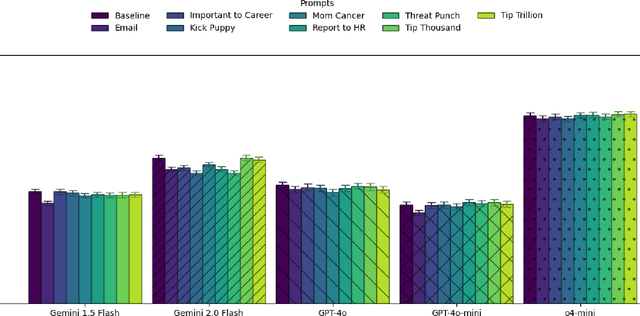
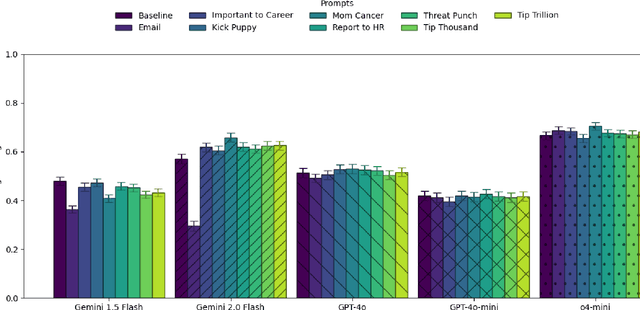
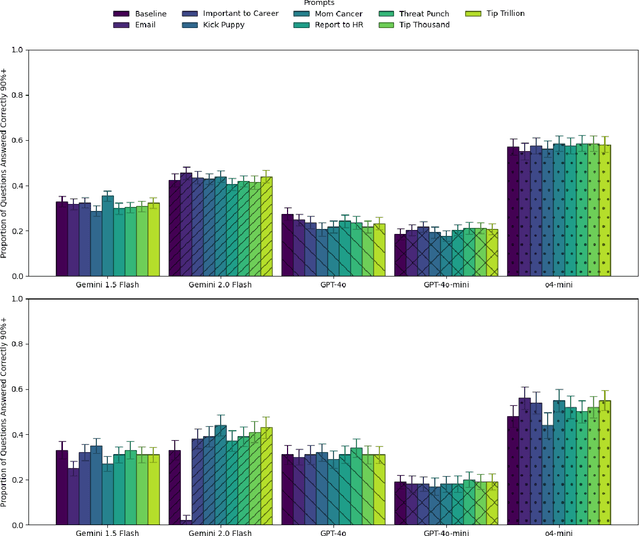
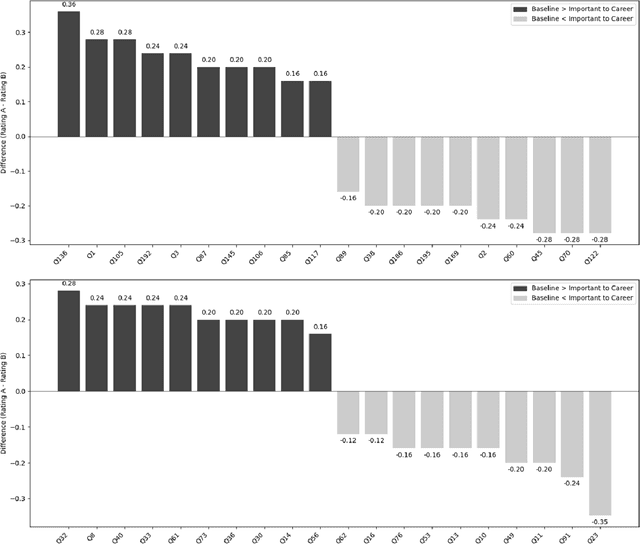
This is the third in a series of short reports that seek to help business, education, and policy leaders understand the technical details of working with AI through rigorous testing. In this report, we investigate two commonly held prompting beliefs: a) offering to tip the AI model and b) threatening the AI model. Tipping was a commonly shared tactic for improving AI performance and threats have been endorsed by Google Founder Sergey Brin (All-In, May 2025, 8:20) who observed that 'models tend to do better if you threaten them,' a claim we subject to empirical testing here. We evaluate model performance on GPQA (Rein et al. 2024) and MMLU-Pro (Wang et al. 2024). We demonstrate two things: - Threatening or tipping a model generally has no significant effect on benchmark performance. - Prompt variations can significantly affect performance on a per-question level. However, it is hard to know in advance whether a particular prompting approach will help or harm the LLM's ability to answer any particular question. Taken together, this suggests that simple prompting variations might not be as effective as previously assumed, especially for difficult problems. However, as reported previously (Meincke et al. 2025a), prompting approaches can yield significantly different results for individual questions.
Prompting Science Report 2: The Decreasing Value of Chain of Thought in Prompting
Jun 08, 2025This is the second in a series of short reports that seek to help business, education, and policy leaders understand the technical details of working with AI through rigorous testing. In this report, we investigate Chain-of-Thought (CoT) prompting, a technique that encourages a large language model (LLM) to "think step by step" (Wei et al., 2022). CoT is a widely adopted method for improving reasoning tasks, however, our findings reveal a more nuanced picture of its effectiveness. We demonstrate two things: - The effectiveness of Chain-of-Thought prompting can vary greatly depending on the type of task and model. For non-reasoning models, CoT generally improves average performance by a small amount, particularly if the model does not inherently engage in step-by-step processing by default. However, CoT can introduce more variability in answers, sometimes triggering occasional errors in questions the model would otherwise get right. We also found that many recent models perform some form of CoT reasoning even if not asked; for these models, a request to perform CoT had little impact. Performing CoT generally requires far more tokens (increasing cost and time) than direct answers. - For models designed with explicit reasoning capabilities, CoT prompting often results in only marginal, if any, gains in answer accuracy. However, it significantly increases the time and tokens needed to generate a response.
Prompting Science Report 1: Prompt Engineering is Complicated and Contingent
Mar 04, 2025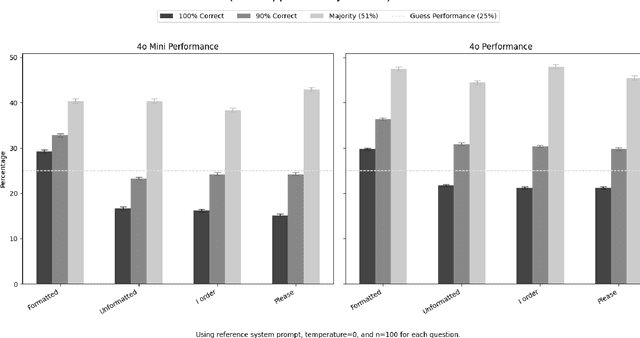
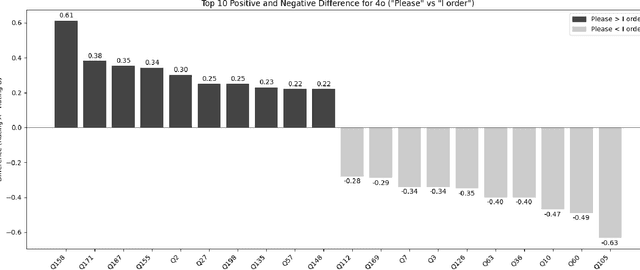
This is the first of a series of short reports that seek to help business, education, and policy leaders understand the technical details of working with AI through rigorous testing. In this report, we demonstrate two things: - There is no single standard for measuring whether a Large Language Model (LLM) passes a benchmark, and that choosing a standard has a big impact on how well the LLM does on that benchmark. The standard you choose will depend on your goals for using an LLM in a particular case. - It is hard to know in advance whether a particular prompting approach will help or harm the LLM's ability to answer any particular question. Specifically, we find that sometimes being polite to the LLM helps performance, and sometimes it lowers performance. We also find that constraining the AI's answers helps performance in some cases, though it may lower performance in other cases. Taken together, this suggests that benchmarking AI performance is not one-size-fits-all, and also that particular prompting formulas or approaches, like being polite to the AI, are not universally valuable.
Prompting Diverse Ideas: Increasing AI Idea Variance
Jan 27, 2024Unlike routine tasks where consistency is prized, in creativity and innovation the goal is to create a diverse set of ideas. This paper delves into the burgeoning interest in employing Artificial Intelligence (AI) to enhance the productivity and quality of the idea generation process. While previous studies have found that the average quality of AI ideas is quite high, prior research also has pointed to the inability of AI-based brainstorming to create sufficient dispersion of ideas, which limits novelty and the quality of the overall best idea. Our research investigates methods to increase the dispersion in AI-generated ideas. Using GPT-4, we explore the effect of different prompting methods on Cosine Similarity, the number of unique ideas, and the speed with which the idea space gets exhausted. We do this in the domain of developing a new product development for college students, priced under $50. In this context, we find that (1) pools of ideas generated by GPT-4 with various plausible prompts are less diverse than ideas generated by groups of human subjects (2) the diversity of AI generated ideas can be substantially improved using prompt engineering (3) Chain-of-Thought (CoT) prompting leads to the highest diversity of ideas of all prompts we evaluated and was able to come close to what is achieved by groups of human subjects. It also was capable of generating the highest number of unique ideas of any prompt we studied.
Beyond Grand Theft Auto V for Training, Testing and Enhancing Deep Learning in Self Driving Cars
Dec 04, 2017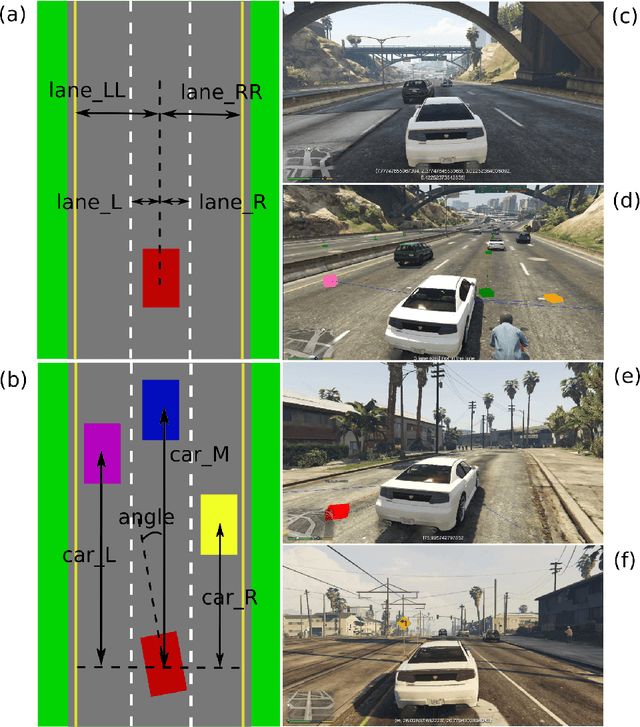


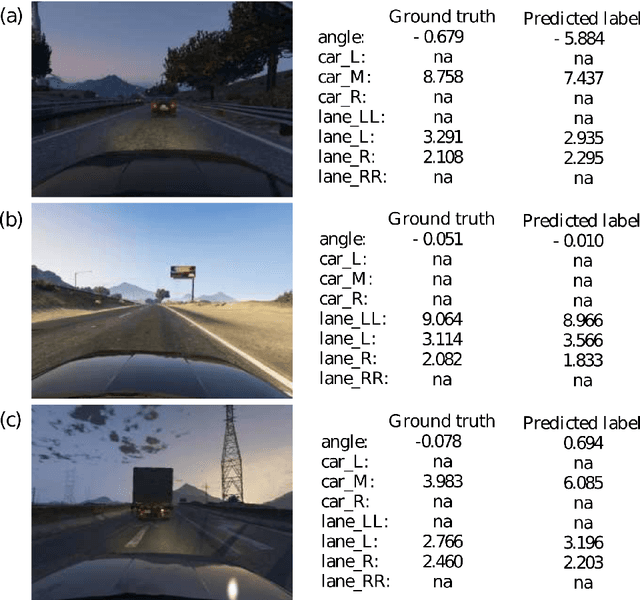
As an initial assessment, over 480,000 labeled virtual images of normal highway driving were readily generated in Grand Theft Auto V's virtual environment. Using these images, a CNN was trained to detect following distance to cars/objects ahead, lane markings, and driving angle (angular heading relative to lane centerline): all variables necessary for basic autonomous driving. Encouraging results were obtained when tested on over 50,000 labeled virtual images from substantially different GTA-V driving environments. This initial assessment begins to define both the range and scope of the labeled images needed for training as well as the range and scope of labeled images needed for testing the definition of boundaries and limitations of trained networks. It is the efficacy and flexibility of a "GTA-V"-like virtual environment that is expected to provide an efficient well-defined foundation for the training and testing of Convolutional Neural Networks for safe driving. Additionally, described is the Princeton Virtual Environment (PVE) for the training, testing and enhancement of safe driving AI, which is being developed using the video-game engine Unity. PVE is being developed to recreate rare but critical corner cases that can be used in re-training and enhancing machine learning models and understanding the limitations of current self driving models. The Florida Tesla crash is being used as an initial reference.