 Add to Chrome
 Add to Firefox
 Add to Edge
An event-based sequence modeling approach to recognizing non-triad chords with oversegmentation minimization
Apr 27, 2026
Automatic chord recognition (ACR) extracts time-aligned chord labels from music audio recordings. Despite recent advances, ACR still struggles with oversegmentation, data scarcity, and imbalance, especially in recognizing complex chords such as non-triads, which are unpopular in existing datasets. To address these challenges, we reformulate ACR as a segment-level sequence-to-sequence prediction task, where chord sequences are predicted auto-regressively rather than frame by frame. This design mitigates excessive segmentation by detecting chord changes only at segment boundaries. We further introduce two types of token representations and an encoder pre-training method, both specifically designed for time-aligned chord modeling. Experimental results show that our model improves performance in both chord recognition and segmentation, with notable gains for complex and infrequent chord types. These findings demonstrate the effectiveness of segment-level sequence modeling, structured tokenization, and representation learning for advancing chord recognition systems.

MambaSL: Exploring Single-Layer Mamba for Time Series Classification
Apr 16, 2026Despite recent advances in state space models (SSMs) such as Mamba across various sequence domains, research on their standalone capacity for time series classification (TSC) has remained limited. We propose MambaSL, a framework that minimally redesigns the selective SSM and projection layers of a single-layer Mamba, guided by four TSC-specific hypotheses. To address benchmarking limitations -- restricted configurations, partial University of East Anglia (UEA) dataset coverage, and insufficiently reproducible setups -- we re-evaluate 20 strong baselines across all 30 UEA datasets under a unified protocol. As a result, MambaSL achieves state-of-the-art performance with statistically significant average improvements, while ensuring reproducibility via public checkpoints for all evaluated models. Together with visualizations, these results demonstrate the potential of Mamba-based architectures as a TSC backbone.
Note-Level Singing Melody Transcription for Time-Aligned Musical Score Generation
Feb 18, 2025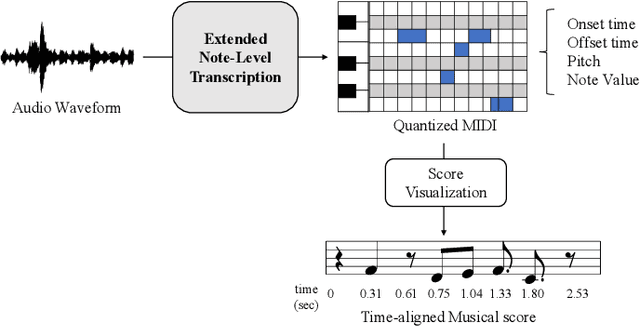
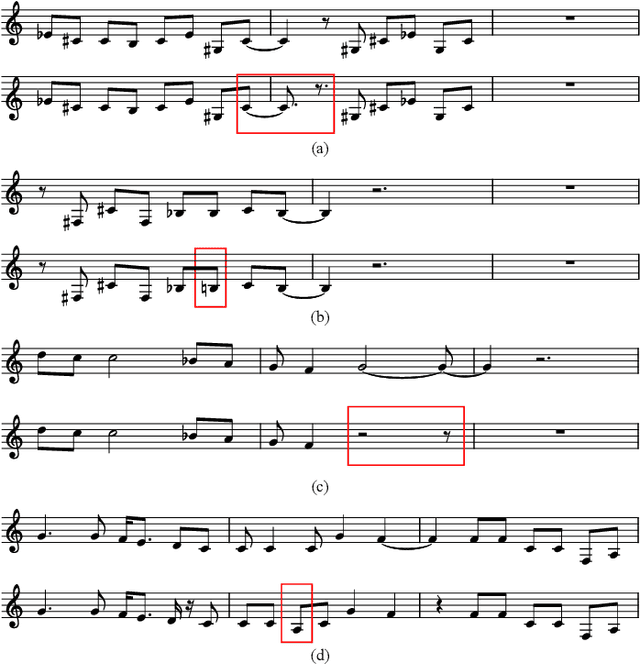
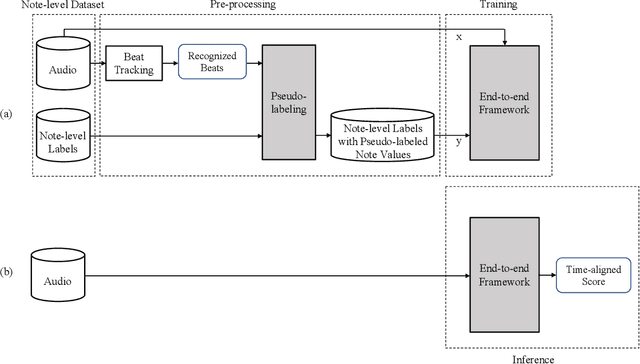
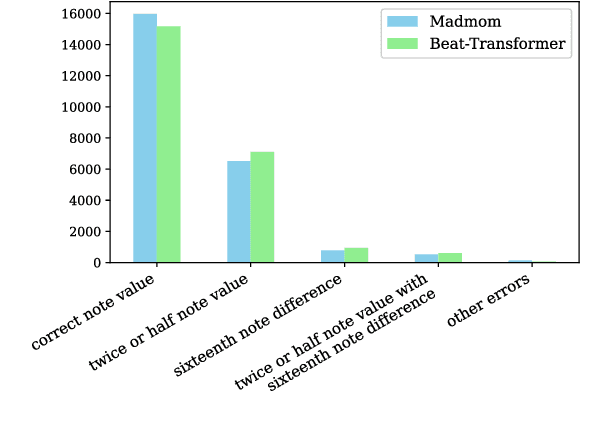
Automatic music transcription converts audio recordings into symbolic representations, facilitating music analysis, retrieval, and generation. A musical note is characterized by pitch, onset, and offset in an audio domain, whereas it is defined in terms of pitch and note value in a musical score domain. A time-aligned score, derived from timing information along with pitch and note value, allows matching a part of the score with the corresponding part of the music audio, enabling various applications. In this paper, we consider an extended version of the traditional note-level transcription task that recognizes onset, offset, and pitch, through including extraction of additional note value to generate a time-aligned score from an audio input. To address this new challenge, we propose an end-to-end framework that integrates recognition of the note value, pitch, and temporal information. This approach avoids error accumulation inherent in multi-stage methods and enhances accuracy through mutual reinforcement. Our framework employs tokenized representations specifically targeted for this task, through incorporating note value information. Furthermore, we introduce a pseudo-labeling technique to address a scarcity problem of annotated note value data. This technique produces approximate note value labels from existing datasets for the traditional note-level transcription. Experimental results demonstrate the superior performance of the proposed model in note-level transcription tasks when compared to existing state-of-the-art approaches. We also introduce new evaluation metrics that assess both temporal and note value aspects to demonstrate the robustness of the model. Moreover, qualitative assessments via visualized musical scores confirmed the effectiveness of our model in capturing the note values.