 Add to Chrome
 Add to Firefox
 Add to Edge
Artificial neural networks ensemble methodology to predict significant wave height
Sep 17, 2025
The forecast of wave variables are important for several applications that depend on a better description of the ocean state. Due to the chaotic behaviour of the differential equations which model this problem, a well know strategy to overcome the difficulties is basically to run several simulations, by for instance, varying the initial condition, and averaging the result of each of these, creating an ensemble. Moreover, in the last few years, considering the amount of available data and the computational power increase, machine learning algorithms have been applied as surrogate to traditional numerical models, yielding comparative or better results. In this work, we present a methodology to create an ensemble of different artificial neural networks architectures, namely, MLP, RNN, LSTM, CNN and a hybrid CNN-LSTM, which aims to predict significant wave height on six different locations in the Brazilian coast. The networks are trained using NOAA's numerical reforecast data and target the residual between observational data and the numerical model output. A new strategy to create the training and target datasets is demonstrated. Results show that our framework is capable of producing high efficient forecast, with an average accuracy of $80\%$, that can achieve up to $88\%$ in the best case scenario, which means $5\%$ reduction in error metrics if compared to NOAA's numerical model, and a increasingly reduction of computational cost.

Explaining Deep Network Classification of Matrices: A Case Study on Monotonicity
Jul 30, 2025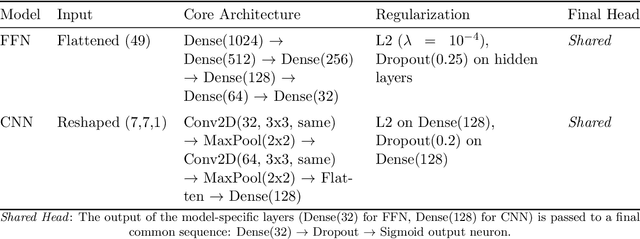
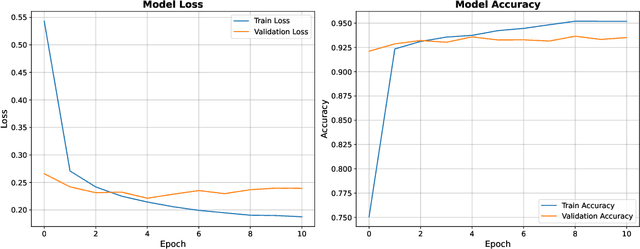
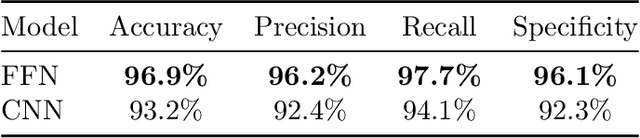
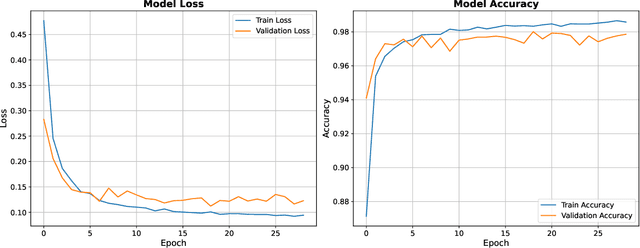
This work demonstrates a methodology for using deep learning to discover simple, practical criteria for classifying matrices based on abstract algebraic properties. By combining a high-performance neural network with explainable AI (XAI) techniques, we can distill a model's learned strategy into human-interpretable rules. We apply this approach to the challenging case of monotone matrices, defined by the condition that their inverses are entrywise nonnegative. Despite their simple definition, an easy characterization in terms of the matrix elements or the derived parameters is not known. Here, we present, to the best of our knowledge, the first systematic machine-learning approach for deriving a practical criterion that distinguishes monotone from non-monotone matrices. After establishing a labelled dataset by randomly generated monotone and non-monotone matrices uniformly on $(-1,1)$, we employ deep neural network algorithms for classifying the matrices as monotone or non-monotone, using both their entries and a comprehensive set of matrix features. By saliency methods, such as integrated gradients, we identify among all features, two matrix parameters which alone provide sufficient information for the matrix classification, with $95\%$ accuracy, namely the absolute values of the two lowest-order coefficients, $c_0$ and $c_1$ of the matrix's characteristic polynomial. A data-driven study of 18,000 random $7\times7$ matrices shows that the monotone class obeys $\lvert c_{0}/c_{1}\rvert\le0.18$ with probability $>99.98\%$; because $\lvert c_{0}/c_{1}\rvert = 1/\mathrm{tr}(A^{-1})$ for monotone $A$, this is equivalent to the simple bound $\mathrm{tr}(A^{-1})\ge5.7$.