 Add to Chrome
 Add to Firefox
 Add to Edge
The Theory and Practice of MAP Inference over Non-Convex Constraints
Feb 09, 2026
In many safety-critical settings, probabilistic ML systems have to make predictions subject to algebraic constraints, e.g., predicting the most likely trajectory that does not cross obstacles. These real-world constraints are rarely convex, nor the densities considered are (log-)concave. This makes computing this constrained maximum a posteriori (MAP) prediction efficiently and reliably extremely challenging. In this paper, we first investigate under which conditions we can perform constrained MAP inference over continuous variables exactly and efficiently and devise a scalable message-passing algorithm for this tractable fragment. Then, we devise a general constrained MAP strategy that interleaves partitioning the domain into convex feasible regions with numerical constrained optimization. We evaluate both methods on synthetic and real-world benchmarks, showing our % approaches outperform constraint-agnostic baselines, and scale to complex densities intractable for SoTA exact solvers.

A Probabilistic Neuro-symbolic Layer for Algebraic Constraint Satisfaction
Mar 25, 2025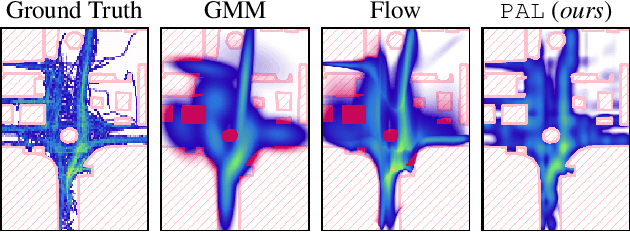
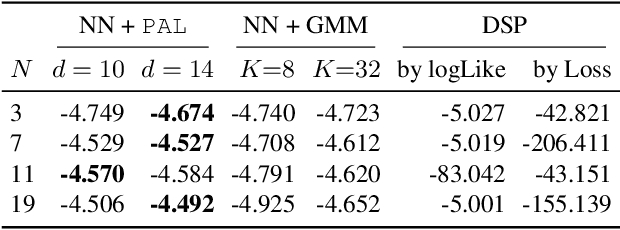
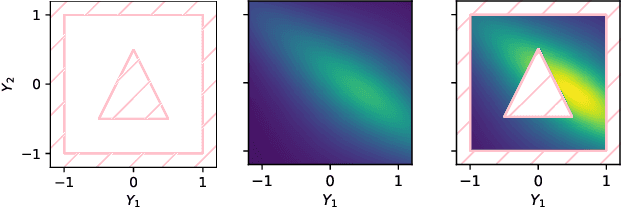
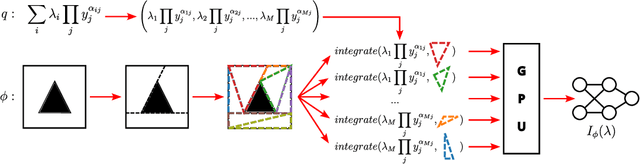
In safety-critical applications, guaranteeing the satisfaction of constraints over continuous environments is crucial, e.g., an autonomous agent should never crash into obstacles or go off-road. Neural models struggle in the presence of these constraints, especially when they involve intricate algebraic relationships. To address this, we introduce a differentiable probabilistic layer that guarantees the satisfaction of non-convex algebraic constraints over continuous variables. This probabilistic algebraic layer (PAL) can be seamlessly plugged into any neural architecture and trained via maximum likelihood without requiring approximations. PAL defines a distribution over conjunctions and disjunctions of linear inequalities, parameterized by polynomials. This formulation enables efficient and exact renormalization via symbolic integration, which can be amortized across different data points and easily parallelized on a GPU. We showcase PAL and our integration scheme on a number of benchmarks for algebraic constraint integration and on real-world trajectory data.