 Add to Chrome
 Add to Firefox
 Add to Edge
LEMMA: Laplacian pyramids for Efficient Marine SeMAntic Segmentation
Mar 26, 2026
Semantic segmentation in marine environments is crucial for the autonomous navigation of unmanned surface vessels (USVs) and coastal Earth Observation events such as oil spills. However, existing methods, often relying on deep CNNs and transformer-based architectures, face challenges in deployment due to their high computational costs and resource-intensive nature. These limitations hinder the practicality of real-time, low-cost applications in real-world marine settings. To address this, we propose LEMMA, a lightweight semantic segmentation model designed specifically for accurate remote sensing segmentation under resource constraints. The proposed architecture leverages Laplacian Pyramids to enhance edge recognition, a critical component for effective feature extraction in complex marine environments for disaster response, environmental surveillance, and coastal monitoring. By integrating edge information early in the feature extraction process, LEMMA eliminates the need for computationally expensive feature map computations in deeper network layers, drastically reducing model size, complexity and inference time. LEMMA demonstrates state-of-the-art performance across datasets captured from diverse platforms while reducing trainable parameters and computational requirements by up to 71x, GFLOPs by up to 88.5\%, and inference time by up to 84.65\%, as compared to existing models. Experimental results highlight its effectiveness and real-world applicability, including 93.42\% IoU on the Oil Spill dataset and 98.97\% mIoU on Mastr1325.

SolarPanel Segmentation :Self-Supervised Learning for Imperfect Datasets
Feb 20, 2024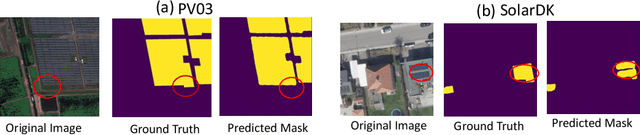

The increasing adoption of solar energy necessitates advanced methodologies for monitoring and maintenance to ensure optimal performance of solar panel installations. A critical component in this context is the accurate segmentation of solar panels from aerial or satellite imagery, which is essential for identifying operational issues and assessing efficiency. This paper addresses the significant challenges in panel segmentation, particularly the scarcity of annotated data and the labour-intensive nature of manual annotation for supervised learning. We explore and apply Self-Supervised Learning (SSL) to solve these challenges. We demonstrate that SSL significantly enhances model generalization under various conditions and reduces dependency on manually annotated data, paving the way for robust and adaptable solar panel segmentation solutions.
ReFuSeg: Regularized Multi-Modal Fusion for Precise Brain Tumour Segmentation
Aug 26, 2023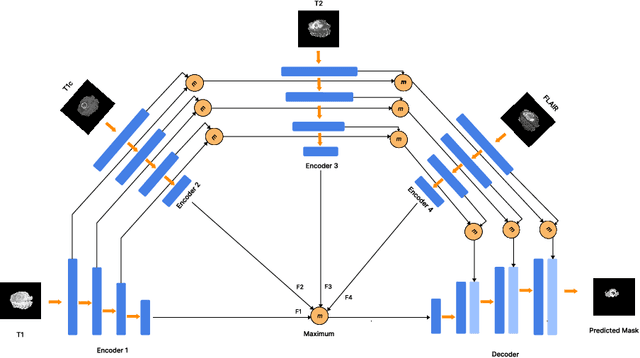
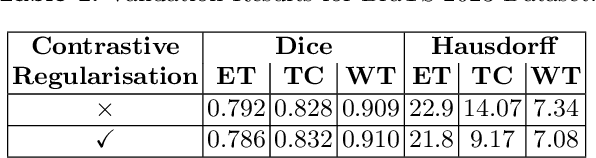
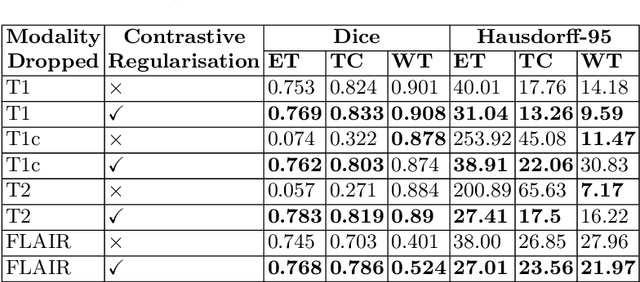
Semantic segmentation of brain tumours is a fundamental task in medical image analysis that can help clinicians in diagnosing the patient and tracking the progression of any malignant entities. Accurate segmentation of brain lesions is essential for medical diagnosis and treatment planning. However, failure to acquire specific MRI imaging modalities can prevent applications from operating in critical situations, raising concerns about their reliability and overall trustworthiness. This paper presents a novel multi-modal approach for brain lesion segmentation that leverages information from four distinct imaging modalities while being robust to real-world scenarios of missing modalities, such as T1, T1c, T2, and FLAIR MRI of brains. Our proposed method can help address the challenges posed by artifacts in medical imagery due to data acquisition errors (such as patient motion) or a reconstruction algorithm's inability to represent the anatomy while ensuring a trade-off in accuracy. Our proposed regularization module makes it robust to these scenarios and ensures the reliability of lesion segmentation.