 Add to Chrome
 Add to Firefox
 Add to Edge
Using Data Imputation for Signal Separation in High Contrast Imaging
Jan 27, 2020
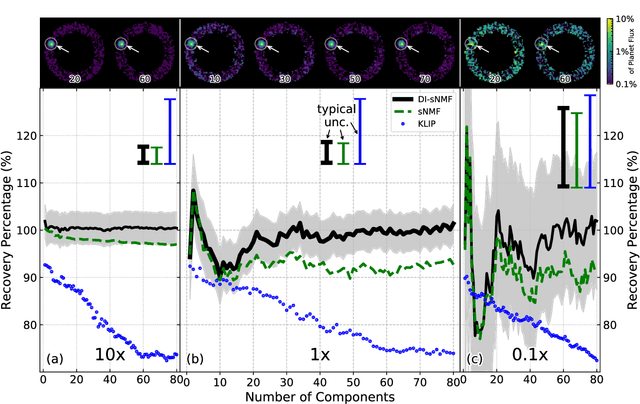
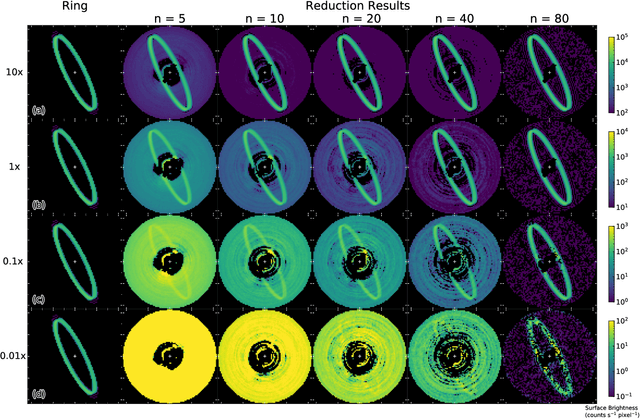
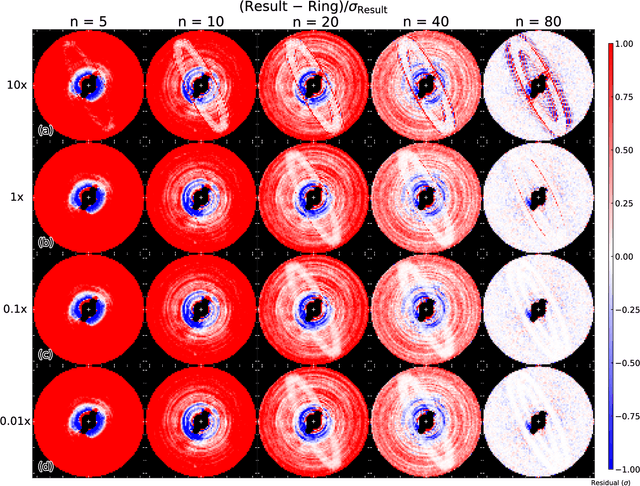
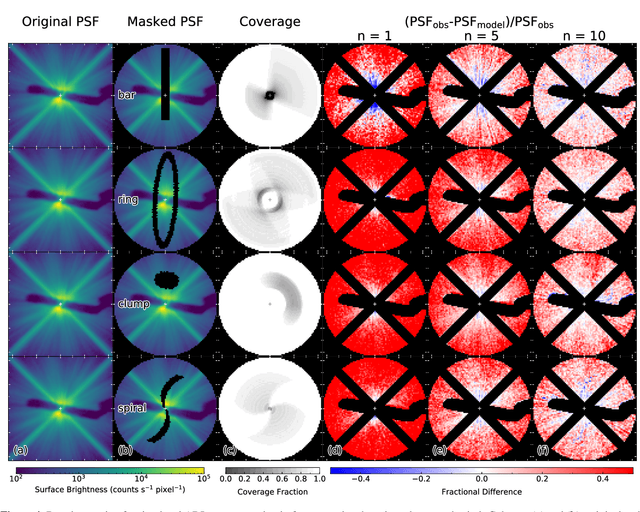
To characterize circumstellar systems in high contrast imaging, the fundamental step is to construct a best point spread function (PSF) template for the non-circumstellar signals (i.e., star light and speckles) and separate it from the observation. With existing PSF construction methods, the circumstellar signals (e.g., planets, circumstellar disks) are unavoidably altered by over-fitting and/or self-subtraction, making forward modeling a necessity to recover these signals. We present a forward modeling--free solution to these problems with data imputation using sequential non-negative matrix factorization (DI-sNMF). DI-sNMF first converts this signal separation problem to a "missing data" problem in statistics by flagging the regions which host circumstellar signals as missing data, then attributes PSF signals to these regions. We mathematically prove it to have negligible alteration to circumstellar signals when the imputation region is relatively small, which thus enables precise measurement for these circumstellar objects. We apply it to simulated point source and circumstellar disk observations to demonstrate its proper recovery of them. We apply it to Gemini Planet Imager (GPI) K1-band observations of the debris disk surrounding HR 4796A, finding a tentative trend that the dust is more forward scattering as the wavelength increases. We expect DI-sNMF to be applicable to other general scenarios where the separation of signals is needed.

Non-negative Matrix Factorization: Robust Extraction of Extended Structures
Jan 12, 2018


We apply the vectorized Non-negative Matrix Factorization (NMF) method to post-processing of direct imaging data for exoplanetary systems such as circumstellar disks. NMF is an iterative approach, which first creates a non-orthogonal and non-negative basis of components using given reference images, then models a target with the components. The constructed model is then rescaled with a factor to compensate for the contribution from a disk. We compare NMF with existing methods (classical reference differential imaging method, and the Karhunen-Lo\`eve image projection algorithm) using synthetic circumstellar disks, and demonstrate the superiority of NMF: with no need for prior selection of references, NMF can detect fainter circumstellar disks, better preserve low order disk morphology, and does not require forward modeling. As an application to a well-known disk example, we process the archival Hubble Space Telescope (HST) STIS coronagraphic observations of HD~181327 with different methods and compare them. NMF is able to extract some circumstellar material inside the primary ring for the first time. In the appendix, we mathematically investigate the stability of NMF components during iteration, and the linearity of NMF modeling.