 Add to Chrome
 Add to Firefox
 Add to Edge
Improved cross-validated distances for multivariate pattern analysis
Aug 11, 2026
Characterizing the dissimilarity of neural representations between experimental conditions, and tracking it across time, is a central goal of multivariate pattern analysis. Guggenmos et al. (2018) assessed the reliability of many of the measures that can be used for that purpose on MEG data and recommended the use of either the cross-validated Euclidean distance or the within-class-corrected Pearson distance. In this commentary, we show that we can improve upon these distances. First, we show that the cross-validated Euclidean distance is equivalent to a sum of between-partition distances and that this equivalence can be leveraged to obtain a generalized variant, with increased reliability and accuracy. Second, we use the relationship between Euclidean distance and Pearson correlation to define a cross-validated correlation distance in a similar way. The resulting distance is more accurate and interpretable than a formulation proposed by Guggenmos and colleagues. Finally, we discuss the relationship between our generalized cross-validation and within-class correction, another strategy often used to increase reliability, and we show that generalized cross-validation results in higher accuracy for the correlation distance.

Latent Representation Learning for Multimodal Brain Activity Translation
Sep 27, 2024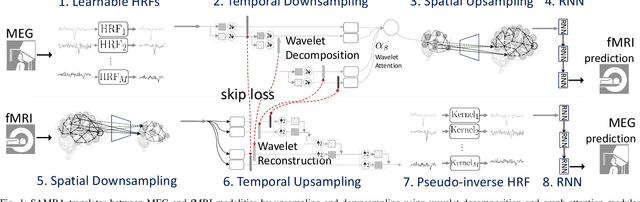
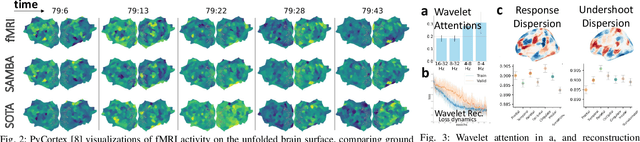
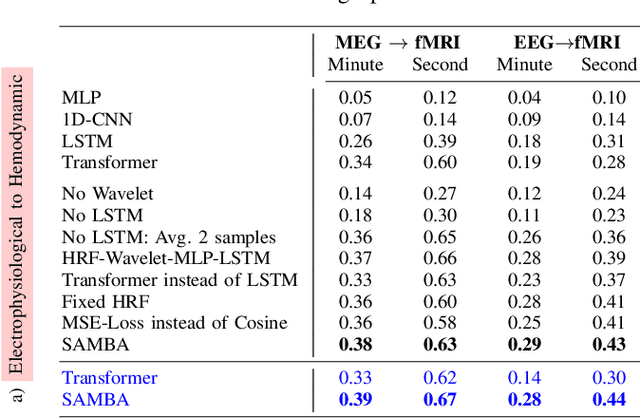
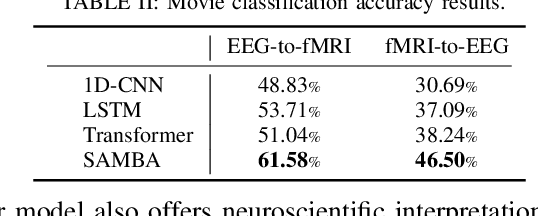
Neuroscience employs diverse neuroimaging techniques, each offering distinct insights into brain activity, from electrophysiological recordings such as EEG, which have high temporal resolution, to hemodynamic modalities such as fMRI, which have increased spatial precision. However, integrating these heterogeneous data sources remains a challenge, which limits a comprehensive understanding of brain function. We present the Spatiotemporal Alignment of Multimodal Brain Activity (SAMBA) framework, which bridges the spatial and temporal resolution gaps across modalities by learning a unified latent space free of modality-specific biases. SAMBA introduces a novel attention-based wavelet decomposition for spectral filtering of electrophysiological recordings, graph attention networks to model functional connectivity between functional brain units, and recurrent layers to capture temporal autocorrelations in brain signal. We show that the training of SAMBA, aside from achieving translation, also learns a rich representation of brain information processing. We showcase this classify external stimuli driving brain activity from the representation learned in hidden layers of SAMBA, paving the way for broad downstream applications in neuroscience research and clinical contexts.