 Add to Chrome
 Add to Firefox
 Add to Edge
The Chebyshev Polynomial Series Frequency Modulation Model for Waveform Design and Analysis
Mar 02, 2026
Polynomial phase signals (PPS) are a staple of waveform design and analysis in sonar, radar, and communications fields. They also find application in the modeling of bioacoustic emissions, especially those of echolocating animals such as bats and odontocetes. This work presents a novel PPS waveform formulation that exploits some special properties of Chebyshev polynomials, such as orthogonality, recurrence relations, and equivalence to trigonometric functions. The result is the Chebyshev Polynomial Frequency Modulation (CPSFM) family of waveforms, which prove useful in the modeling of bioacoustic signals and the approximation of non-polynomial-phase signals such as hyperbolic chirps. We demonstrate that the CPSFM model admits compact analytic expressions for fundamental continuous-time signal processing functions such as the Fourier transform, the convolution and correlation operations, and the ambiguity function. Derivations for these expressions using CPSFM are presented, along with their application to the analysis of biosonar emissions of Mexican free-tailed bats.

Affinity Mixup for Weakly Supervised Sound Event Detection
Jun 21, 2021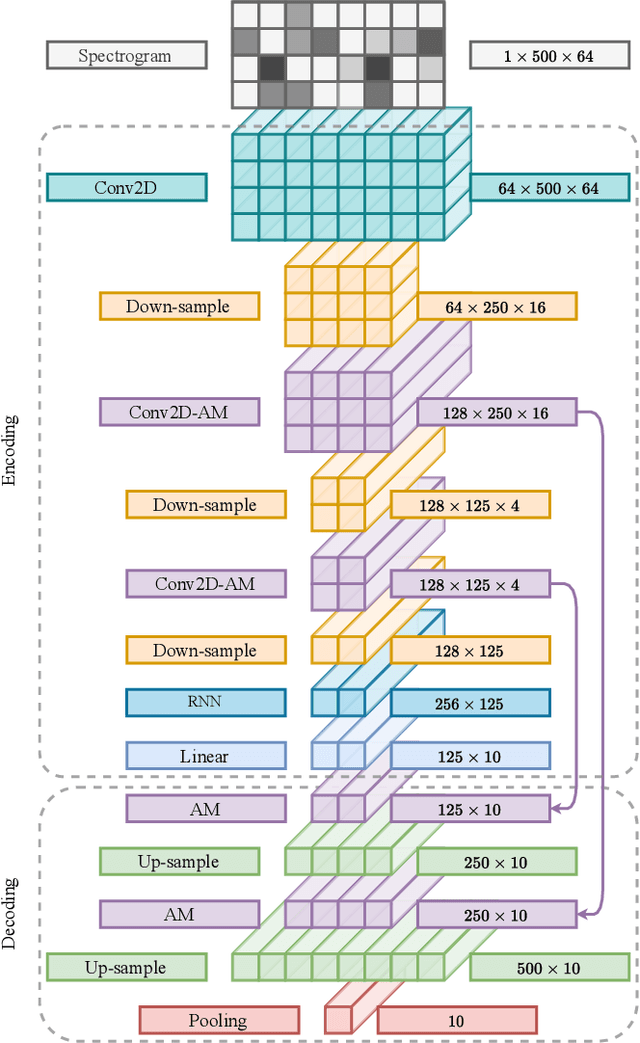
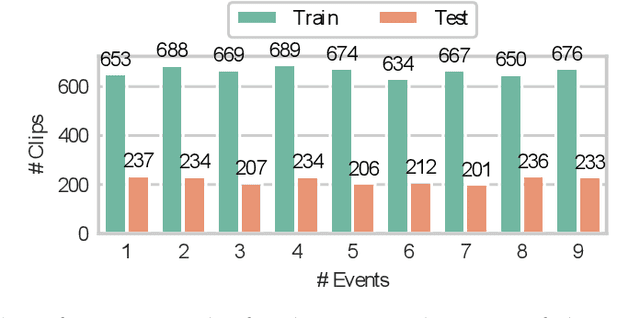
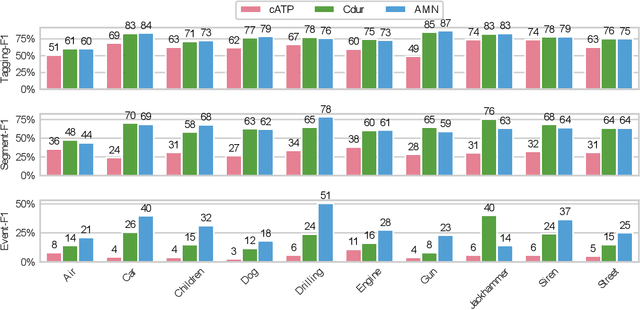
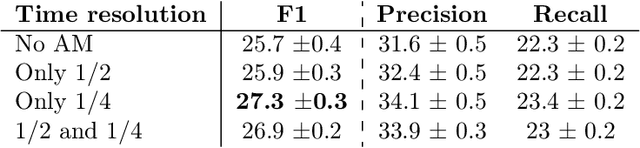
The weakly supervised sound event detection problem is the task of predicting the presence of sound events and their corresponding starting and ending points in a weakly labeled dataset. A weak dataset associates each training sample (a short recording) to one or more present sources. Networks that solely rely on convolutional and recurrent layers cannot directly relate multiple frames in a recording. Motivated by attention and graph neural networks, we introduce the concept of an affinity mixup to incorporate time-level similarities and make a connection between frames. This regularization technique mixes up features in different layers using an adaptive affinity matrix. Our proposed affinity mixup network improves over state-of-the-art techniques event-F1 scores by $8.2\%$.