 Add to Chrome
 Add to Firefox
 Add to Edge
Evaluating Pluralism in LLMs through Latent Perspectives
Jun 11, 2026
The growing need to represent diverse perspectives has increased interest in pluralistic LLM generation. Although difficult to operationalize, identifying perspectives expressed in text would provide clear guidance on pluralistic alignment and more clearly articulate the pluralistic gap in LLM generation. While models have been shown to reduce the diversity of training data and generate homogeneously, this has been demonstrated primarily on multiple-choice questionnaires or using high-level characteristics of free-form text. In this paper, we introduce and implement a domain-agnostic multi-layered framework for unsupervised extraction of perspectives suitable for identifying the pluralistic gap in LLM-generated text. We evaluate our framework on book reviews, a highly opinionated dataset representing diverse perspectives, and compare various prompts and models. Our results show that while some models and prompting techniques come close to covering a broad spectrum of perspectives, rarer perspectives remain disproportionately underrepresented, resulting in distributions that diverge from human text.

Claim Check-Worthiness Detection: How Well do LLMs Grasp Annotation Guidelines?
Apr 18, 2024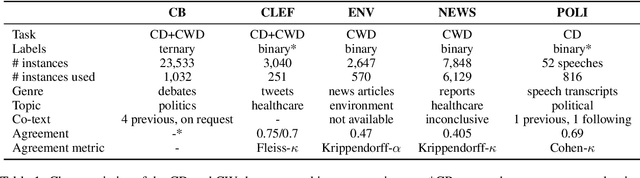
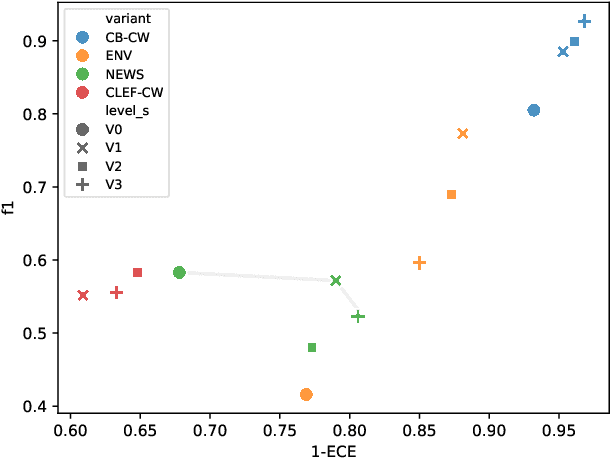
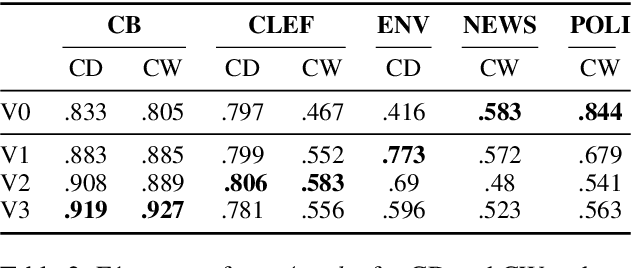
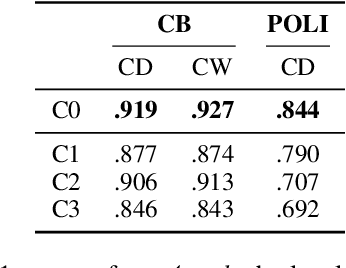
The increasing threat of disinformation calls for automating parts of the fact-checking pipeline. Identifying text segments requiring fact-checking is known as claim detection (CD) and claim check-worthiness detection (CW), the latter incorporating complex domain-specific criteria of worthiness and often framed as a ranking task. Zero- and few-shot LLM prompting is an attractive option for both tasks, as it bypasses the need for labeled datasets and allows verbalized claim and worthiness criteria to be directly used for prompting. We evaluate the LLMs' predictive and calibration accuracy on five CD/CW datasets from diverse domains, each utilizing a different worthiness criterion. We investigate two key aspects: (1) how best to distill factuality and worthiness criteria into a prompt and (2) what amount of context to provide for each claim. To this end, we experiment with varying the level of prompt verbosity and the amount of contextual information provided to the model. Our results show that optimal prompt verbosity is domain-dependent, adding context does not improve performance, and confidence scores can be directly used to produce reliable check-worthiness rankings.
LLMs for Targeted Sentiment in News Headlines: Exploring Different Levels of Prompt Prescriptiveness
Mar 01, 2024News headlines often evoke sentiment by intentionally portraying entities in particular ways, making targeted sentiment analysis (TSA) of headlines a worthwhile but difficult task. Fine-tuned encoder models show satisfactory TSA performance, but their background knowledge is limited, and they require a labeled dataset. LLMs offer a potentially universal solution for TSA due to their broad linguistic and world knowledge along with in-context learning abilities, yet their performance is heavily influenced by prompt design. Drawing parallels with annotation paradigms for subjective tasks, we explore the influence of prompt design on the performance of LLMs for TSA of news headlines. We evaluate the predictive accuracy of state-of-the-art LLMs using prompts with different levels of prescriptiveness, ranging from plain zero-shot to elaborate few-shot prompts matching annotation guidelines. Recognizing the subjective nature of TSA, we evaluate the ability of LLMs to quantify predictive uncertainty via calibration error and correlation to human inter-annotator agreement. We find that, except for few-shot prompting, calibration and F1-score improve with increased prescriptiveness, but the optimal level depends on the model.