 Add to Chrome
 Add to Firefox
 Add to Edge
Contrast detection is enhanced by deterministic, high-frequency transcranial alternating current stimulation with triangle and sine waveform
Sep 28, 2023
Stochastic Resonance (SR) describes a phenomenon where an additive noise (stochastic carrier-wave) enhances the signal transmission in a nonlinear system. In the nervous system, nonlinear properties are present from the level of single ion channels all the way to perception and appear to support the emergence of SR. For example, SR has been repeatedly demonstrated for visual detection tasks, also by adding noise directly to cortical areas via transcranial random noise stimulation (tRNS). When dealing with nonlinear physical systems, it has been suggested that resonance can be induced not only by adding stochastic signals (i.e., noise) but also by adding a large class of signals that are not stochastic in nature which cause "deterministic amplitude resonance" (DAR). Here we mathematically show that high-frequency, deterministic, periodic signals can yield resonance-like effects with linear transfer and infinite signal-to-noise ratio at the output. We tested this prediction empirically and investigated whether non-random, high-frequency, transcranial alternating current stimulation applied to visual cortex could induce resonance-like effects and enhance performance of a visual detection task. We demonstrated in 28 participants that applying 80 Hz triangular-waves or sine-waves with tACS reduced visual contrast detection threshold for optimal brain stimulation intensities. The influence of tACS on contrast sensitivity was equally effective to tRNS-induced modulation, demonstrating that both tACS and tRNS can reduce contrast detection thresholds. Our findings suggest that a resonance-like mechanism can also emerge when deterministic electrical waveforms are applied via tACS.
* accepted for publication in J. Neurophysiology

Ternary Instantaneous Noise-based Logic
May 09, 2023One of the possible representations of three-valued instantaneous noise-based logic is proposed. The third value is an uncertain bit value, which can be useful in artificial intelligence applications. There is a forth value, too, that can represent a non-existing bit (vacuum-state) that is the same (1 numeric value) for all bits, however that is a squeezed state common for all bits. Some logic gates are explored. A ternary Universe has a significant advantage compared to the standard binary one: its amplitude is never zero during any clock period. All the known binary logic gates work for the binary bit values in the same way as earlier therefore the former binary algorithms can be run in the ternary system with no change and without the problems posed by zero values of the Universe.
Brain: Biological noise-based logic
Aug 18, 2014
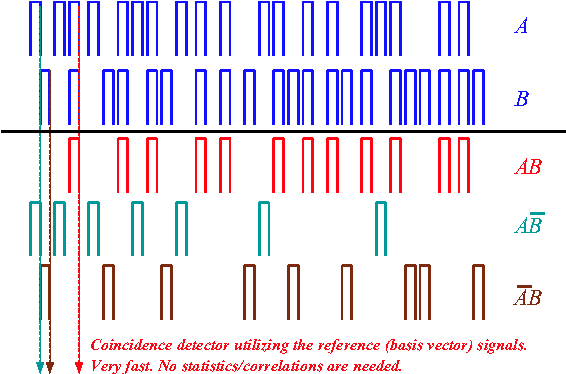
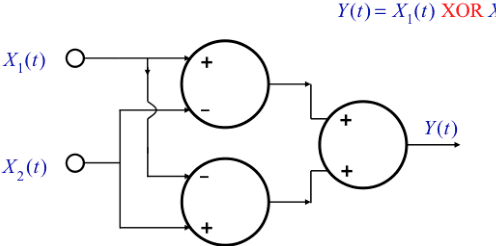
Neural spikes in the brain form stochastic sequences, i.e., belong to the class of pulse noises. This stochasticity is a counterintuitive feature because extracting information - such as the commonly supposed neural information of mean spike frequency - requires long times for reasonably low error probability. The mystery could be solved by noise-based logic, wherein randomness has an important function and allows large speed enhancements for special-purpose tasks, and the same mechanism is at work for the brain logic version of this concept.
* paper in press