 Add to Chrome
 Add to Firefox
 Add to Edge
GPU Acceleration of Sparse Fully Homomorphic Encrypted DNNs
Apr 13, 2026
Fully homomorphic encryption (FHE) has recently attracted significant attention as both a cryptographic primitive and a systems challenge. Given the latest advances in accelerated computing, FHE presents a promising opportunity for progress, with applications ranging from machine learning to information security. We target the most computationally intensive operation in deep neural networks from a hardware perspective, matrix multiplication (matmul), and adapt it for execution on AMD GPUs. We propose a new optimized method that improves the runtime and complexity of ciphertext matmul by using FIDESlib, a recent open-source FHE library designed specifically for GPUs. By exploiting sparsity in both operands, our sparse matmul implementation outperforms its CPU counterpart by up to $3.0\times$ and reduces the time complexity from cubic to semi-linear, demonstrating an improvement over existing FHE matmul implementations.

Exploiting Unstructured Sparsity in Fully Homomorphic Encrypted DNNs
Mar 12, 2025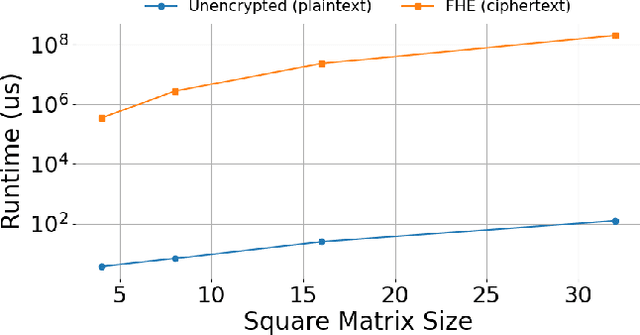
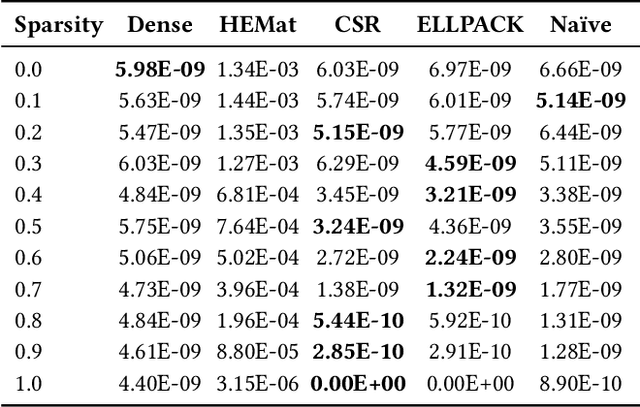
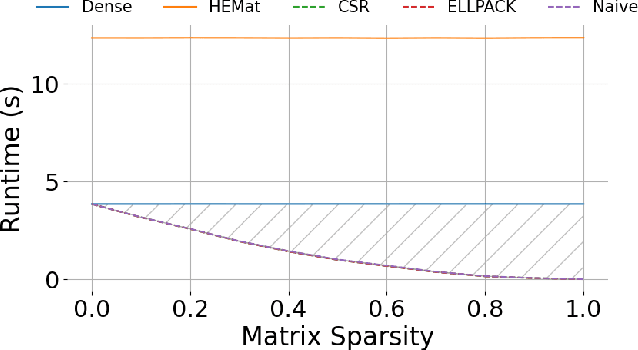
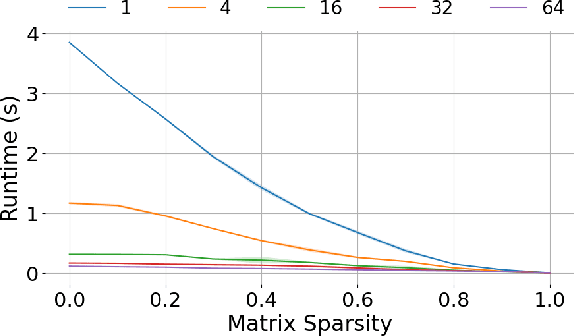
The deployment of deep neural networks (DNNs) in privacy-sensitive environments is constrained by computational overheads in fully homomorphic encryption (FHE). This paper explores unstructured sparsity in FHE matrix multiplication schemes as a means of reducing this burden while maintaining model accuracy requirements. We demonstrate that sparsity can be exploited in arbitrary matrix multiplication, providing runtime benefits compared to a baseline naive algorithm at all sparsity levels. This is a notable departure from the plaintext domain, where there is a trade-off between sparsity and the overhead of the sparse multiplication algorithm. In addition, we propose three sparse multiplication schemes in FHE based on common plaintext sparse encodings. We demonstrate the performance gain is scheme-invariant; however, some sparse schemes vastly reduce the memory storage requirements of the encrypted matrix at high sparsity values. Our proposed sparse schemes yield an average performance gain of 2.5x at 50% unstructured sparsity, with our multi-threading scheme providing a 32.5x performance increase over the equivalent single-threaded sparse computation when utilizing 64 cores.