 Add to Chrome
 Add to Firefox
 Add to Edge
Aleena: Alignment Agent for Research Software Engineering Collaborations
Jul 09, 2026
Research software collaborations span meetings, informal chats, pull requests, and GitHub issues. A decision surfaced in a Slack thread, refined in a meeting, and implemented in a pull request can lose its original rationale across these artifacts, leaving domain researchers and research software engineers with divergent mental models of project intent, ownership, and scientific assumptions. We argue that alignment in research software engineering is a continuous lifecycle problem, and that agentic AI can support stakeholder alignment and project-state tracking without replacing human decision-making. We present Aleena, an open-source lifecycle alignment agent that uses GitHub as a shared collaboration surface, transforming multi-modal stakeholder interactions into structured project records that surface risks, track open questions, and preserve decision continuity. Grounded in university-based research software engineering center experiences, this paper presents the motivating problem, system design, prototype, and illustrative lifecycle scenarios for Aleena.

LLMoxie: Exploring Agentic AI for Scientific Software Development
Jul 02, 2026In this paper, we describe LLMoxie, an institutional AI platform whose three-tiered architecture supports multi-cloud and on-premise inference, a LiteLLM/MLflow control plane for authentication, budgeting, PII masking, and observability, and an application augmentation layer for AI coding agents. Layered on top, an open-source RSE-Plugins ecosystem encodes accumulated RSE knowledge as a Plugin-Agent-Skill hierarchy spanning scientific Python practice, domain-specific knowledge, a six-phase research-and-implement workflow, and project lifecycle management. Scientific software is judged less by raw code quality than by whether it can be cited, audited, reproduced, and extended. Off-the-shelf AI coding agents, optimized against commercial software benchmarks, are poorly calibrated for this setting: they ignore the conventions of the scientific Python libraries they invoke, mishandle sensitive or embargoed data, and leave decision trails that are difficult to reconstruct after the fact. We report on twenty months of practice at a university-based research software engineering (RSE) center, where RSEs embedded across astronomy, earth and climate science, agriculture, and health projects worked to close this gap. We characterize the recurring infrastructure, governance, and process challenges of adopting Agentic AI inside a multi-domain RSE center, describe the platform and plugin design, and distill operational lessons from real scientific software deployments. Together, the platform and plugins shift AI coding agents from generic code generators into domain-aware collaborators that respect community norms and produce auditable provenance of technical reasoning.
Echopype: A Python library for interoperable and scalable processing of water column sonar data for biological information
Oct 30, 2021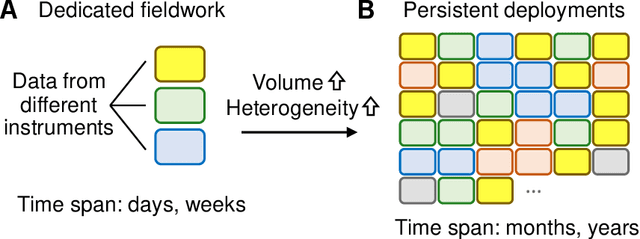
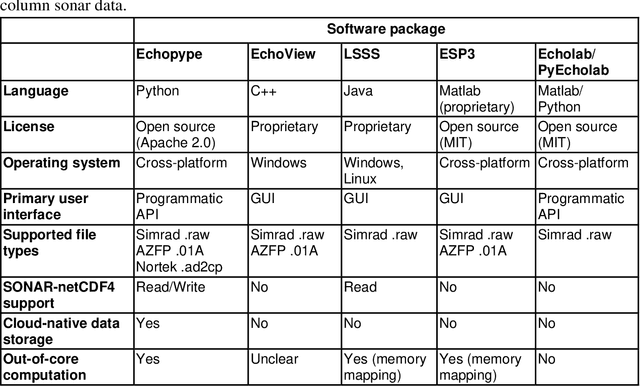
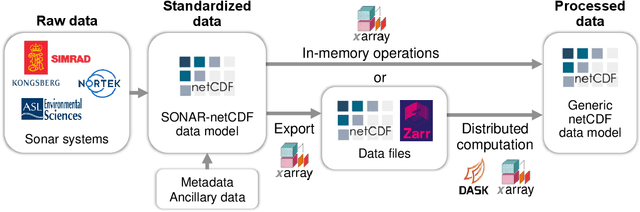
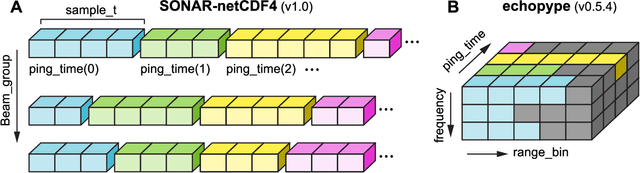
High-frequency sonar systems deployed on a broad variety of ocean observing platforms are creating a deluge of water column sonar data at unprecedented speed from all corners of the ocean. Efficient and integrative analysis of these data, either across different sonar instruments or with other oceanographic datasets, holds the key to monitoring and understanding the response of marine organisms to the rapidly changing environments. In this paper we present echopype, an open-source Python software library designed to address this need. By standardizing water column sonar data from diverse instrument sources following a community convention and utilizing the widely embraced netCDF data model to encode sonar data as labeled, multi-dimensional arrays, echopype facilitates intuitive, user-friendly exploration and use of sonar data in an instrument-agnostic manner. Through leveraging existing open-source Python libraries optimized for distributed computing, echopype directly enables computational interoperability and scalability in both local and cloud computing environments. Echopype's modularized package structure further provides a conceptually unified implementation framework for expanding its support for additional instrument raw data formats and incorporating new data analysis and visualization functionalities. We envision the continued development of echopype as a catalyst for making information derived from water column sonar data an integrated component of regional and global ocean observation strategies.