 Add to Chrome
 Add to Firefox
 Add to Edge
Think-Aloud Reshapes Automated Cognitive Model Discovery Beyond Behavior
May 06, 2026
Computational cognitive models discovered using large language models have so far relied solely on behavioral data. However, it is well-known that models produced from the behavioral trajectory alone are typically under-determined. In this work, we explore the use of Think Aloud traces as an additional form of data constraint during automated model discovery. When applied to the domain of risky decision-making, we find that the models discovered with think-aloud achieve significantly improved predictive performance on held-out data. Additionally, we find that the discovered models belong to different structural classes than those discovered from behavior alone for the majority of participants (69.4\%), specifically, it shifts from Explicit comparator towards Integrated utility. These results suggest that process-level language data not only improve model fit, but also systematically reshape the structure of the discovered cognitive models, enabling the identification of mechanisms that are not recoverable from behavior alone.

Large Language Models Think Too Fast To Explore Effectively
Jan 29, 2025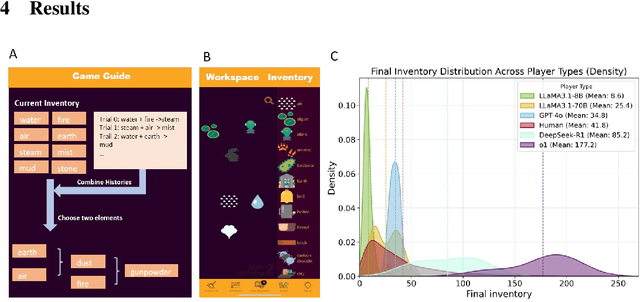
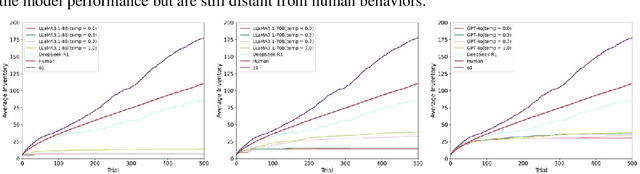
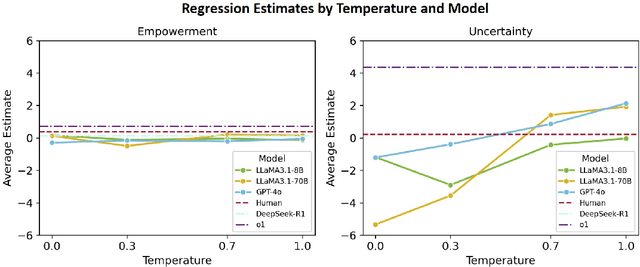
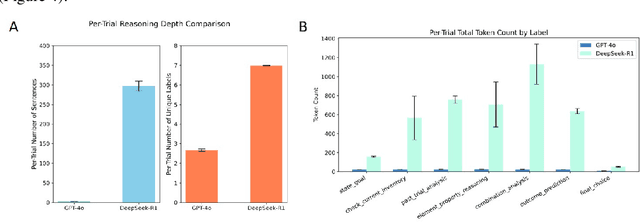
Large Language Models have emerged many intellectual capacities. While numerous benchmarks assess their intelligence, limited attention has been given to their ability to explore, an essential capacity for discovering new information and adapting to novel environments in both natural and artificial systems. The extent to which LLMs can effectively explore, particularly in open-ended tasks, remains unclear. This study investigates whether LLMs can surpass humans in exploration during an open-ended task, using Little Alchemy 2 as a paradigm, where agents combine elements to discover new ones. Results show most LLMs underperform compared to humans, except for the o1 model, with those traditional LLMs relying primarily on uncertainty driven strategies, unlike humans who balance uncertainty and empowerment. Representational analysis of the models with Sparse Autoencoders revealed that uncertainty and choices are represented at earlier transformer blocks, while empowerment values are processed later, causing LLMs to think too fast and make premature decisions, hindering effective exploration. These findings shed light on the limitations of LLM exploration and suggest directions for improving their adaptability.