 Add to Chrome
 Add to Firefox
 Add to Edge
Phase transitions for the noisy transformer model in arbitrary dimension
Jun 03, 2026
We study the McKean--Vlasov free energy on the unit sphere associated with the unnormalized self-attention (USA) model for noisy transformer dynamics. We prove a sharp global-minimizer dichotomy in every dimension $d\ge2$. There is a unique $β_*^{(d)}>0$ such that \begin{equation*} \frac{I_{d/2+1}(β_*^{(d)})}{I_{d/2}(β_*^{(d)})}=\frac1d, \end{equation*} where $I_ν$ is the modified Bessel function of the first kind. For $0<β\le β_*^{(d)}$, the uniform density remains the unique global minimizer up to the linear-stability threshold \begin{equation*} K_\#^{(d)}(β)=\frac{β^{d/2}}{2^{d/2}Γ(d/2)I_{d/2}(β)}, \end{equation*} and the phase transition is continuous. For $β>β_*^{(d)}$, the uniform density is not globally minimizing at $K_\#^{(d)}(β)$, so the critical coupling satisfies $K_c<K_\#^{(d)}(β)$ and the transition is discontinuous. This result generalizes the authors' recent $d=2$ work arXiv:2604.16288 to arbitrary dimension. The proof uses the sharp Beckner--Onofri/logarithmic Hardy-Littlewood-Sobolev (HLS) inequality on the sphere, together with a Funk--Hecke/Bessel coefficient computation and a degree-two quartic obstruction.

Mini-Batch Optimization of Contrastive Loss
Jul 12, 2023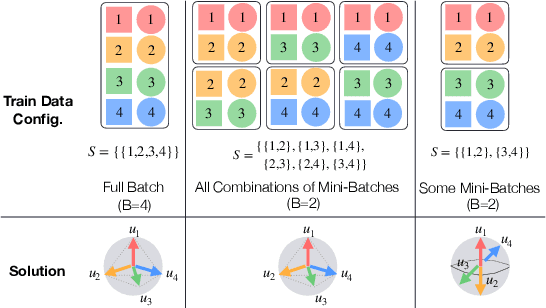
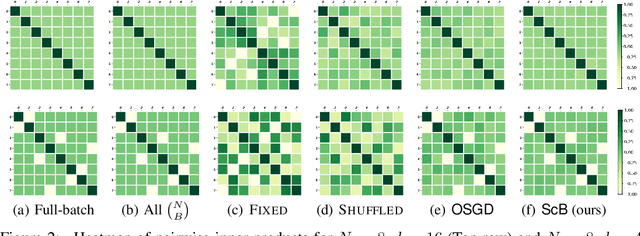
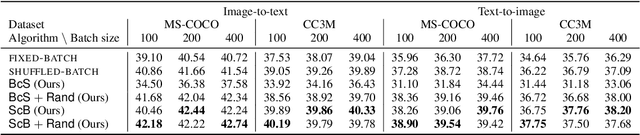
Contrastive learning has gained significant attention as a method for self-supervised learning. The contrastive loss function ensures that embeddings of positive sample pairs (e.g., different samples from the same class or different views of the same object) are similar, while embeddings of negative pairs are dissimilar. Practical constraints such as large memory requirements make it challenging to consider all possible positive and negative pairs, leading to the use of mini-batch optimization. In this paper, we investigate the theoretical aspects of mini-batch optimization in contrastive learning. We show that mini-batch optimization is equivalent to full-batch optimization if and only if all $\binom{N}{B}$ mini-batches are selected, while sub-optimality may arise when examining only a subset. We then demonstrate that utilizing high-loss mini-batches can speed up SGD convergence and propose a spectral clustering-based approach for identifying these high-loss mini-batches. Our experimental results validate our theoretical findings and demonstrate that our proposed algorithm outperforms vanilla SGD in practically relevant settings, providing a better understanding of mini-batch optimization in contrastive learning.