 Add to Chrome
 Add to Firefox
 Add to Edge
Fast LLM-Based Semantic Filtering: From a Unified Framework to an Adaptive Two-Phase Method
Jun 06, 2026
Evaluating a natural-language yes/no predicate over a document corpus under an accuracy target - the semantic filter - is a cornerstone of LLM-based data processing. Calling the LLM on every document (the oracle) is prohibitive, so cascades pair the oracle with a fast proxy. As deployed today, they leave four limitations on the table. (1) Each cascade family - model-free clustering, prebuilt small-LLM proxies, online-trained proxies - commits to a single representation and pipeline, and wins on only a narrow query regime. (2) The strongest online proxy invests in a custom training scheme on a bi-encoder over dense embeddings, missing the token-level evidence richer predicates require. (3) The proxy is trained against binary yes/no labels, wasting the LLM's per-document confidence at the boundary documents it most needs to learn. (4) Existing calibrations add a uniform safety margin, conflating genuine proxy uncertainty with small-sample noise and inflating cascade cost. We address these by (1) composing families adaptively - model-free clustering first, online proxy only when needed, with oracle calls shared across phases; (2) replacing the cosine bi-encoder with a hybrid of off-the-shelf token-aware models; (3) training the proxy with the oracle's per-document confidence as a soft label; and (4) a calibration that adds the safety margin only where the labeled sample is sparse. We are also the first to use the oracle's per-document confidence for three purposes: a query-level difficulty compass, a lower bound on the minimum oracle calls any proxy-based cascade can make, and the proxy's soft training label. At a 90% accuracy target on three 10K-document corpora, our methods are 1.6-2.0x faster than the best prior method per corpus and meet the target on 95% of queries; the BER-derived lower bound indicates a further ~4-20x of headroom for future work.

Trustworthy and Efficient LLMs Meet Databases
Dec 23, 2024In the rapidly evolving AI era with large language models (LLMs) at the core, making LLMs more trustworthy and efficient, especially in output generation (inference), has gained significant attention. This is to reduce plausible but faulty LLM outputs (a.k.a hallucinations) and meet the highly increased inference demands. This tutorial explores such efforts and makes them transparent to the database community. Understanding these efforts is essential in harnessing LLMs in database tasks and adapting database techniques to LLMs. Furthermore, we delve into the synergy between LLMs and databases, highlighting new opportunities and challenges in their intersection. This tutorial aims to share with database researchers and practitioners essential concepts and strategies around LLMs, reduce the unfamiliarity of LLMs, and inspire joining in the intersection between LLMs and databases.
The Effect of Scheduling and Preemption on the Efficiency of LLM Inference Serving
Nov 12, 2024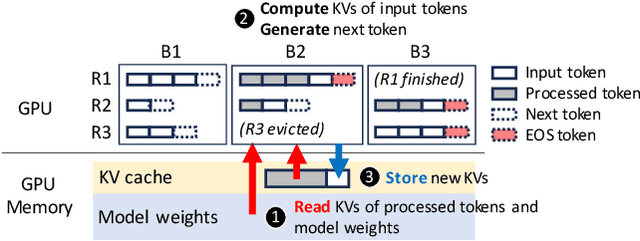
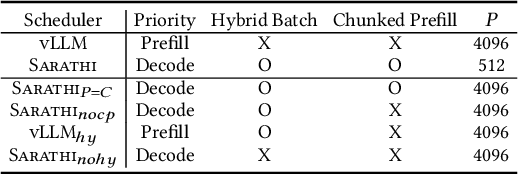
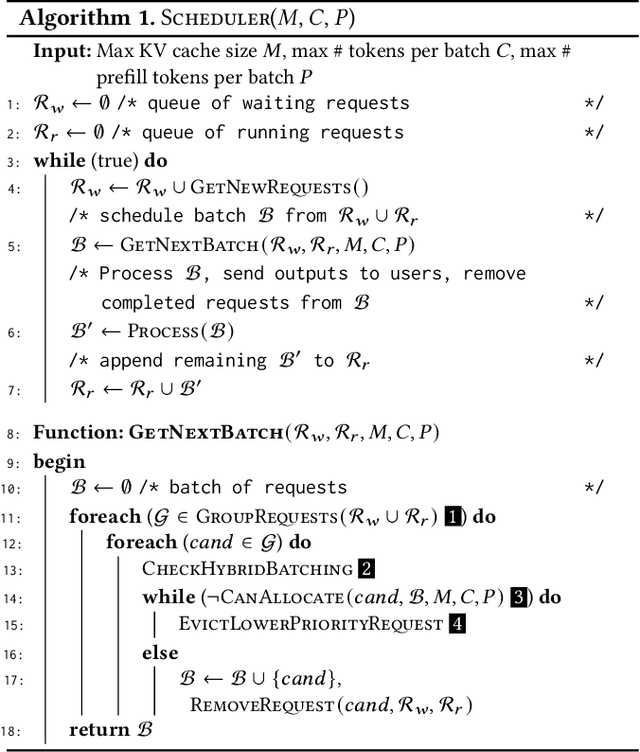
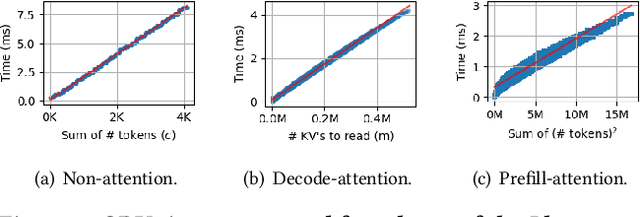
The growing usage of Large Language Models (LLMs) highlights the demands and challenges in scalable LLM inference systems, affecting deployment and development processes. On the deployment side, there is a lack of comprehensive analysis on the conditions under which a particular scheduler performs better or worse, with performance varying substantially across different schedulers, hardware, models, and workloads. Manually testing each configuration on GPUs can be prohibitively expensive. On the development side, unpredictable performance and unknown upper limits can lead to inconclusive trial-and-error processes, consuming resources on ideas that end up ineffective. To address these challenges, we introduce INFERMAX, an analytical framework that uses inference cost models to compare various schedulers, including an optimal scheduler formulated as a constraint satisfaction problem (CSP) to establish an upper bound on performance. Our framework offers in-depth analysis and raises essential questions, challenging assumptions and exploring opportunities for more efficient scheduling. Notably, our findings indicate that preempting requests can reduce GPU costs by 30% compared to avoiding preemptions at all. We believe our methods and insights will facilitate the cost-effective deployment and development of scalable, efficient inference systems and pave the way for cost-based scheduling.