 Add to Chrome
 Add to Firefox
 Add to Edge
Decoupling Search from Reasoning: A Vendor-Agnostic Grounding Architecture for LLM Agents
Jun 17, 2026
Production LLM agents increasingly depend on real-time search, yet native search grounding bundles retrieval policy, provider choice, evidence injection, cost, latency, and generation behavior behind a single model-provider boundary. This coupling makes grounding hard to inspect, tune, reuse, or port, and can trigger Search-Induced Verbosity that breaks strict output contracts. We present Decoupled Search Grounding (DSG), a vendor-agnostic boundary that moves grounding outside the reasoning model through an MCP-compatible gateway, exposing provider routing, source-aware context rendering, configured fallback, retrieval-depth control, and exact plus semantic caching as first-class controls. Across five frontier models on SimpleQA, FreshQA, and HotpotQA, native search leads on recency-sensitive FreshQA, but DSG exposes a stronger frontier when control matters: on SimpleQA it nearly matches native accuracy (86.1% vs. 87.7%) at 91% lower search cost, preserves concise answer contracts, and reaches a 99.4% warm-cache hit rate with 68% lower latency. Deployed as a shared production grounding layer for large-scale agentic workloads with interchangeable models, DSG matches or slightly exceeds native-search accuracy on an e-commerce query-understanding (QIU) workload while cutting search cost by over 98%. Real-time grounding is best treated as an optimizable interface boundary, not a fixed model feature.

Agentic Multi-Source Grounding for Enhanced Query Intent Understanding: A DoorDash Case Study
Mar 02, 2026Accurately mapping user queries to business categories is a fundamental Information Retrieval challenge for multi-category marketplaces, where context-sparse queries such as "Wildflower" exhibit intent ambiguity, simultaneously denoting a restaurant chain, a retail product, and a floral item. Traditional classifiers force a winner-takes-all assignment, while general-purpose LLMs hallucinate unavailable inventory. We introduce an Agentic Multi-Source Grounded system that addresses both failure modes by grounding LLM inference in (i) a staged catalog entity retrieval pipeline and (ii) an agentic web-search tool invoked autonomously for cold-start queries. Rather than predicting a single label, the model emits an ordered multi-intent set, resolved by a configurable disambiguation layer that applies deterministic business policies and is designed for extensibility to personalization signals. This decoupled design generalizes across domains, allowing any marketplace to supply its own grounding sources and resolution rules without modifying the core architecture. Evaluated on DoorDash's multi-vertical search platform, the system achieves +10.9pp over the ungrounded LLM baseline and +4.6pp over the legacy production system. On long-tail queries, incremental ablations attribute +8.3pp to catalog grounding, +3.2pp to agentic web search grounding, and +1.5pp to dual intent disambiguation, yielding 90.7% accuracy (+13.0pp over baseline). The system is deployed in production, serving over 95% of daily search impressions, and establishes a generalizable paradigm for applications requiring foundation models grounded in proprietary context and real-time web knowledge to resolve ambiguous, context-sparse decision problems at scale.
Human Activity Recognition with Convolutional Neural Netowrks
Jun 05, 2019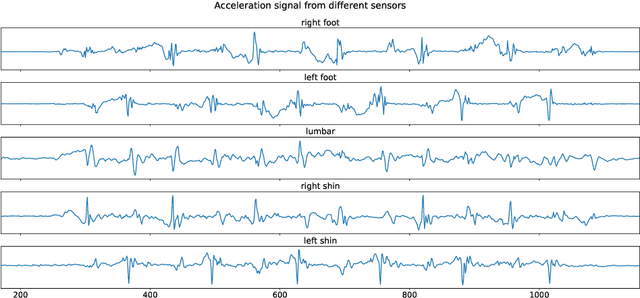
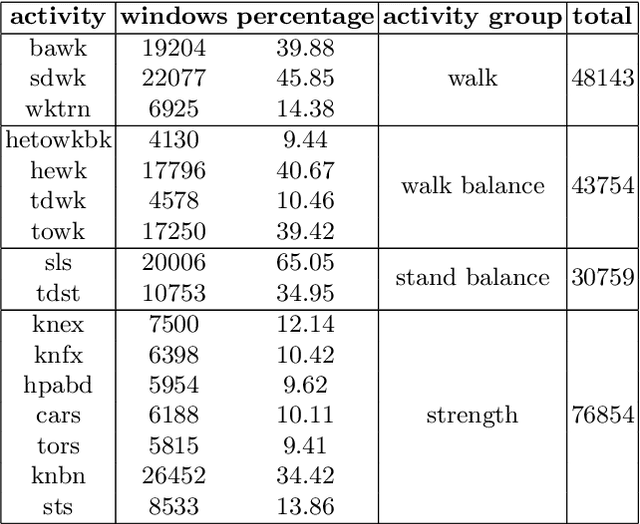
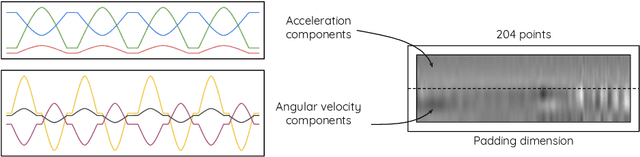
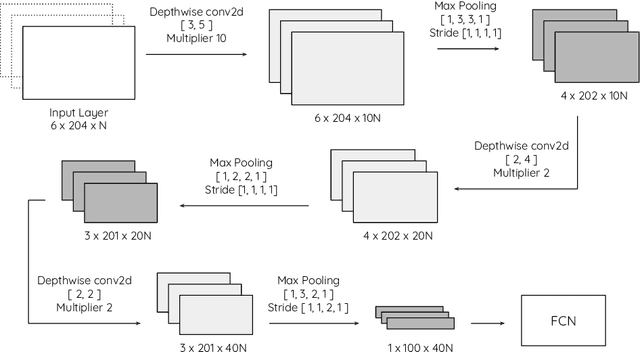
The problem of automatic identification of physical activities performed by human subjects is referred to as Human Activity Recognition (HAR). There exist several techniques to measure motion characteristics during these physical activities, such as Inertial Measurement Units (IMUs). IMUs have a cornerstone position in this context, and are characterized by usage flexibility, low cost, and reduced privacy impact. With the use of inertial sensors, it is possible to sample some measures such as acceleration and angular velocity of a body, and use them to learn models that are capable of correctly classifying activities to their corresponding classes. In this paper, we propose to use Convolutional Neural Networks (CNNs) to classify human activities. Our models use raw data obtained from a set of inertial sensors. We explore several combinations of activities and sensors, showing how motion signals can be adapted to be fed into CNNs by using different network architectures. We also compare the performance of different groups of sensors, investigating the classification potential of single, double and triple sensor systems. The experimental results obtained on a dataset of 16 lower-limb activities, collected from a group of participants with the use of five different sensors, are very promising.