 Add to Chrome
 Add to Firefox
 Add to Edge
Selection of Random Walkers that Optimizes the Global Mean First-Passage Time for Search in Complex Networks
Dec 12, 2018
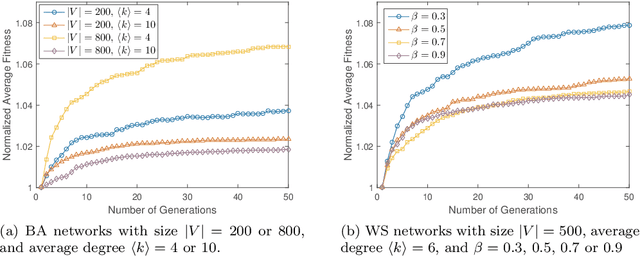

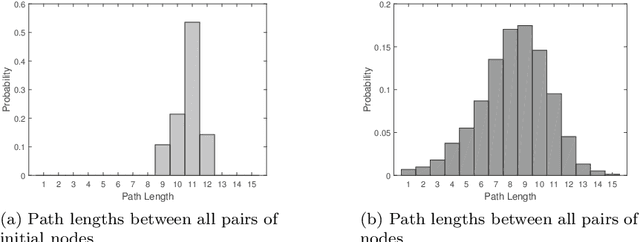
We design a method to optimize the global mean first-passage time (GMFPT) of multiple random walkers searching in complex networks for a general target, without specifying the property of the target node. According to the Laplace transformed formula of the GMFPT, we can equivalently minimize the overlap between the probability distribution of sites visited by the random walkers. We employ a mutation only genetic algorithm to solve this optimization problem using a population of walkers with different starting positions and a corresponding mutation matrix to modify them. The numerical experiments on two kinds of random networks (WS and BA) show satisfactory results in selecting the origins for the walkers to achieve minimum overlap. Our method thus provides guidance for setting up the search process by multiple random walkers on complex networks.
* 5 pages, 2 figures, accepted at ICCS'17

Optimization of Reliability of Network of Given Connectivity using Genetic Algorithm
Dec 13, 2014


Reliability is one of the important measures of how well the system meets its design objective, and mathematically is the probability that a system will perform satisfactorily for at least a given period of time. When the system is described by a connected network of N components (nodes) and their L connection (links), the reliability of the system becomes a difficult network design problem which solutions are of great practical interest in science and engineering. This paper discusses the numerical method of finding the most reliable network for a given N and L using genetic algorithm. For a given topology of the network, the reliability is numerically computed using adjacency matrix. For a search in the space of all possible topologies of the connected network with N nodes and L links, genetic operators such as mutation and crossover are applied to the adjacency matrix through a string representation. In the context of graphs, the mutation of strings in genetic algorithm corresponds to the rewiring of graphs, while crossover corresponds to the interchange of the sub-graphs. For small networks where the most reliable network can be found by exhaustive search, genetic algorithm is very efficient. For larger networks, our results not only demonstrate the efficiency of our algorithm, but also suggest that the most reliable network will have high symmetry.