 Add to Chrome
 Add to Firefox
 Add to Edge
ECHO: A Locally-Deployable Agentic Health Assistant with Temporal Memory, Safety Guardrails, and Speech Assessment
Aug 06, 2026
This paper presents ECHO (Enhanced Care \& Health Observer), a locally-deployable conversational health assistant for long-term chronic care management. ECHO integrates three complementary software modules developed under shared supervision as a unified system. The core module is an agentic chatbot built on a ReAct loop orchestrated via LangGraph, equipped with 17 clinical tools and a temporal knowledge graph for persistent cross-session memory; it achieves a 94.9\% tool-execution pass rate across a 59-scenario benchmark with GPT-5 Mini. A two-stage hybrid safety layer intercepts all incoming queries: a rule-based layer handles explicit crisis signals and jailbreak attempts in under 1ms, while a signed graph neural network (GNN) with APPNP-style propagation classifies boundary cases by clinical intent, achieving 88.8\% accuracy and 90.6\% unsafe recall on a 2,537-query annotated Turkish health dataset while outperforming zero-shot LLM baselines including Llama 3.3 70B. A multimodal speech assessment module combining Whisper acoustic encoding and BERT text encoding with cross-attention fusion estimates emotion, depression, and pain, reaching a mean macro F1 of 0.652. The full system is implemented as a web application that can run entirely on consumer hardware, with no patient data transmitted to external services, supporting compliance with GDPR and KVKK.

Multi-Modal Optimization with k-Cluster Big Bang-Big Crunch Algorithm
Dec 21, 2023
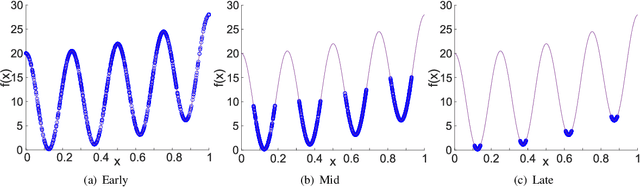
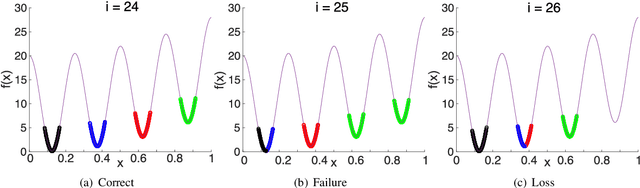
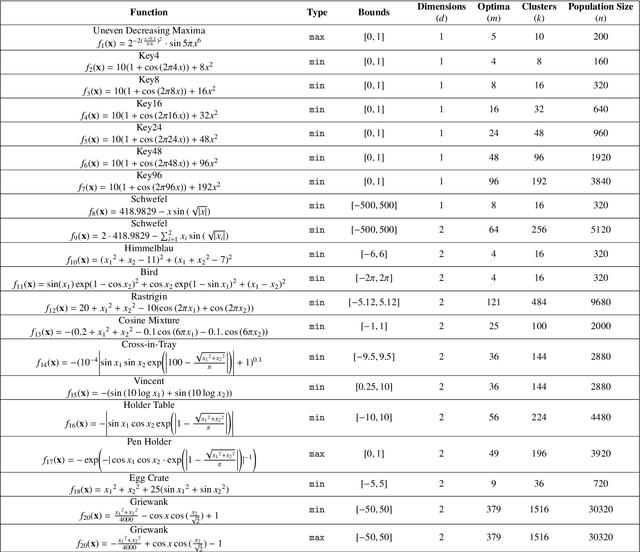
Multi-modal optimization is often encountered in engineering problems, especially when different and alternative solutions are sought. Evolutionary algorithms can efficiently tackle multi-modal optimization thanks to their features such as the concept of population, exploration/exploitation, and being suitable for parallel computation. This paper introduces a multi-modal optimization version of the Big Bang-Big Crunch algorithm based on clustering, namely, k-BBBC. This algorithm guarantees a complete convergence of the entire population, retrieving on average the 99\% of local optima for a specific problem. Additionally, we introduce two post-processing methods to (i) identify the local optima in a set of retrieved solutions (i.e., a population), and (ii) quantify the number of correctly retrieved optima against the expected ones (i.e., success rate). Our results show that k-BBBC performs well even with problems having a large number of optima (tested on 379 optima) and high dimensionality (tested on 32 decision variables). When compared to other multi-modal optimization methods, it outperforms them in terms of accuracy (in both search and objective space) and success rate (number of correctly retrieved optima) -- especially when elitism is applied. Lastly, we validated our proposed post-processing methods by comparing their success rate to the actual one. Results suggest that these methods can be used to evaluate the performance of a multi-modal optimization algorithm by correctly identifying optima and providing an indication of success -- without the need to know where the optima are located in the search space.