 Add to Chrome
 Add to Firefox
 Add to Edge
PatchPoison: Poisoning Multi-View Datasets to Degrade 3D Reconstruction
Apr 14, 2026
3D Gaussian Splatting (3DGS) has recently enabled highly photorealistic 3D reconstruction from casually captured multi-view images. However, this accessibility raises a privacy concern: publicly available images or videos can be exploited to reconstruct detailed 3D models of scenes or objects without the owner's consent. We present PatchPoison, a lightweight dataset-poisoning method that prevents unauthorized 3D reconstruction. Unlike global perturbations, PatchPoison injects a small high-frequency adversarial patch, a structured checkerboard, into the periphery of each image in a multi-view dataset. The patch is designed to corrupt the feature-matching stage of Structure-from-Motion (SfM) pipelines such as COLMAP by introducing spurious correspondences that systematically misalign estimated camera poses. Consequently, downstream 3DGS optimization diverges from the correct scene geometry. On the NeRF-Synthetic benchmark, inserting a 12 X 12 pixel patch increases reconstruction error by 6.8x in LPIPS, while the poisoned images remain unobtrusive to human viewers. PatchPoison requires no pipeline modifications, offering a practical, "drop-in" preprocessing step for content creators to protect their multi-view data.

InteracTalker: Prompt-Based Human-Object Interaction with Co-Speech Gesture Generation
Dec 14, 2025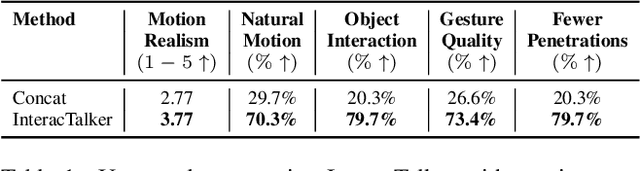
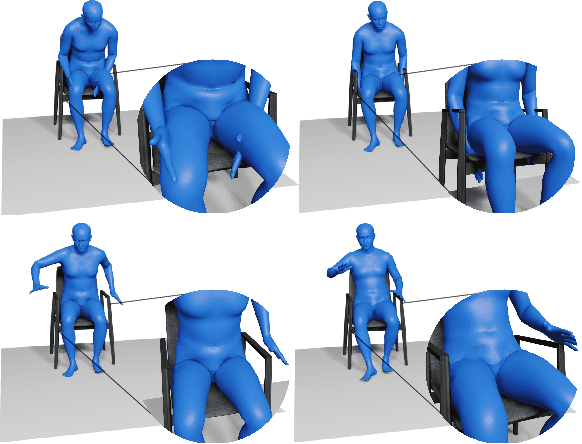
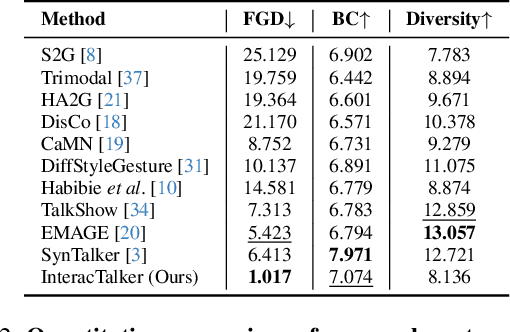
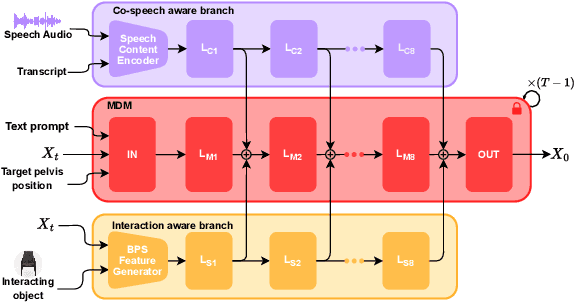
Generating realistic human motions that naturally respond to both spoken language and physical objects is crucial for interactive digital experiences. Current methods, however, address speech-driven gestures or object interactions independently, limiting real-world applicability due to a lack of integrated, comprehensive datasets. To overcome this, we introduce InteracTalker, a novel framework that seamlessly integrates prompt-based object-aware interactions with co-speech gesture generation. We achieve this by employing a multi-stage training process to learn a unified motion, speech, and prompt embedding space. To support this, we curate a rich human-object interaction dataset, formed by augmenting an existing text-to-motion dataset with detailed object interaction annotations. Our framework utilizes a Generalized Motion Adaptation Module that enables independent training, adapting to the corresponding motion condition, which is then dynamically combined during inference. To address the imbalance between heterogeneous conditioning signals, we propose an adaptive fusion strategy, which dynamically reweights the conditioning signals during diffusion sampling. InteracTalker successfully unifies these previously separate tasks, outperforming prior methods in both co-speech gesture generation and object-interaction synthesis, outperforming gesture-focused diffusion methods, yielding highly realistic, object-aware full-body motions with enhanced realism, flexibility, and control.