 Add to Chrome
 Add to Firefox
 Add to Edge
Transformer-Driven Multimodal Fusion for Explainable Suspiciousness Estimation in Visual Surveillance
Dec 10, 2025
Suspiciousness estimation is critical for proactive threat detection and ensuring public safety in complex environments. This work introduces a large-scale annotated dataset, USE50k, along with a computationally efficient vision-based framework for real-time suspiciousness analysis. The USE50k dataset contains 65,500 images captured from diverse and uncontrolled environments, such as airports, railway stations, restaurants, parks, and other public areas, covering a broad spectrum of cues including weapons, fire, crowd density, abnormal facial expressions, and unusual body postures. Building on this dataset, we present DeepUSEvision, a lightweight and modular system integrating three key components, i.e., a Suspicious Object Detector based on an enhanced YOLOv12 architecture, dual Deep Convolutional Neural Networks (DCNN-I and DCNN-II) for facial expression and body-language recognition using image and landmark features, and a transformer-based Discriminator Network that adaptively fuses multimodal outputs to yield an interpretable suspiciousness score. Extensive experiments confirm the superior accuracy, robustness, and interpretability of the proposed framework compared to state-of-the-art approaches. Collectively, the USE50k dataset and the DeepUSEvision framework establish a strong and scalable foundation for intelligent surveillance and real-time risk assessment in safety-critical applications.

Brain Age Group Classification Based on Resting State Functional Connectivity Metrics
Mar 27, 2025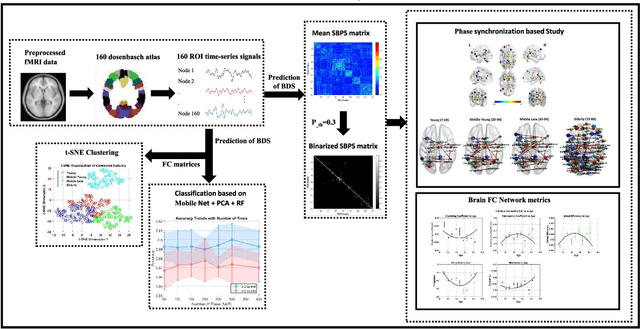
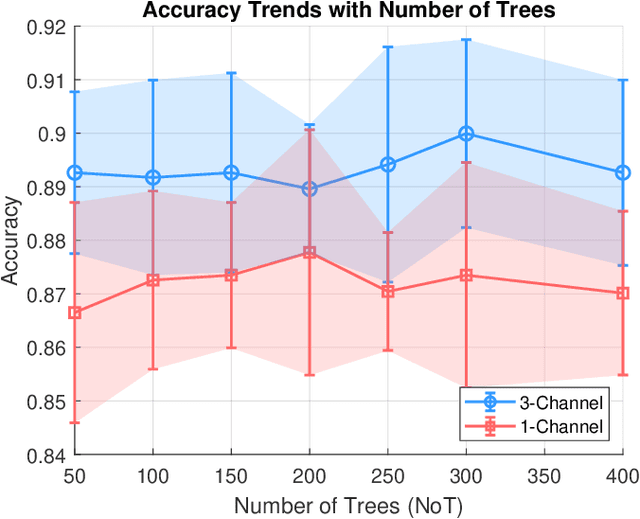
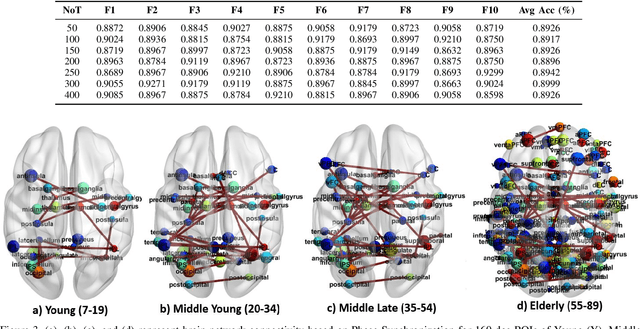
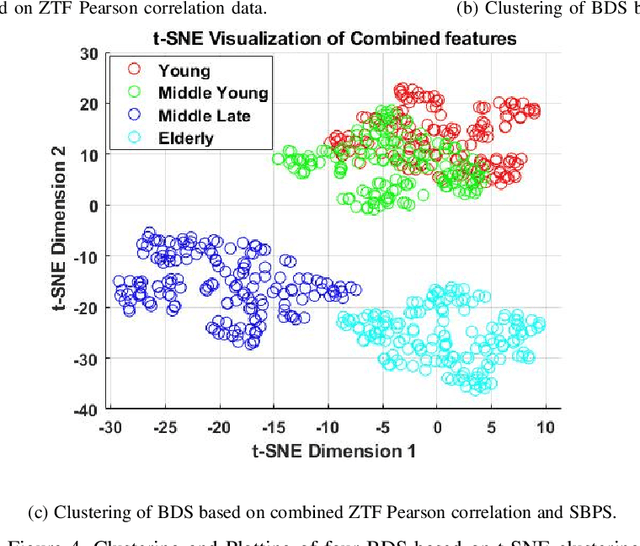
This study investigated age-related changes in functional connectivity using resting-state fMRI and explored the efficacy of traditional deep learning for classifying brain developmental stages (BDS). Functional connectivity was assessed using Seed-Based Phase Synchronization (SBPS) and Pearson correlation across 160 ROIs. Clustering was performed using t-SNE, and network topology was analyzed through graph-theoretic metrics. Adaptive learning was implemented to classify the age group by extracting bottleneck features through mobileNetV2. These deep features were embedded and classified using Random Forest and PCA. Results showed a shift in phase synchronization patterns from sensory-driven networks in youth to more distributed networks with aging. t-SNE revealed that SBPS provided the most distinct clustering of BDS. Global efficiency and participation coefficient followed an inverted U-shaped trajectory, while clustering coefficient and modularity exhibited a U-shaped pattern. MobileNet outperformed other models, achieving the highest classification accuracy for BDS. Aging was associated with reduced global integration and increased local connectivity, indicating functional network reorganization. While this study focused solely on functional connectivity from resting-state fMRI and a limited set of connectivity features, deep learning demonstrated superior classification performance, highlighting its potential for characterizing age-related brain changes.