 Add to Chrome
 Add to Firefox
 Add to Edge
Evaluating Agentic Learning Harness Capabilities Without Labels via the Scaling Hypothesis
Aug 11, 2026
Agentic "Continual Learning Harnesses", systems that pair an LLM with retrieval or memory to improve from feedback without retraining, have shown growing value in cybersecurity. But their value is conventionally measured by gains against labeled benchmarks, an approach that often fails in operational security settings. Benchmark labels are scarce, stale, and unrepresentative, so a practitioner often cannot tell whether a given harness helps at all or which of two is better for their task. Traditional LLM-as-a-judge offers little signal because it is no stronger than the agent it evaluates, and distillation is unreliable on scarce, sporadic, and biased labels. We propose a framework for evaluating learning harnesses end-to-end without a labeled benchmark, grounded in the scaling hypothesis. A stronger teacher model provides sparsely sampled corrections to a smaller student with a continual learning harness. We score a harness by how much its student converges toward the teacher over time. Across security tasks, model families, and harness designs, we show that improvement relative to the teacher correlates with improvement relative to a held-out gold standard, validating teacher-relative lift as a proxy for true harness uplift when labels are absent. We further show that LLM-as-a-judge between similarly powered models yields no usable signal. These results suggest that a teacher-sized model can be improved through the same harness when humans provide the same kind of sparse, high-precision corrections.

Unsupervised Multilingual Alignment using Wasserstein Barycenter
Jan 28, 2020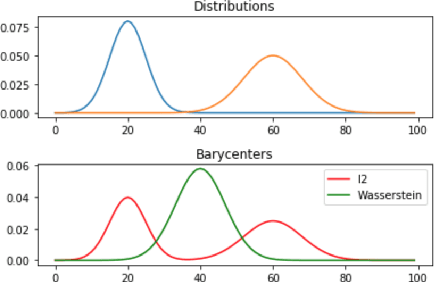
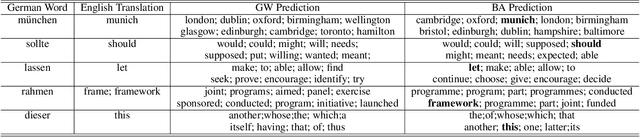
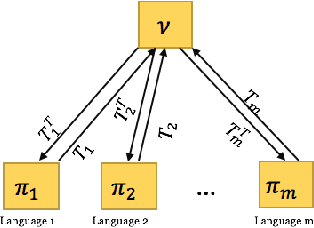
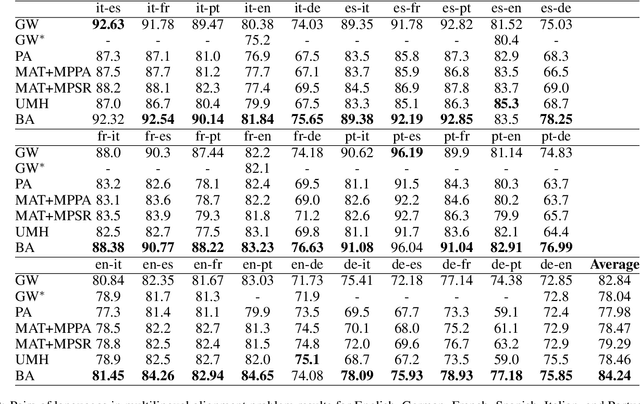
We study unsupervised multilingual alignment, the problem of finding word-to-word translations between multiple languages without using any parallel data. One popular strategy is to reduce multilingual alignment to the much simplified bilingual setting, by picking one of the input languages as the pivot language that we transit through. However, it is well-known that transiting through a poorly chosen pivot language (such as English) may severely degrade the translation quality, since the assumed transitive relations among all pairs of languages may not be enforced in the training process. Instead of going through a rather arbitrarily chosen pivot language, we propose to use the Wasserstein barycenter as a more informative ''mean'' language: it encapsulates information from all languages and minimizes all pairwise transportation costs. We evaluate our method on standard benchmarks and demonstrate state-of-the-art performances.
Relational Representation Learning for Dynamic (Knowledge) Graphs: A Survey
May 27, 2019
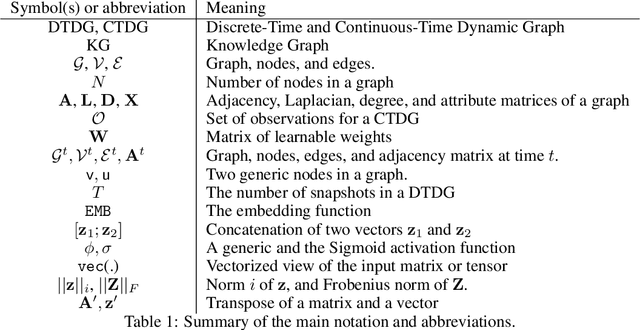
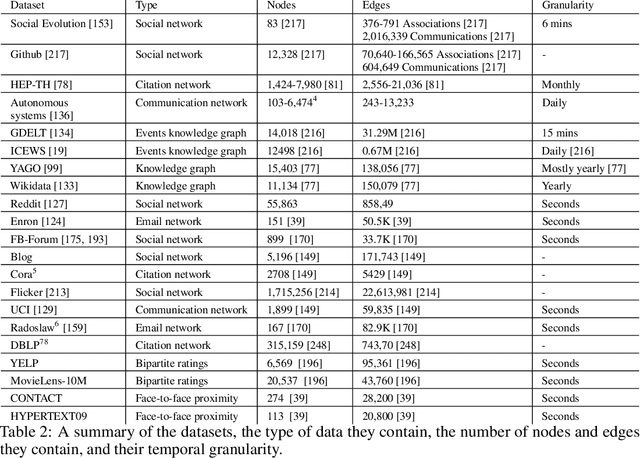
Graphs arise naturally in many real-world applications including social networks, recommender systems, ontologies, biology, and computational finance. Traditionally, machine learning models for graphs have been mostly designed for static graphs. However, many applications involve evolving graphs. This introduces important challenges for learning and inference since nodes, attributes, and edges change over time. In this survey, we review the recent advances in representation learning for dynamic graphs, including dynamic knowledge graphs. We describe existing models from an encoder-decoder perspective, categorize these encoders and decoders based on the techniques they employ, and analyze the approaches in each category. We also review several prominent applications and widely used datasets, and highlight directions for future research.