 Add to Chrome
 Add to Firefox
 Add to Edge
Keyframe-based Dense Mapping with the Graph of View-Dependent Local Maps
Jan 13, 2026
In this article, we propose a new keyframe-based mapping system. The proposed method updates local Normal Distribution Transform maps (NDT) using data from an RGB-D sensor. The cells of the NDT are stored in 2D view-dependent structures to better utilize the properties and uncertainty model of RGB-D cameras. This method naturally represents an object closer to the camera origin with higher precision. The local maps are stored in the pose graph which allows correcting global map after loop closure detection. We also propose a procedure that allows merging and filtering local maps to obtain a global map of the environment. Finally, we compare our method with Octomap and NDT-OM and provide example applications of the proposed mapping method.

Using Mobile AR for Rapid Feasibility Analysis for Deployment of Robots: A Usability Study with Non-Expert Users
Mar 18, 2025
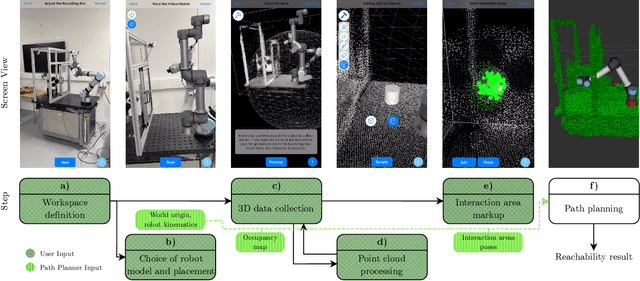

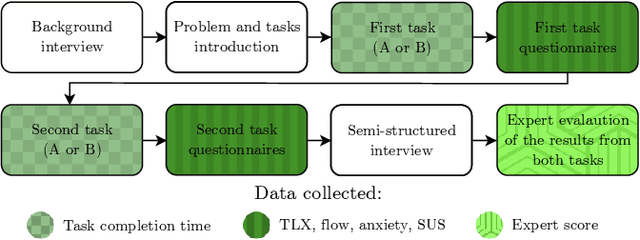
Automating a production line with robotic arms is a complex, demanding task that requires not only substantial resources but also a deep understanding of the automated processes and available technologies and tools. Expert integrators must consider factors such as placement, payload, and robot reach requirements to determine the feasibility of automation. Ideally, such considerations are based on a detailed digital simulation developed before any hardware is deployed. However, this process is often time-consuming and challenging. To simplify these processes, we introduce a much simpler method for the feasibility analysis of robotic arms' reachability, designed for non-experts. We implement this method through a mobile, sensing-based prototype tool. The two-step experimental evaluation included the expert user study results, which helped us identify the difficulty levels of various deployment scenarios and refine the initial prototype. The results of the subsequent quantitative study with 22 non-expert participants utilizing both scenarios indicate that users could complete both simple and complex feasibility analyses in under ten minutes, exhibiting similar cognitive loads and high engagement. Overall, the results suggest that the tool was well-received and rated as highly usable, thereby showing a new path for changing the ease of feasibility analysis for automation.