 Add to Chrome
 Add to Firefox
 Add to Edge
Large-Scale Aspect-Based Sentiment Analysis with Reasoning-Infused LLMs
Jan 07, 2026
We introduce Arctic-ABSA, a collection of powerful models for real-life aspect-based sentiment analysis (ABSA). Our models are tailored to commercial needs, trained on a large corpus of public data alongside carefully generated synthetic data, resulting in a dataset 20 times larger than SemEval14. We extend typical ABSA models by expanding the number of sentiment classes from the standard three (positive, negative, neutral) to five, adding mixed and unknown classes, while also jointly predicting overall text sentiment and supporting multiple languages. We experiment with reasoning injection by fine-tuning on Chain-of-Thought (CoT) examples and introduce a novel reasoning pretraining technique for encoder-only models that significantly improves downstream fine-tuning and generalization. Our 395M-parameter encoder and 8B-parameter decoder achieve up to 10 percentage points higher accuracy than GPT-4o and Claude 3.5 Sonnet, while setting new state-of-the-art results on the SemEval14 benchmark. A single multilingual model maintains 87-91% accuracy across six languages without degrading English performance. We release ABSA-mix, a large-scale benchmark aggregating 17 public ABSA datasets across 92 domains.

Bigger, Regularized, Optimistic: scaling for compute and sample-efficient continuous control
May 25, 2024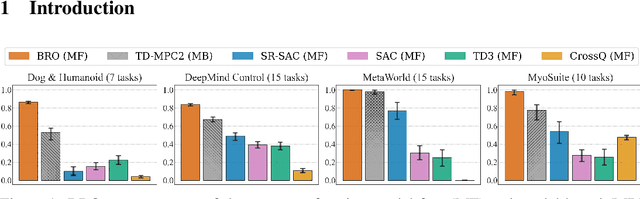


Sample efficiency in Reinforcement Learning (RL) has traditionally been driven by algorithmic enhancements. In this work, we demonstrate that scaling can also lead to substantial improvements. We conduct a thorough investigation into the interplay of scaling model capacity and domain-specific RL enhancements. These empirical findings inform the design choices underlying our proposed BRO (Bigger, Regularized, Optimistic) algorithm. The key innovation behind BRO is that strong regularization allows for effective scaling of the critic networks, which, paired with optimistic exploration, leads to superior performance. BRO achieves state-of-the-art results, significantly outperforming the leading model-based and model-free algorithms across 40 complex tasks from the DeepMind Control, MetaWorld, and MyoSuite benchmarks. BRO is the first model-free algorithm to achieve near-optimal policies in the notoriously challenging Dog and Humanoid tasks.
Red-Teaming Segment Anything Model
Apr 02, 2024Foundation models have emerged as pivotal tools, tackling many complex tasks through pre-training on vast datasets and subsequent fine-tuning for specific applications. The Segment Anything Model is one of the first and most well-known foundation models for computer vision segmentation tasks. This work presents a multi-faceted red-teaming analysis that tests the Segment Anything Model against challenging tasks: (1) We analyze the impact of style transfer on segmentation masks, demonstrating that applying adverse weather conditions and raindrops to dashboard images of city roads significantly distorts generated masks. (2) We focus on assessing whether the model can be used for attacks on privacy, such as recognizing celebrities' faces, and show that the model possesses some undesired knowledge in this task. (3) Finally, we check how robust the model is to adversarial attacks on segmentation masks under text prompts. We not only show the effectiveness of popular white-box attacks and resistance to black-box attacks but also introduce a novel approach - Focused Iterative Gradient Attack (FIGA) that combines white-box approaches to construct an efficient attack resulting in a smaller number of modified pixels. All of our testing methods and analyses indicate a need for enhanced safety measures in foundation models for image segmentation.