 Add to Chrome
 Add to Firefox
 Add to Edge
Cyber Threat Intelligence for Artificial Intelligence Systems
Mar 05, 2026
As artificial intelligence (AI) becomes deeply embedded in critical services and everyday products, it is increasingly exposed to security threats which traditional cyber defenses were not designed to handle. In this paper, we investigate how cyber threat intelligence (CTI) may evolve to address attacks that target AI systems. We first analyze the assumptions and workflows of conventional threat intelligence with the needs of AI-focused defense, highlighting AI-specific assets and vulnerabilities. We then review and organize the current landscape of AI security knowledge. Based on this, we outline what an AI-oriented threat intelligence knowledge base should contain, describing concrete indicators of compromise (IoC) for different AI supply-chain phases and artifacts, and showing how such a knowledge base could support security tools. Finally, we discuss techniques for measuring similarity between collected indicators and newly observed AI artifacts. The review reveals gaps and quality issues in existing resources and identifies potential future research directions toward a practical threat intelligence framework tailored to AI.

Ransomware Detection Using Machine Learning in the Linux Kernel
Sep 10, 2024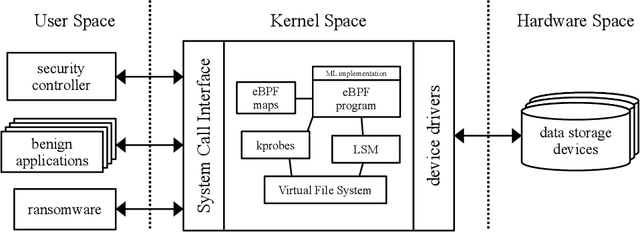
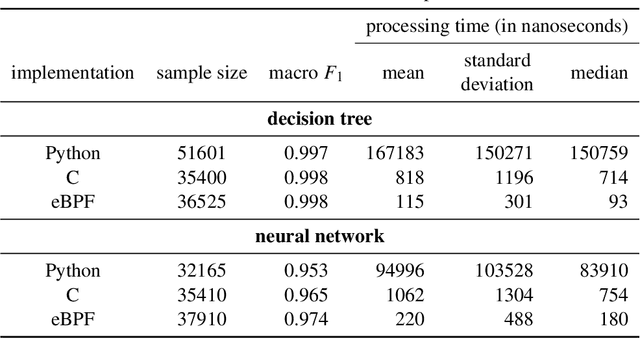
Linux-based cloud environments have become lucrative targets for ransomware attacks, employing various encryption schemes at unprecedented speeds. Addressing the urgency for real-time ransomware protection, we propose leveraging the extended Berkeley Packet Filter (eBPF) to collect system call information regarding active processes and infer about the data directly at the kernel level. In this study, we implement two Machine Learning (ML) models in eBPF - a decision tree and a multilayer perceptron. Benchmarking latency and accuracy against their user space counterparts, our findings underscore the efficacy of this approach.