 Add to Chrome
 Add to Firefox
 Add to Edge
MobileDev-Bench: A Comprehensive Benchmark for Evaluating Language Models on Mobile Application Development
Mar 26, 2026
Large language models (LLMs) have shown strong performance on automated software engineering tasks, yet existing benchmarks focus primarily on general-purpose libraries or web applications, leaving mobile application development largely unexplored despite its strict platform constraints, framework-driven lifecycles, and complex platform API interactions. We introduce MobileDev-Bench, a benchmark comprising 384 real-world issue-resolution tasks collected from 18 production mobile applications spanning Android Native (Java/Kotlin), React Native (TypeScript), and Flutter (Dart). Each task pairs an authentic developer-reported issue with executable test patches, enabling fully automated validation of model-generated fixes within mobile build environments. The benchmark exhibits substantial patch complexity: fixes modify 12.5 files and 324.9 lines on average, and 35.7% of instances require coordinated changes across multiple artifact types, such as source and manifest files. Evaluation of four state-of-the-art code-capable LLMs, GPT- 5.2, Claude Sonnet 4.5, Gemini Flash 2.5, and Qwen3-Coder, yields low end-to-end resolution rates of 3.39%-5.21%, revealing significant performance gaps compared to prior benchmarks. Further analysis reveals systematic failure modes, with fault localization across multi-file and multi-artifact changes emerging as the primary bottleneck.

A Large-Scale Study on the Development and Issues of Multi-Agent AI Systems
Jan 12, 2026The rapid emergence of multi-agent AI systems (MAS), including LangChain, CrewAI, and AutoGen, has shaped how large language model (LLM) applications are developed and orchestrated. However, little is known about how these systems evolve and are maintained in practice. This paper presents the first large-scale empirical study of open-source MAS, analyzing over 42K unique commits and over 4.7K resolved issues across eight leading systems. Our analysis identifies three distinct development profiles: sustained, steady, and burst-driven. These profiles reflect substantial variation in ecosystem maturity. Perfective commits constitute 40.8% of all changes, suggesting that feature enhancement is prioritized over corrective maintenance (27.4%) and adaptive updates (24.3%). Data about issues shows that the most frequent concerns involve bugs (22%), infrastructure (14%), and agent coordination challenges (10%). Issue reporting also increased sharply across all frameworks starting in 2023. Median resolution times range from under one day to about two weeks, with distributions skewed toward fast responses but a minority of issues requiring extended attention. These results highlight both the momentum and the fragility of the current ecosystem, emphasizing the need for improved testing infrastructure, documentation quality, and maintenance practices to ensure long-term reliability and sustainability.
What Users Value and Critique: Large-Scale Analysis of User Feedback on AI-Powered Mobile Apps
Jun 12, 2025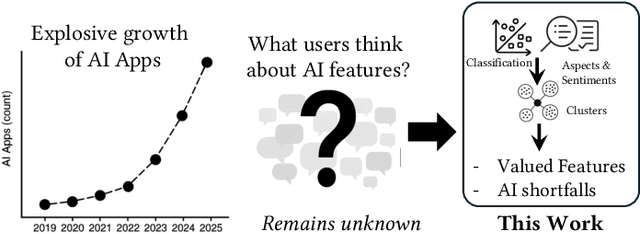
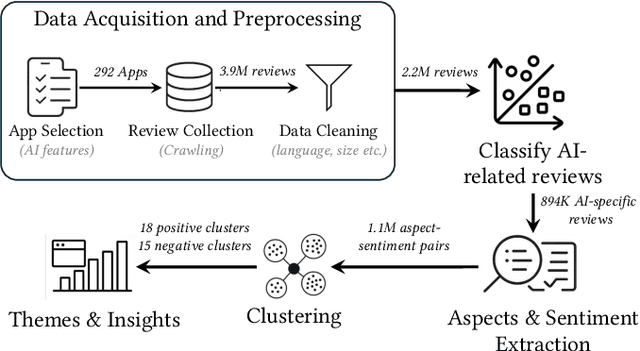
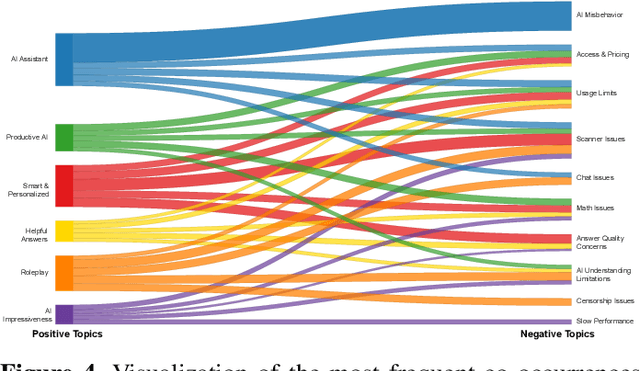
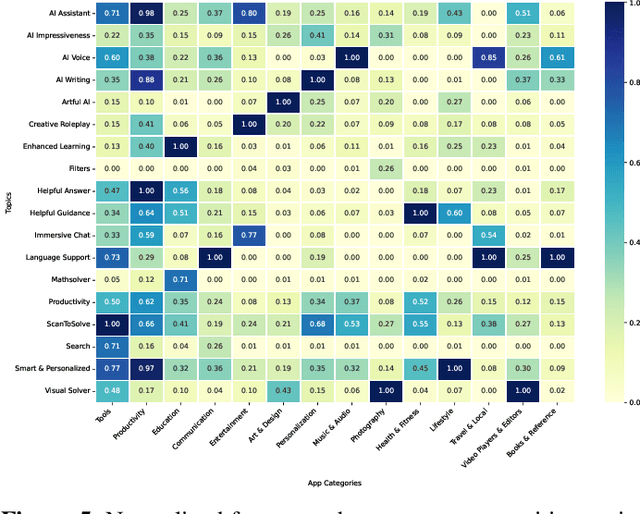
Artificial Intelligence (AI)-powered features have rapidly proliferated across mobile apps in various domains, including productivity, education, entertainment, and creativity. However, how users perceive, evaluate, and critique these AI features remains largely unexplored, primarily due to the overwhelming volume of user feedback. In this work, we present the first comprehensive, large-scale study of user feedback on AI-powered mobile apps, leveraging a curated dataset of 292 AI-driven apps across 14 categories with 894K AI-specific reviews from Google Play. We develop and validate a multi-stage analysis pipeline that begins with a human-labeled benchmark and systematically evaluates large language models (LLMs) and prompting strategies. Each stage, including review classification, aspect-sentiment extraction, and clustering, is validated for accuracy and consistency. Our pipeline enables scalable, high-precision analysis of user feedback, extracting over one million aspect-sentiment pairs clustered into 18 positive and 15 negative user topics. Our analysis reveals that users consistently focus on a narrow set of themes: positive comments emphasize productivity, reliability, and personalized assistance, while negative feedback highlights technical failures (e.g., scanning and recognition), pricing concerns, and limitations in language support. Our pipeline surfaces both satisfaction with one feature and frustration with another within the same review. These fine-grained, co-occurring sentiments are often missed by traditional approaches that treat positive and negative feedback in isolation or rely on coarse-grained analysis. To this end, our approach provides a more faithful reflection of the real-world user experiences with AI-powered apps. Category-aware analysis further uncovers both universal drivers of satisfaction and domain-specific frustrations.