 Add to Chrome
 Add to Firefox
 Add to Edge
PhyPush: One Push is All You Need for Sensorless Physical Property Estimation with Physics-Guided Transformers
May 25, 2026
Accurately estimating object mass and friction is fundamental to achieving reliable and adaptive robotic manipulation. Although interactive perception provides a powerful mechanism for inferring such properties, most existing approaches depend on specialized hardware such as force/torque sensors, tactile arrays, or multi-camera motion-capture systems, limiting scalability and deployment. This paper presents PhyPush, a physics-guided Transformer framework that estimates an object's mass and friction coefficient using only kinematically derived end-effector velocity from a single push. This typically requires data available on standard robotic arms. The model incorporates constraints from Newton's second law and the Coulomb friction model through a physics-guided loss, improving physical consistency and generalization to unseen objects and surfaces. Across diverse simulation and real-world setups, PhyPush consistently achieves more accurate mass and friction estimation in challenging out-of-domain conditions. In simulation, it reduces error by over 10% compared with a baseline that has privileged access to full force information, while in real-world experiments, it outperforms a data-driven loss approach. Overall, the results demonstrate that physics-guided learning can enable low-cost, sensor-efficient estimation of physical properties, relying solely on a single push and readily available kinematic data.

Beyond Detection -- Orchestrating Human-Robot-Robot Assistance via an Internet of Robotic Things Paradigm
Sep 26, 2025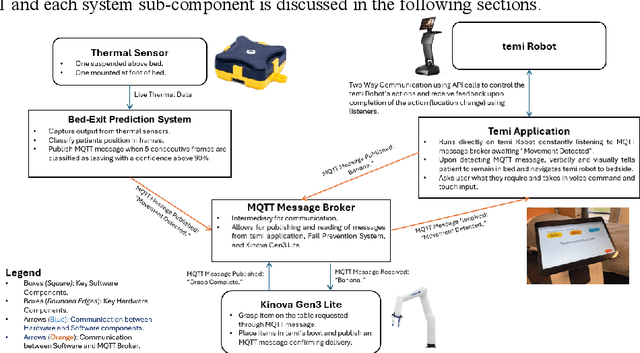
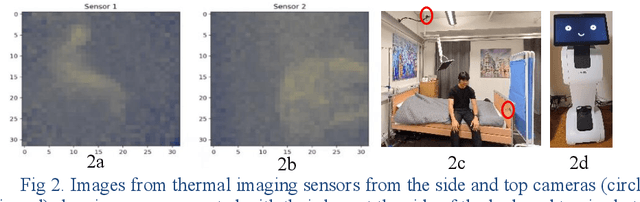
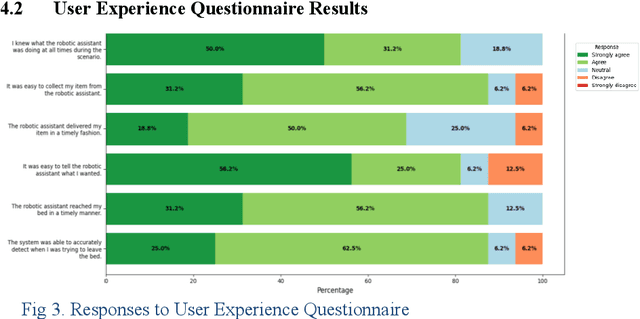
Hospital patient falls remain a critical and costly challenge worldwide. While conventional fall prevention systems typically rely on post-fall detection or reactive alerts, they also often suffer from high false positive rates and fail to address the underlying patient needs that lead to bed-exit attempts. This paper presents a novel system architecture that leverages the Internet of Robotic Things (IoRT) to orchestrate human-robot-robot interaction for proactive and personalized patient assistance. The system integrates a privacy-preserving thermal sensing model capable of real-time bed-exit prediction, with two coordinated robotic agents that respond dynamically based on predicted intent and patient input. This orchestrated response could not only reduce fall risk but also attend to the patient's underlying motivations for movement, such as thirst, discomfort, or the need for assistance, before a hazardous situation arises. Our contributions with this pilot study are three-fold: (1) a modular IoRT-based framework enabling distributed sensing, prediction, and multi-robot coordination; (2) a demonstration of low-resolution thermal sensing for accurate, privacy-preserving preemptive bed-exit detection; and (3) results from a user study and systematic error analysis that inform the design of situationally aware, multi-agent interactions in hospital settings. The findings highlight how interactive and connected robotic systems can move beyond passive monitoring to deliver timely, meaningful assistance, empowering safer, more responsive care environments.