 Add to Chrome
 Add to Firefox
 Add to Edge
L1-Regularized ICA: A Novel Method for Analysis of Task-related fMRI Data
Oct 17, 2024
We propose a new method of independent component analysis (ICA) in order to extract appropriate features from high-dimensional data. In general, matrix factorization methods including ICA have a problem regarding the interpretability of extracted features. For the improvement of interpretability, it is considered that sparse constraint on a factorized matrix is helpful. With this background, we construct a new ICA method with sparsity. In our method, the L1-regularization term is added to the cost function of ICA, and minimization of the cost function is performed by difference of convex functions algorithm. For the validity of our proposed method, we apply it to synthetic data and real functional magnetic resonance imaging data.
* 29 pages, 9 figures, 4 tables. Python code is available. Please contact the corresponding author for the code

Performance evaluation of matrix factorization for fMRI data
Dec 14, 2023In the study of the brain, there is a hypothesis that sparse coding is realized in information representation of external stimuli, which is experimentally confirmed for visual stimulus recently. However, unlike the specific functional region in the brain, sparse coding in information processing in the whole brain has not been clarified sufficiently. In this study, we investigate the validity of sparse coding in the whole human brain by applying various matrix factorization methods to functional magnetic resonance imaging data of neural activities in the whole human brain. The result suggests sparse coding hypothesis in information representation in the whole human brain, because extracted features from sparse MF method, SparsePCA or MOD under high sparsity setting, or approximate sparse MF method, FastICA, can classify external visual stimuli more accurately than non-sparse MF method or sparse MF method under low sparsity setting.
* 22 pages, 8 figures
Automatic Hyperparameter Tuning in Sparse Matrix Factorization
May 17, 2023We study the problem of hyperparameter tuning in sparse matrix factorization under Bayesian framework. In the prior work, an analytical solution of sparse matrix factorization with Laplace prior was obtained by variational Bayes method under several approximations. Based on this solution, we propose a novel numerical method of hyperparameter tuning by evaluating the zero point of normalization factor in sparse matrix prior. We also verify that our method shows excellent performance for ground-truth sparse matrix reconstruction by comparing it with the widely-used algorithm of sparse principal component analysis.
* 13 pages, 5 figures
Generalization of generative model for neuronal ensemble inference method
Nov 07, 2022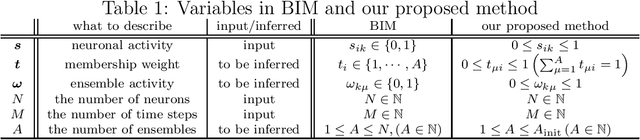
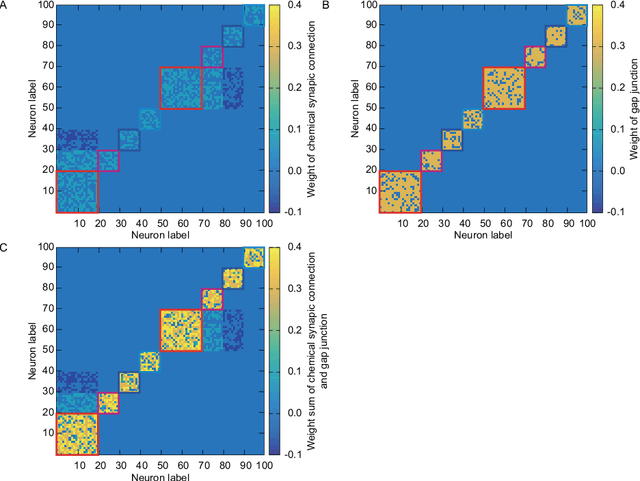
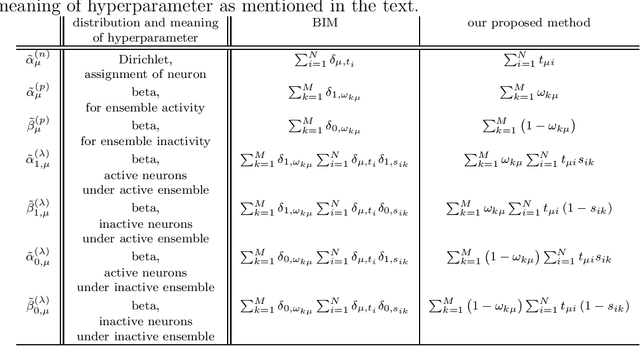

Various brain functions that are necessary to maintain life activities materialize through the interaction of countless neurons. Therefore, it is important to analyze the structure of functional neuronal network. To elucidate the mechanism of brain function, many studies are being actively conducted on the structure of functional neuronal ensemble and hub, including all areas of neuroscience. In addition, recent study suggests that the existence of functional neuronal ensembles and hubs contributes to the efficiency of information processing. For these reasons, there is a demand for methods to infer functional neuronal ensembles from neuronal activity data, and methods based on Bayesian inference have been proposed. However, there is a problem in modeling the activity in Bayesian inference. The features of each neuron's activity have non-stationarity depending on physiological experimental conditions. As a result, the assumption of stationarity in Bayesian inference model impedes inference, which leads to destabilization of inference results and degradation of inference accuracy. In this study, we extend the expressivity of the model in the previous study and improve it to a soft clustering method, which can be applied to activity data with non-stationarity. In addition, for the effectiveness of the method, we apply the developed method to synthetic data generated by the leaky-integrate-and-fire model, and discuss the result.
Improved Neuronal Ensemble Inference with Generative Model and MCMC
May 20, 2021


Neuronal ensemble inference is a significant problem in the study of biological neural networks. Various methods have been proposed for ensemble inference from experimental data of neuronal activity. Among them, Bayesian inference approach with generative model was proposed recently. However, this method requires large computational cost for appropriate inference. In this work, we give an improved Bayesian inference algorithm by modifying update rule in Markov chain Monte Carlo method and introducing the idea of simulated annealing for hyperparameter control. We compare the performance of ensemble inference between our algorithm and the original one, and discuss the advantage of our method.
Belief Propagation for Maximum Coverage on Weighted Bipartite Graph and Application to Text Summarization
Mar 26, 2020


We study text summarization from the viewpoint of maximum coverage problem. In graph theory, the task of text summarization is regarded as maximum coverage problem on bipartite graph with weighted nodes. In recent study, belief-propagation based algorithm for maximum coverage on unweighted graph was proposed using the idea of statistical mechanics. We generalize it to weighted graph for text summarization. Then we apply our algorithm to weighted biregular random graph for verification of maximum coverage performance. We also apply it to bipartite graph representing real document in open text dataset, and check the performance of text summarization. As a result, our algorithm exhibits better performance than greedy-type algorithm in some setting of text summarization.
* 4 pages, 4 figures
Improved algorithm for neuronal ensemble inference by Monte Carlo method
Nov 15, 2019


Neuronal ensemble inference is one of the significant problems in the study of biological neural networks. Various methods have been proposed for ensemble inference from their activity data taken experimentally. Here we focus on Bayesian inference approach for ensembles with generative model, which was proposed in recent work. However, this method requires large computational cost, and the result sometimes gets stuck in bad local maximum solution of Bayesian inference. In this work, we give improved Bayesian inference algorithm for these problems. We modify ensemble generation rule in Markov chain Monte Carlo method, and introduce the idea of simulated annealing for hyperparameter control. We also compare the performance of ensemble inference between our algorithm and the original one.
Approximate Method of Variational Bayesian Matrix Factorization/Completion with Sparse Prior
Mar 14, 2018


We derive analytical expression of matrix factorization/completion solution by variational Bayes method, under the assumption that observed matrix is originally the product of low-rank dense and sparse matrices with additive noise. We assume the prior of sparse matrix is Laplace distribution by taking matrix sparsity into consideration. Then we use several approximations for derivation of matrix factorization/completion solution. By our solution, we also numerically evaluate the performance of sparse matrix reconstruction in matrix factorization, and completion of missing matrix element in matrix completion.
* 22 pages, 4 figures, part of this work was presented in IEEE International Workshop on Machine Learning for Signal Processing (2017)