 Add to Chrome
 Add to Firefox
 Add to Edge
Processing through encoding: Quantum circuit approaches for point-wise multiplication and convolution
Dec 12, 2025
This paper introduces quantum circuit methodologies for pointwise multiplication and convolution of complex functions, conceptualized as "processing through encoding". Leveraging known techniques, we describe an approach where multiple complex functions are encoded onto auxiliary qubits. Applying the proposed scheme for two functions $f$ and $g$, their pointwise product $f(x)g(x)$ is shown to naturally form as the coefficients of part of the resulting quantum state. Adhering to the convolution theorem, we then demonstrate how the convolution $f*g$ can be constructed. Similarly to related work, this involves the encoding of the Fourier coefficients $\mathcal{F}[f]$ and $\mathcal{F}[g]$, which facilitates their pointwise multiplication, followed by the inverse Quantum Fourier Transform. We discuss the simulation of these techniques, their integration into an extended \verb|quantumaudio| package for audio signal processing, and present initial experimental validations. This work offers a promising avenue for quantum signal processing, with potential applications in areas such as quantum-enhanced audio manipulation and synthesis.

Efficient automated U-Net based tree crown delineation using UAV multi-spectral imagery on embedded devices
Jul 16, 2021

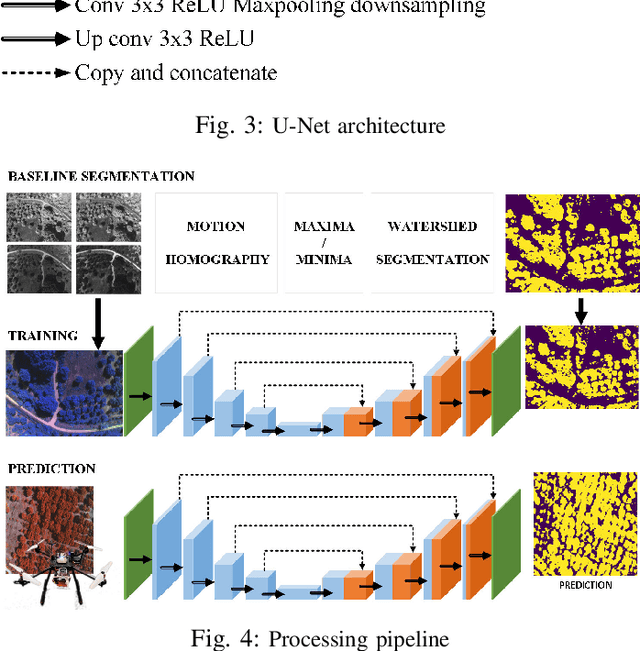

Delineation approaches provide significant benefits to various domains, including agriculture, environmental and natural disasters monitoring. Most of the work in the literature utilize traditional segmentation methods that require a large amount of computational and storage resources. Deep learning has transformed computer vision and dramatically improved machine translation, though it requires massive dataset for training and significant resources for inference. More importantly, energy-efficient embedded vision hardware delivering real-time and robust performance is crucial in the aforementioned application. In this work, we propose a U-Net based tree delineation method, which is effectively trained using multi-spectral imagery but can then delineate single-spectrum images. The deep architecture that also performs localization, i.e., a class label corresponds to each pixel, has been successfully used to allow training with a small set of segmented images. The ground truth data were generated using traditional image denoising and segmentation approaches. To be able to execute the proposed DNN efficiently in embedded platforms designed for deep learning approaches, we employ traditional model compression and acceleration methods. Extensive evaluation studies using data collected from UAVs equipped with multi-spectral cameras demonstrate the effectiveness of the proposed methods in terms of delineation accuracy and execution efficiency.