 Add to Chrome
 Add to Firefox
 Add to Edge
Decision-Aware Training for Sample-Based Generative Models
Jul 01, 2026
Sample-based generative models are increasingly used for probabilistic forecasting in high-stakes decision settings, yet their training objectives are blind to the decision maker's cost structure. These models are commonly trained with strictly proper scoring rules, such as the energy score, which allocate their training signal in proportion to data density, with no awareness of where forecast errors are most costly for downstream decisions. We therefore propose decision-aware training for sample-based generative models, augmenting the energy score objective with a differentiable decision loss that directly penalises the cost incurred by acting on the model's forecast. This combined loss is theoretically grounded, as the decision loss is itself a proper scoring rule. We validate our method on one synthetic and two real-world tasks, showing targeted improvements in cost-sensitive regions while retaining full probabilistic forecasts.

Evaluating Weather Forecasts from a Decision Maker's Perspective
Dec 16, 2025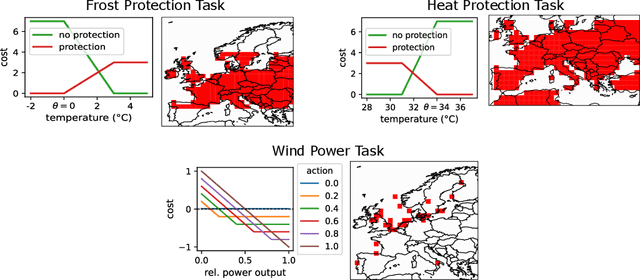
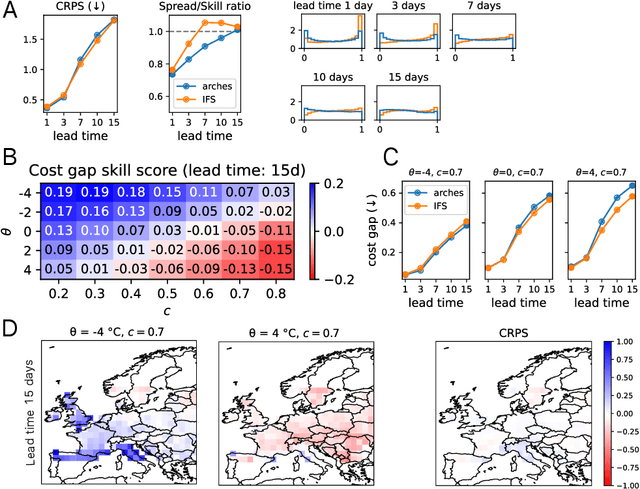
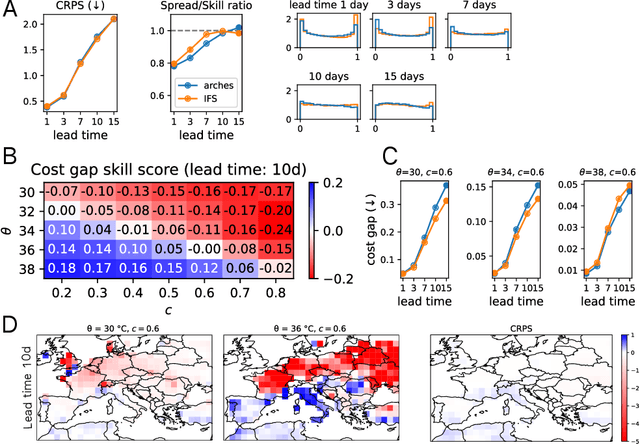
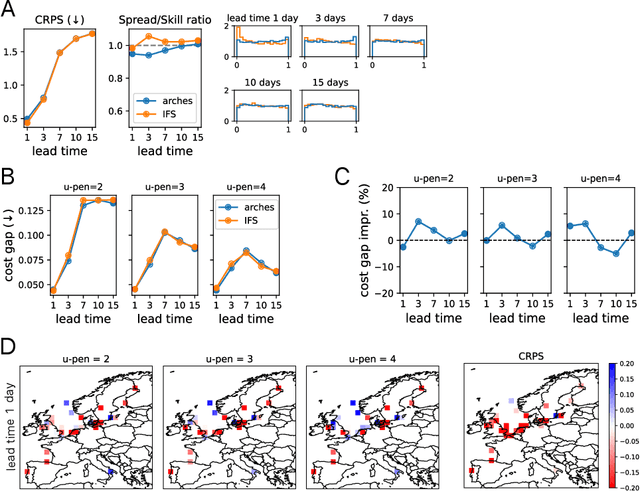
Standard weather forecast evaluations focus on the forecaster's perspective and on a statistical assessment comparing forecasts and observations. In practice, however, forecasts are used to make decisions, so it seems natural to take the decision-maker's perspective and quantify the value of a forecast by its ability to improve decision-making. Decision calibration provides a novel framework for evaluating forecast performance at the decision level rather than the forecast level. We evaluate decision calibration to compare Machine Learning and classical numerical weather prediction models on various weather-dependent decision tasks. We find that model performance at the forecast level does not reliably translate to performance in downstream decision-making: some performance differences only become apparent at the decision level, and model rankings can change among different decision tasks. Our results confirm that typical forecast evaluations are insufficient for selecting the optimal forecast model for a specific decision task.