 Add to Chrome
 Add to Firefox
 Add to Edge
Dreaming in Code for Curriculum Learning in Open-Ended Worlds
Feb 09, 2026
Open-ended learning frames intelligence as emerging from continual interaction with an ever-expanding space of environments. While recent advances have utilized foundation models to programmatically generate diverse environments, these approaches often focus on discovering isolated behaviors rather than orchestrating sustained progression. In complex open-ended worlds, the large combinatorial space of possible challenges makes it difficult for agents to discover sequences of experiences that remain consistently learnable. To address this, we propose Dreaming in Code (DiCode), a framework in which foundation models synthesize executable environment code to scaffold learning toward increasing competence. In DiCode, "dreaming" takes the form of materializing code-level variations of the world. We instantiate DiCode in Craftax, a challenging open-ended benchmark characterized by rich mechanics and long-horizon progression. Empirically, DiCode enables agents to acquire long-horizon skills, achieving a $16\%$ improvement in mean return over the strongest baseline and non-zero success on late-game combat tasks where prior methods fail. Our results suggest that code-level environment design provides a practical mechanism for curriculum control, enabling the construction of intermediate environments that bridge competence gaps in open-ended worlds. Project page and source code are available at https://konstantinosmitsides.github.io/dreaming-in-code and https://github.com/konstantinosmitsides/dreaming-in-code.

Scaling Policy Gradient Quality-Diversity with Massive Parallelization via Behavioral Variations
Jan 30, 2025
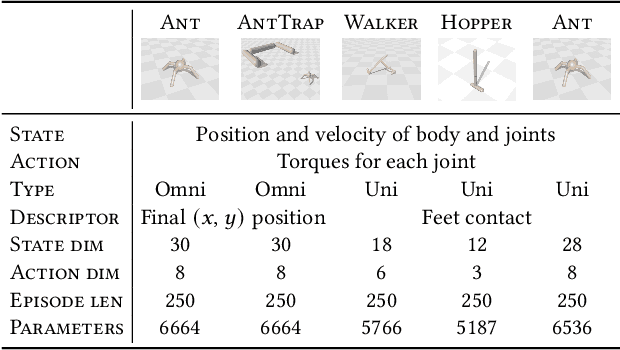
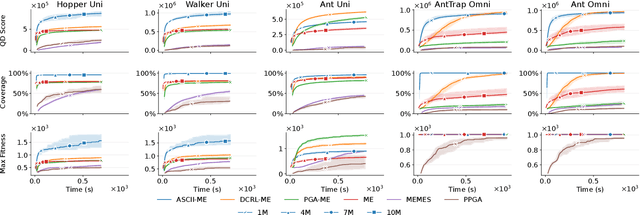
Quality-Diversity optimization comprises a family of evolutionary algorithms aimed at generating a collection of diverse and high-performing solutions. MAP-Elites (ME), a notable example, is used effectively in fields like evolutionary robotics. However, the reliance of ME on random mutations from Genetic Algorithms limits its ability to evolve high-dimensional solutions. Methods proposed to overcome this include using gradient-based operators like policy gradients or natural evolution strategies. While successful at scaling ME for neuroevolution, these methods often suffer from slow training speeds, or difficulties in scaling with massive parallelization due to high computational demands or reliance on centralized actor-critic training. In this work, we introduce a fast, sample-efficient ME based algorithm capable of scaling up with massive parallelization, significantly reducing runtimes without compromising performance. Our method, ASCII-ME, unlike existing policy gradient quality-diversity methods, does not rely on centralized actor-critic training. It performs behavioral variations based on time step performance metrics and maps these variations to solutions using policy gradients. Our experiments show that ASCII-ME can generate a diverse collection of high-performing deep neural network policies in less than 250 seconds on a single GPU. Additionally, it operates on average, five times faster than state-of-the-art algorithms while still maintaining competitive sample efficiency.