 Add to Chrome
 Add to Firefox
 Add to Edge
Leveraging LLMs for Collaborative Ontology Engineering in Parkinson Disease Monitoring and Alerting
Dec 16, 2025
This paper explores the integration of Large Language Models (LLMs) in the engineering of a Parkinson's Disease (PD) monitoring and alerting ontology through four key methodologies: One Shot (OS) prompt techniques, Chain of Thought (CoT) prompts, X-HCOME, and SimX-HCOME+. The primary objective is to determine whether LLMs alone can create comprehensive ontologies and, if not, whether human-LLM collaboration can achieve this goal. Consequently, the paper assesses the effectiveness of LLMs in automated ontology development and the enhancement achieved through human-LLM collaboration. Initial ontology generation was performed using One Shot (OS) and Chain of Thought (CoT) prompts, demonstrating the capability of LLMs to autonomously construct ontologies for PD monitoring and alerting. However, these outputs were not comprehensive and required substantial human refinement to enhance their completeness and accuracy. X-HCOME, a hybrid ontology engineering approach that combines human expertise with LLM capabilities, showed significant improvements in ontology comprehensiveness. This methodology resulted in ontologies that are very similar to those constructed by experts. Further experimentation with SimX-HCOME+, another hybrid methodology emphasizing continuous human supervision and iterative refinement, highlighted the importance of ongoing human involvement. This approach led to the creation of more comprehensive and accurate ontologies. Overall, the paper underscores the potential of human-LLM collaboration in advancing ontology engineering, particularly in complex domains like PD. The results suggest promising directions for future research, including the development of specialized GPT models for ontology construction.

ChatGPT and Persuasive Technologies for the Management and Delivery of Personalized Recommendations in Hotel Hospitality
Jul 26, 2023Recommender systems have become indispensable tools in the hotel hospitality industry, enabling personalized and tailored experiences for guests. Recent advancements in large language models (LLMs), such as ChatGPT, and persuasive technologies, have opened new avenues for enhancing the effectiveness of those systems. This paper explores the potential of integrating ChatGPT and persuasive technologies for automating and improving hotel hospitality recommender systems. First, we delve into the capabilities of ChatGPT, which can understand and generate human-like text, enabling more accurate and context-aware recommendations. We discuss the integration of ChatGPT into recommender systems, highlighting the ability to analyze user preferences, extract valuable insights from online reviews, and generate personalized recommendations based on guest profiles. Second, we investigate the role of persuasive technology in influencing user behavior and enhancing the persuasive impact of hotel recommendations. By incorporating persuasive techniques, such as social proof, scarcity and personalization, recommender systems can effectively influence user decision-making and encourage desired actions, such as booking a specific hotel or upgrading their room. To investigate the efficacy of ChatGPT and persuasive technologies, we present a pilot experi-ment with a case study involving a hotel recommender system. We aim to study the impact of integrating ChatGPT and persua-sive techniques on user engagement, satisfaction, and conversion rates. The preliminary results demonstrate the potential of these technologies in enhancing the overall guest experience and business performance. Overall, this paper contributes to the field of hotel hospitality by exploring the synergistic relationship between LLMs and persuasive technology in recommender systems, ultimately influencing guest satisfaction and hotel revenue.
Knowledge Graphs and Machine Learning in biased C4I applications
Jun 17, 2021This paper introduces our position on the critical issue of bias that recently appeared in AI applications. Specifically, we discuss the combination of current technologies used in AI applications i.e., Machine Learning and Knowledge Graphs, and point to their involvement in (de)biased applications of the C4I domain. Although this is a wider problem that currently emerges from different application domains, bias appears more critical in C4I than in others due to its security-related nature. While proposing certain actions to be taken towards debiasing C4I applications, we acknowledge the immature aspect of this topic within the Knowledge Graph and Semantic Web communities.
Semantic Integration & Single-Site Opening of Multiple Governmental Data Sources
Jul 02, 2014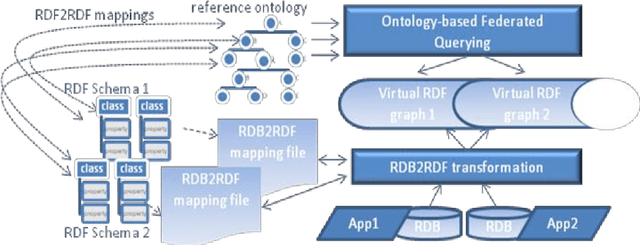
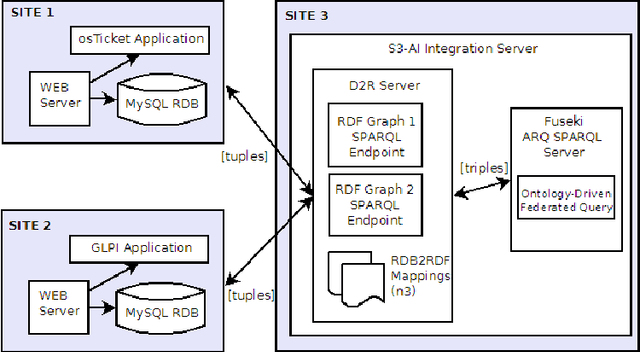
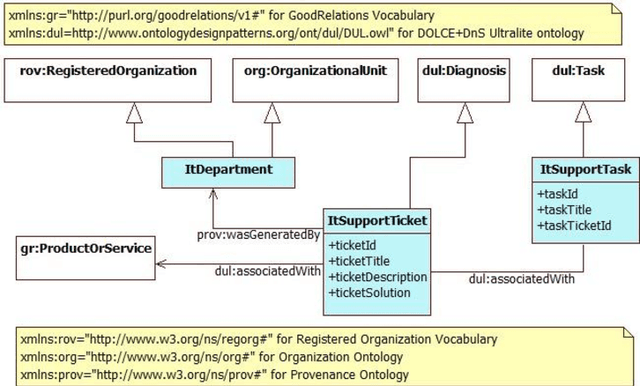
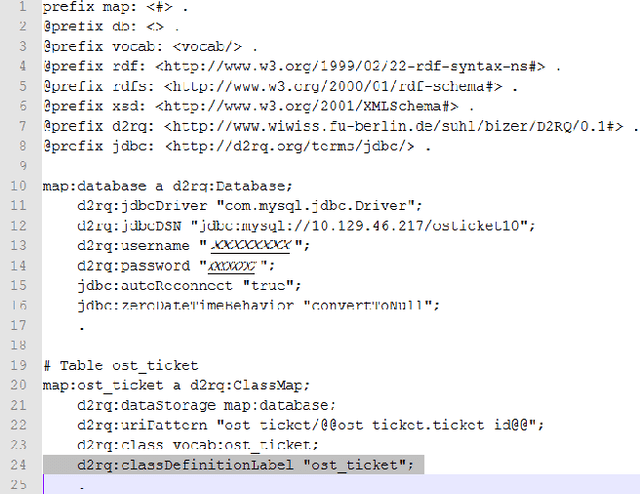
In many cases, government data is still "locked" in several "data silos", even within the boundaries of a single (inter-)national public organization with disparate and distributed organizational units and departments spread across multiple sites. Opening data and enabling its unified querying from a single site in an efficient and effective way is a semantic application integration and open government data challenge. This paper describes how NARA is using Semantic Web technology to implement an application integration approach within the boundaries of its organization via opening and querying multiple governmental data sources from a single site. The generic approach proposed, namely S3-AI, provides support to answering unified, ontology-mediated, federated queries to data produced and exploited by disparate applications, while these are being located in different organizational sites. S3-AI preserves ownership, autonomy and independency of applications and data. The paper extensively demonstrates S3-AI, using the D2RQ and Fuseki technologies, for addressing the needs of a governmental "IT helpdesk support" case.