 Add to Chrome
 Add to Firefox
 Add to Edge
Generalization Error Bounds for Picard-Type Operator Learning in Nonlinear Parabolic PDEs
May 11, 2026
Operator learning for partial differential equations (PDEs) aims to learn solution operators on infinite-dimensional function spaces from finite-resolution data. In this setting, it is important for the learned model to be discretization-invariant, or resolution-robust, and to reflect PDE-specific structure. It is therefore natural to ask how such structure should be encoded in the model architecture, hypothesis class, or learning procedure. In this paper, we study operator learning for solution operators of nonlinear parabolic PDEs based on Duhamel--Picard iteration. We formulate Picard iteration as an abstract state-transition model and present a theoretical framework for Picard-type operator learning. We derive implementation-agnostic generalization error bounds that separate the implementation error from the estimation error associated with the abstract state-transition model induced by Picard iteration. A key consequence is that increasing the Picard depth reduces the Picard truncation error without causing an unbounded growth of the entropy-based estimation error. We also extend the analysis to long-time prediction by rolling out the same learned local model over successive time blocks. Finally, we illustrate the theory for nonlinear heat equations on the torus using a Picard-type Fourier neural operator as a concrete implementation.

Quantitative Approximation for Neural Operators in Nonlinear Parabolic Equations
Oct 03, 2024Neural operators serve as universal approximators for general continuous operators. In this paper, we derive the approximation rate of solution operators for the nonlinear parabolic partial differential equations (PDEs), contributing to the quantitative approximation theorem for solution operators of nonlinear PDEs. Our results show that neural operators can efficiently approximate these solution operators without the exponential growth in model complexity, thus strengthening the theoretical foundation of neural operators. A key insight in our proof is to transfer PDEs into the corresponding integral equations via Duahamel's principle, and to leverage the similarity between neural operators and Picard's iteration, a classical algorithm for solving PDEs. This approach is potentially generalizable beyond parabolic PDEs to a range of other equations, including the Navier-Stokes equation, nonlinear Schr\"odinger equations and nonlinear wave equations, which can be solved by Picard's iteration.
Variational Inference with Gaussian Mixture by Entropy Approximation
Feb 26, 2022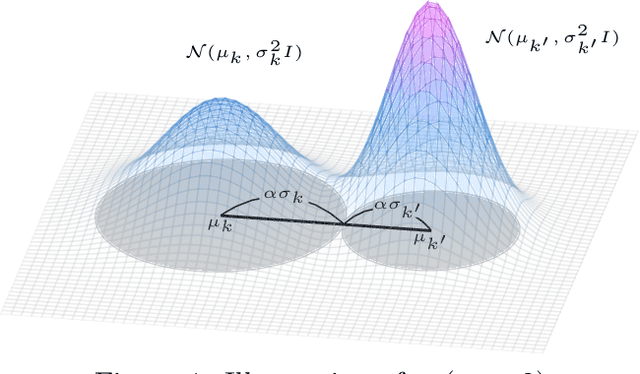
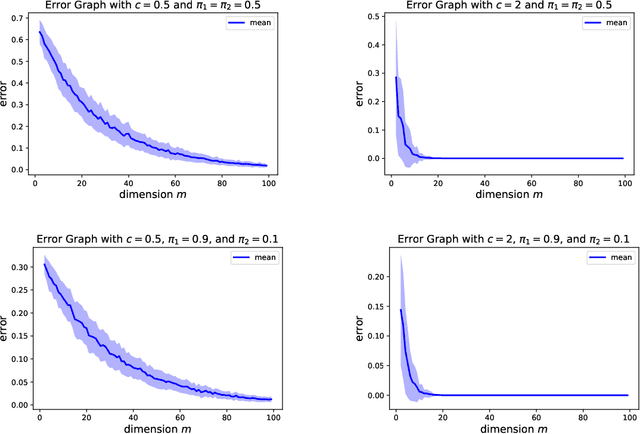
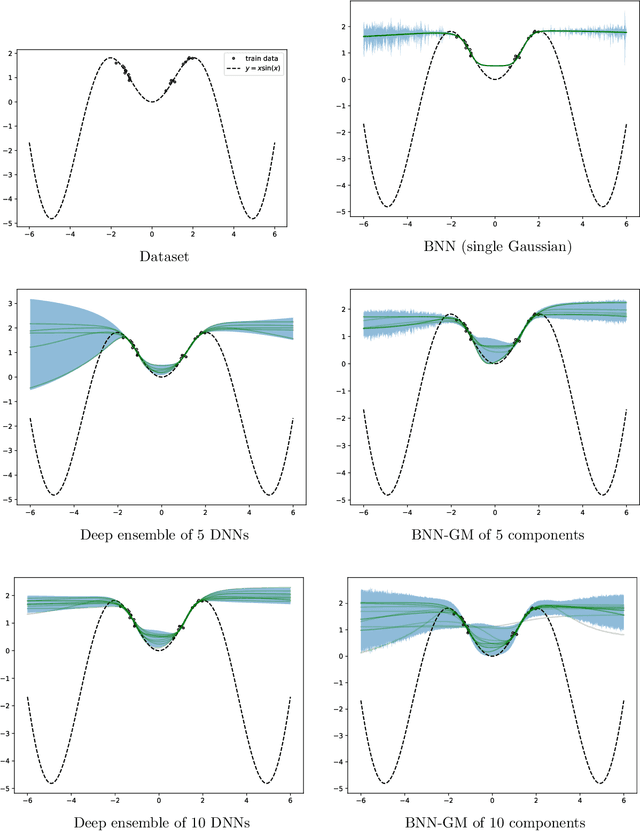
Variational inference is a technique for approximating intractable posterior distributions in order to quantify the uncertainty of machine learning. Although the unimodal Gaussian distribution is usually chosen as a parametric distribution, it hardly approximates the multimodality. In this paper, we employ the Gaussian mixture distribution as a parametric distribution. A main difficulty of variational inference with the Gaussian mixture is how to approximate the entropy of the Gaussian mixture. We approximate the entropy of the Gaussian mixture as the sum of the entropy of the unimodal Gaussian, which can be analytically calculated. In addition, we theoretically analyze the approximation error between the true entropy and approximated one in order to reveal when our approximation works well. Specifically, the approximation error is controlled by the ratios of the distances between the means to the sum of the variances of the Gaussian mixture, and it converges to zero when the ratios go to infinity. This situation seems to be more likely to occur in higher dimensional weight spaces because of the curse of dimensionality. Therefore, our result guarantees that our approximation works well, for example, in neural networks that assume a large number of weights.
Spectral Pruning for Recurrent Neural Networks
May 23, 2021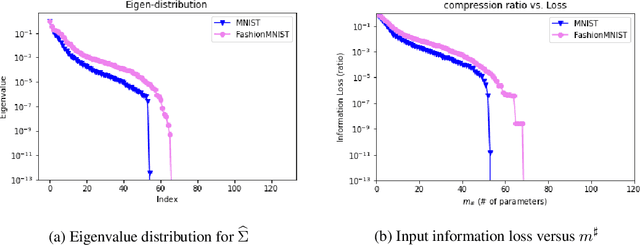
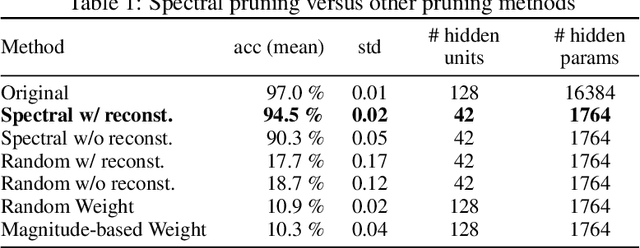
Pruning techniques for neural networks with a recurrent architecture, such as the recurrent neural network (RNN), are strongly desired for their application to edge-computing devices. However, the recurrent architecture is generally not robust to pruning because even small pruning causes accumulation error and the total error increases significantly over time. In this paper, we propose an appropriate pruning algorithm for RNNs inspired by "spectral pruning", and provide the generalization error bounds for compressed RNNs. We also provide numerical experiments to demonstrate our theoretical results and show the effectiveness of our pruning method compared with existing methods.