 Add to Chrome
 Add to Firefox
 Add to Edge
Learning to Throw Objects Safely in Multi-Obstacle Environments
Jul 07, 2026
Robotic throwing enables fast and efficient object placement beyond the robot's immediate workspace, but reliable throwing in cluttered environments remains underexplored. Existing approaches, such as TossingBot, learn throwing strategies from visual input but assume obstacle-free settings. In this paper, we address the problem of throwing objects into a target basket while avoiding obstacles placed randomly in the scene. We introduce a potential field state representation that compactly encodes both basket attraction and obstacle repulsion on a fixed-size grid, enabling reinforcement learning (RL) policies to generalize across arbitrary numbers and configurations of obstacles. The policy is initialized from kinesthetic demonstrations and optimized in simulation using three state-of-the-art RL algorithms (SAC, DDPG, TD3). Among these, SAC achieves the most consistent performance across scenarios. We compare the potential field representation against explicit state encodings and demonstrate that it achieves higher success rates and better scalability to unseen obstacle configurations. Real-robot experiments with unseen throwable objects confirm robust sim-to-real transfer, achieving up to $90\%$ success in cluttered scenes. These results demonstrate that PFR provides a practical and robust representation for safe and efficient robotic throwing in unstructured environments. A video showcasing our experiments is available at: https://youtu.be/ZZnJf8ua2dE

The State of Service Robots: Current Bottlenecks in Object Perception and Manipulation
Mar 18, 2020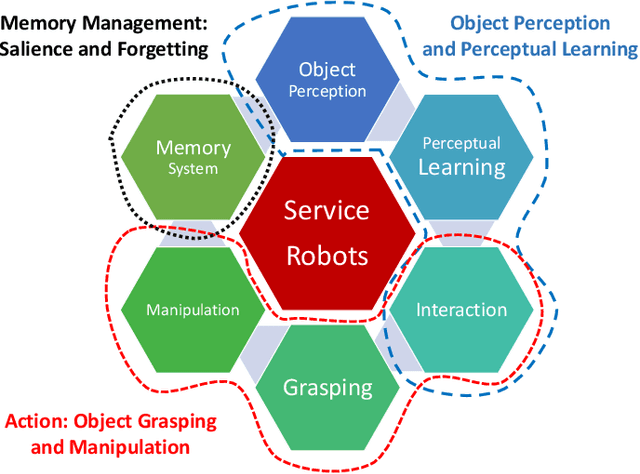
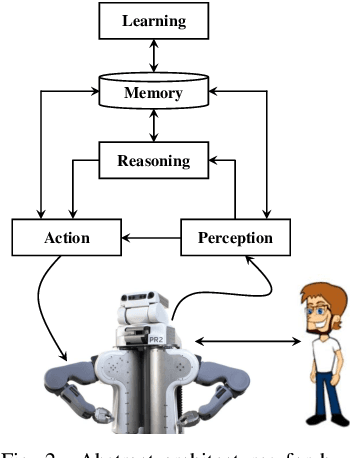
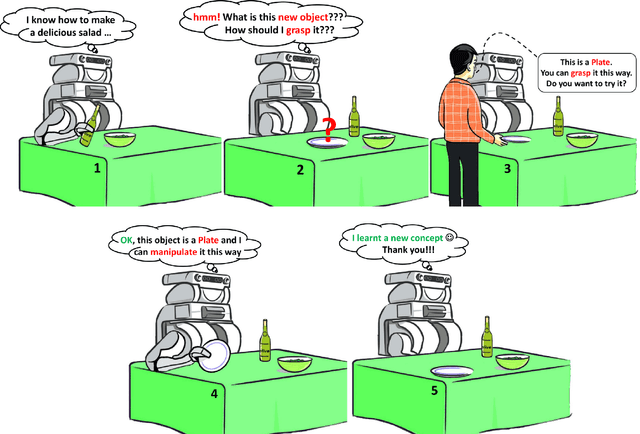
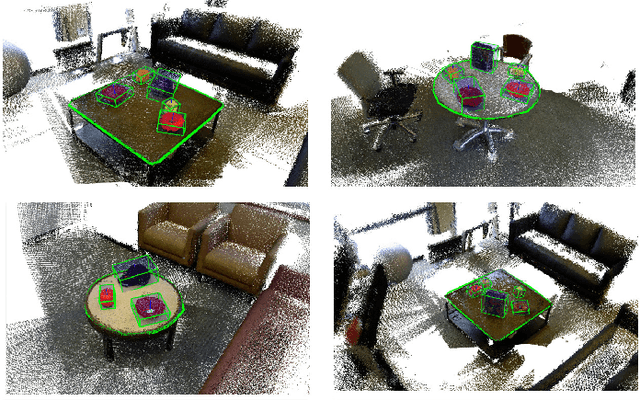
Service robots are appearing more and more in our daily life. The development of service robots combines multiple fields of research, from object perception to object manipulation. The state-of-the-art continues to improve to make a proper coupling between object perception and manipulation. This coupling is necessary for service robots not only to perform various tasks in a reasonable amount of time but also to adapt to new environments through time and interact with non-expert human users safely. Nowadays, robots are able to recognize various objects, and quickly plan a collision-free trajectory to grasp a target object. While there are many successes, the robot should be painstakingly coded in advance to perform a set of predefined tasks. Besides, in most of the cases, there is a reliance on large amounts of training data. Therefore, the knowledge of such robots is fixed after the training phase, and any changes in the environment require complicated, time-consuming, and expensive robot re-programming by human experts. Therefore, these approaches are still too rigid for real-life applications in unstructured environments, where a significant portion of the environment is unknown and cannot be directly sensed or controlled. In this paper, we review advances in service robots from object perception to complex object manipulation and shed a light on the current challenges and bottlenecks.