 Add to Chrome
 Add to Firefox
 Add to Edge
Enhancing Network Slicing Architectures with Machine Learning, Security, Sustainability and Experimental Networks Integration
Jul 18, 2023
Network Slicing (NS) is an essential technique extensively used in 5G networks computing strategies, mobile edge computing, mobile cloud computing, and verticals like the Internet of Vehicles and industrial IoT, among others. NS is foreseen as one of the leading enablers for 6G futuristic and highly demanding applications since it allows the optimization and customization of scarce and disputed resources among dynamic, demanding clients with highly distinct application requirements. Various standardization organizations, like 3GPP's proposal for new generation networks and state-of-the-art 5G/6G research projects, are proposing new NS architectures. However, new NS architectures have to deal with an extensive range of requirements that inherently result in having NS architecture proposals typically fulfilling the needs of specific sets of domains with commonalities. The Slicing Future Internet Infrastructures (SFI2) architecture proposal explores the gap resulting from the diversity of NS architectures target domains by proposing a new NS reference architecture with a defined focus on integrating experimental networks and enhancing the NS architecture with Machine Learning (ML) native optimizations, energy-efficient slicing, and slicing-tailored security functionalities. The SFI2 architectural main contribution includes the utilization of the slice-as-a-service paradigm for end-to-end orchestration of resources across multi-domains and multi-technology experimental networks. In addition, the SFI2 reference architecture instantiations will enhance the multi-domain and multi-technology integrated experimental network deployment with native ML optimization, energy-efficient aware slicing, and slicing-tailored security functionalities for the practical domain.
* 10 pages, 11 figures

Optimal Resource Allocation with Delay Guarantees for Network Slicing in Disaggregated RAN
Jun 05, 2023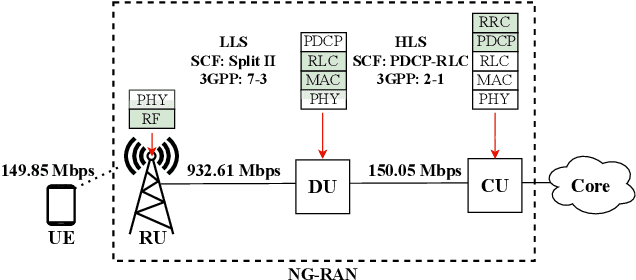
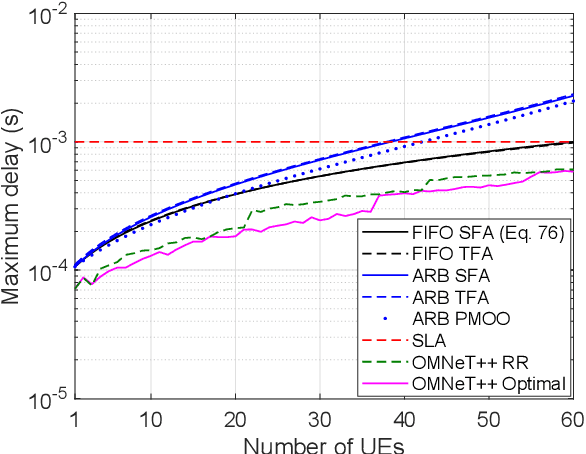
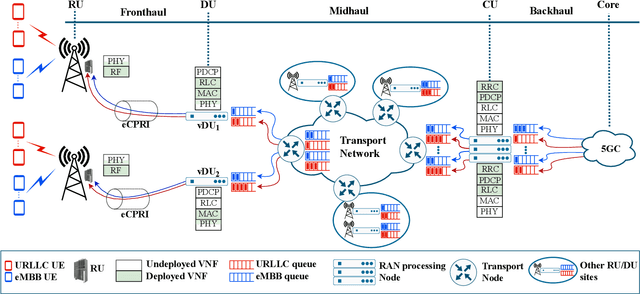
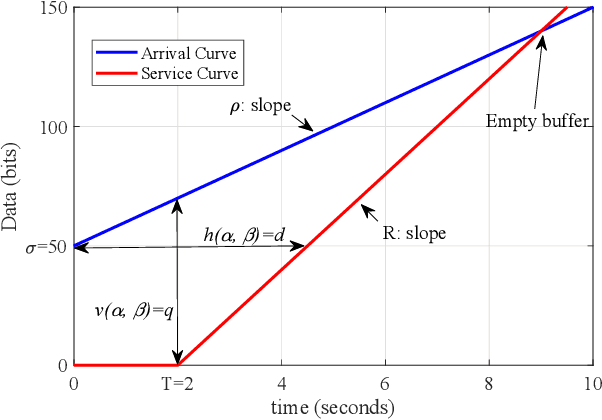
In this article, we propose a novel formulation for the resource allocation problem of a sliced and disaggregated Radio Access Network (RAN) and its transport network. Our proposal assures an end-to-end delay bound for the Ultra-Reliable and Low-Latency Communication (URLLC) use case while jointly considering the number of admitted users, the transmission rate allocation per slice, the functional split of RAN nodes and the routing paths in the transport network. We use deterministic network calculus theory to calculate delay along the transport network connecting disaggregated RANs deploying network functions at the Radio Unit (RU), Distributed Unit (DU), and Central Unit (CU) nodes. The maximum end-to-end delay is a constraint in the optimization-based formulation that aims to maximize Mobile Network Operator (MNO) profit, considering a cash flow analysis to model revenue and operational costs using data from one of the world's leading MNOs. The optimization model leverages a Flexible Functional Split (FFS) approach to provide a new degree of freedom to the resource allocation strategy. Simulation results reveal that, due to its non-linear nature, there is no trivial solution to the proposed optimization problem formulation. Our proposal guarantees a maximum delay for URLLC services while satisfying minimal bandwidth requirements for enhanced Mobile BroadBand (eMBB) services and maximizing the MNO's profit.