 Add to Chrome
 Add to Firefox
 Add to Edge
The Limits of Binding in Dual Encoders
Aug 16, 2026
Dual-encoder models such as CLIP score an image-caption pair by a single inner product of two independently computed unit vectors, and fail at binding, often scoring near chance when asked to distinguish "a red car and a blue dog" from "a blue car and a red dog". We give a mathematical account of when this failure is necessary and when it is contingent. Working within the ideal-encoder framework proposed by Kang et al., we first show the relevant axioms are satisfiable, so every impossibility must enter through an added, checkable hypothesis. We then prove three such obstructions. Depth: for recursive role-binding codes the swap margin obeys an exact law $m(D) = 2b^{-D}$ in the nesting depth D, with a finite-dimension version holding up to one explicitly flagged concentration estimate; the resolvable depth grows only logarithmically in the dimension and is single-digit at CLIP scale, the nesting depth of ordinary language. Objective: architecture-free throttle theorems showing that the contrastive objective's entire reward for binding is bounded by the rate at which training contrasts a caption against its own swap, a rate that vanishes at web scale, and that exactly reversed binding costs only that rate times the mean binding margin; both are verified in simulation. Geometry: a tight smoothness-binding frontier: the closer the two swap-related captions must embed to a shared paraphrase anchor, the smaller the binding margin can be, with an exact constant. Measuring its text-only diagnostic across 18 deployed text encoders, every model sits at roughly 25-35% of its ceiling, and the induced per-item ceiling tracks SugarCrepe's subset difficulty at r = 0.99. Binding failure in deployed dual encoders is thus not a dimension or smoothness limit today, but an incentive and code-structure limit, with a proved depth ceiling that remains once those are fixed.

Quantum-Like Contextuality in Large Language Models
Dec 21, 2024Contextuality is a distinguishing feature of quantum mechanics and there is growing evidence that it is a necessary condition for quantum advantage. In order to make use of it, researchers have been asking whether similar phenomena arise in other domains. The answer has been yes, e.g. in behavioural sciences. However, one has to move to frameworks that take some degree of signalling into account. Two such frameworks exist: (1) a signalling-corrected sheaf theoretic model, and (2) the Contextuality-by-Default (CbD) framework. This paper provides the first large scale experimental evidence for a yes answer in natural language. We construct a linguistic schema modelled over a contextual quantum scenario, instantiate it in the Simple English Wikipedia and extract probability distributions for the instances using the large language model BERT. This led to the discovery of 77,118 sheaf-contextual and 36,938,948 CbD contextual instances. We proved that the contextual instances came from semantically similar words, by deriving an equation between degrees of contextuality and Euclidean distances of BERT's embedding vectors. A regression model further reveals that Euclidean distance is indeed the best statistical predictor of contextuality. Our linguistic schema is a variant of the co-reference resolution challenge. These results are an indication that quantum methods may be advantageous in language tasks.
Developments in Sheaf-Theoretic Models of Natural Language Ambiguities
Feb 07, 2024Sheaves are mathematical objects consisting of a base which constitutes a topological space and the data associated with each open set thereof, e.g. continuous functions defined on the open sets. Sheaves have originally been used in algebraic topology and logic. Recently, they have also modelled events such as physical experiments and natural language disambiguation processes. We extend the latter models from lexical ambiguities to discourse ambiguities arising from anaphora. To begin, we calculated a new measure of contextuality for a dataset of basic anaphoric discourses, resulting in a higher proportion of contextual models--82.9%--compared to previous work which only yielded 3.17% contextual models. Then, we show how an extension of the natural language processing challenge, known as the Winograd Schema, which involves anaphoric ambiguities can be modelled on the Bell-CHSH scenario with a contextual fraction of 0.096.
Generalised Winograd Schema and its Contextuality
Aug 31, 2023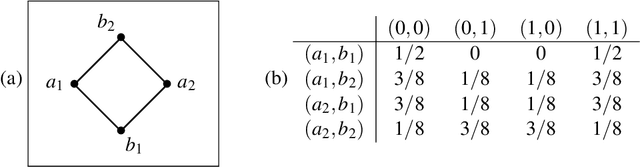

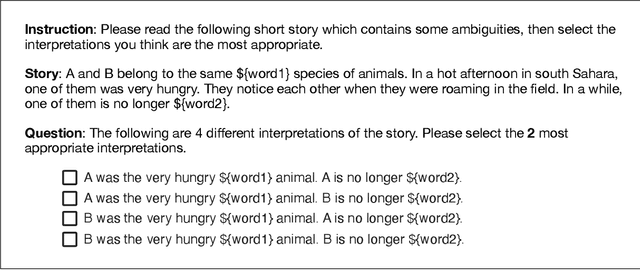
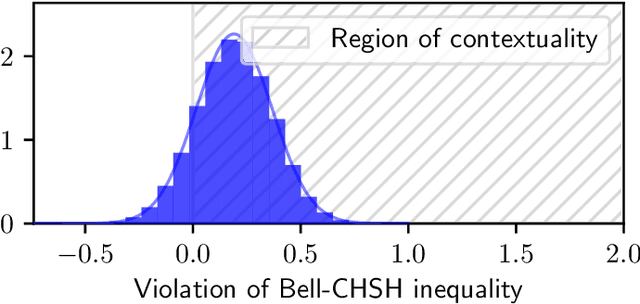
Ambiguities in natural language give rise to probability distributions over interpretations. The distributions are often over multiple ambiguous words at a time; a multiplicity which makes them a suitable topic for sheaf-theoretic models of quantum contextuality. Previous research showed that different quantitative measures of contextuality correlate well with Psycholinguistic research on lexical ambiguities. In this work, we focus on coreference ambiguities and investigate the Winograd Schema Challenge (WSC), a test proposed by Levesque in 2011 to evaluate the intelligence of machines. The WSC consists of a collection of multiple-choice questions that require disambiguating pronouns in sentences structured according to the Winograd schema, in a way that makes it difficult for machines to determine the correct referents but remains intuitive for human comprehension. In this study, we propose an approach that analogously models the Winograd schema as an experiment in quantum physics. However, we argue that the original Winograd Schema is inherently too simplistic to facilitate contextuality. We introduce a novel mechanism for generalising the schema, rendering it analogous to a Bell-CHSH measurement scenario. We report an instance of this generalised schema, complemented by the human judgements we gathered via a crowdsourcing platform. The resulting model violates the Bell-CHSH inequality by 0.192, thus exhibiting contextuality in a coreference resolution setting.
* In Proceedings QPL 2023, arXiv:2308.15489
A Model of Anaphoric Ambiguities using Sheaf Theoretic Quantum-like Contextuality and BERT
Aug 11, 2022
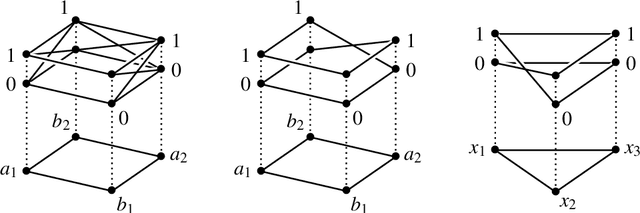

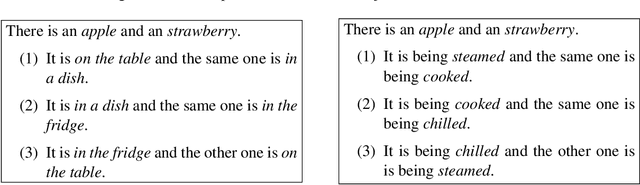
Ambiguities of natural language do not preclude us from using it and context helps in getting ideas across. They, nonetheless, pose a key challenge to the development of competent machines to understand natural language and use it as humans do. Contextuality is an unparalleled phenomenon in quantum mechanics, where different mathematical formalisms have been put forwards to understand and reason about it. In this paper, we construct a schema for anaphoric ambiguities that exhibits quantum-like contextuality. We use a recently developed criterion of sheaf-theoretic contextuality that is applicable to signalling models. We then take advantage of the neural word embedding engine BERT to instantiate the schema to natural language examples and extract probability distributions for the instances. As a result, plenty of sheaf-contextual examples were discovered in the natural language corpora BERT utilises. Our hope is that these examples will pave the way for future research and for finding ways to extend applications of quantum computing to natural language processing.
* In Proceedings E2ECOMPVEC, arXiv:2208.05313
A Quantum Natural Language Processing Approach to Pronoun Resolution
Aug 10, 2022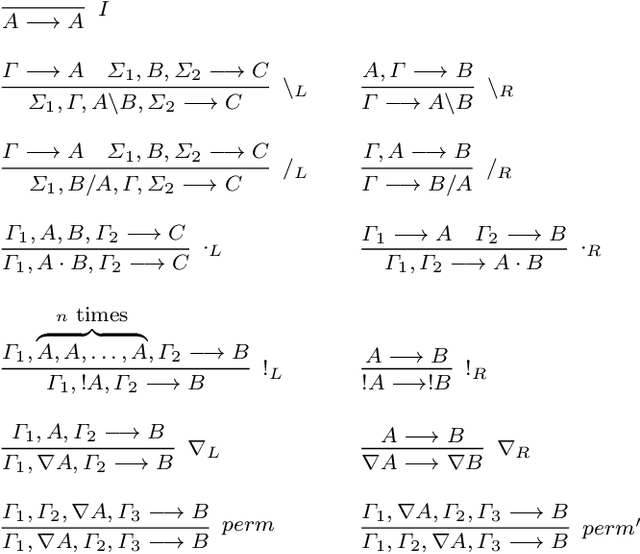
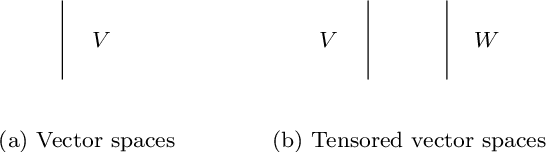
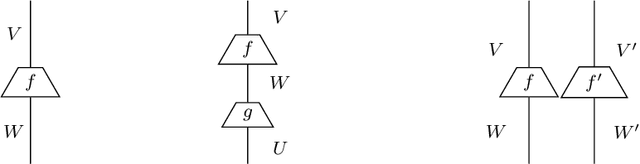
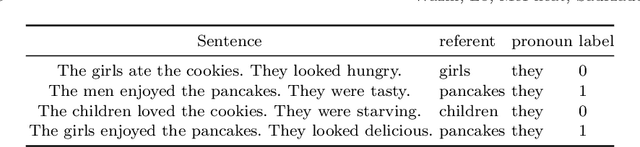
We use the Lambek Calculus with soft sub-exponential modalities to model and reason about discourse relations such as anaphora and ellipsis. A semantics for this logic is obtained by using truncated Fock spaces, developed in our previous work. We depict these semantic computations via a new string diagram. The Fock Space semantics has the advantage that its terms are learnable from large corpora of data using machine learning and they can be experimented with on mainstream natural language tasks. Further, and thanks to an existing translation from vector spaces to quantum circuits, we can also learn these terms on quantum computers and their simulators, such as the IBMQ range. We extend the existing translation to Fock spaces and develop quantum circuit semantics for discourse relations. We then experiment with the IBMQ AerSimulations of these circuits in a definite pronoun resolution task, where the highest accuracies were recorded for models when the anaphora was resolved.