 Add to Chrome
 Add to Firefox
 Add to Edge
AI-based Cognitive-linguistic Features for Dementia Assessment in Picture Description
Jun 16, 2026
Picture descriptions provide valuable insights into several clinical constructs related to cognitive-linguistic abilities. However, operationalizing these constructs into quantitative measures remains challenging, limiting interpretability and clinical utility. We introduced seven constructs tailored to the Cookie Theft picture description task and prompted large language models (LLMs) to evaluate them, generating severity scores and example-based explanations. Among the examined LLMs, Claude 3.5 Sonnet performed the best, producing severity scores that significantly distinguish cognitively impaired individuals from healthy controls. The model achieves a high accuracy of 85% on the ADReSS dataset. Expert evaluation of Claude's scores and explanations yields a 3.99/5 average agreement. The findings demonstrate the potential of LLMs to operationalize clinical constructs and generate interpretable evaluations, offering a promising approach for accessible cognitive screening tools.

Automated Extraction of Spatio-Semantic Graphs for Identifying Cognitive Impairment
Feb 02, 2025
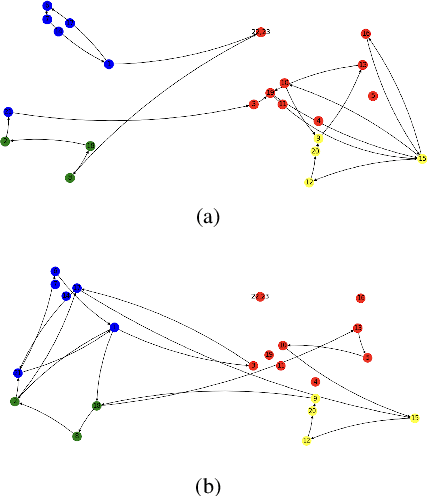
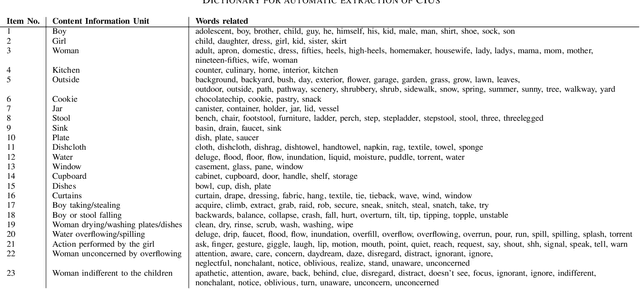
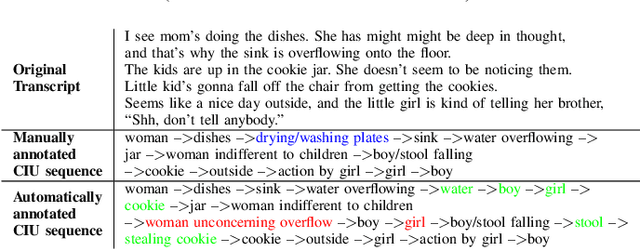
Existing methods for analyzing linguistic content from picture descriptions for assessment of cognitive-linguistic impairment often overlook the participant's visual narrative path, which typically requires eye tracking to assess. Spatio-semantic graphs are a useful tool for analyzing this narrative path from transcripts alone, however they are limited by the need for manual tagging of content information units (CIUs). In this paper, we propose an automated approach for estimation of spatio-semantic graphs (via automated extraction of CIUs) from the Cookie Theft picture commonly used in cognitive-linguistic analyses. The method enables the automatic characterization of the visual semantic path during picture description. Experiments demonstrate that the automatic spatio-semantic graphs effectively differentiate between cognitively impaired and unimpaired speakers. Statistical analyses reveal that the features derived by the automated method produce comparable results to the manual method, with even greater group differences between clinical groups of interest. These results highlight the potential of the automated approach for extracting spatio-semantic features in developing clinical speech models for cognitive impairment assessment.