 Add to Chrome
 Add to Firefox
 Add to Edge
Deep Learning Strain Estimation: Is Physics-Based Simulation the Solution?
May 27, 2026
Speckle tracking echocardiography (STE) is the clinical standard for myocardial strain estimation. Despite good performance on global strain (GLS), its accuracy for regional strain remains limited, even though this biomarker is highly relevant for early diagnosis and the characterization of subtle abnormalities. from clinical data. Deep learning is a promising alternative, but its development is constrained by the lack of reliable motion references. Existing solutions rely either on STE-derived labels or on simulations generated by physics-based models, but these synthetic sequences still have limited realism compared with clinical data.In this paper, we propose a novel simulation strategy that incorporates speckle decorrelation measures from real videos and uses an iterative refinement process to improve the motion realism in the simulations. We created an open-source photorealistic dataset of 1,478 videos with reference motion, which was used to train an echocardiographic motion estimation algorithm. The proposed method achieves unmatched performance on global and regional strain, notably reaching a GLS variability of 1.42% in an inter-expert setting compared to 1.78% for the clinical reference.

Generation of realistic cardiac ultrasound sequences with ground truth motion and speckle decorrelation
Sep 05, 2025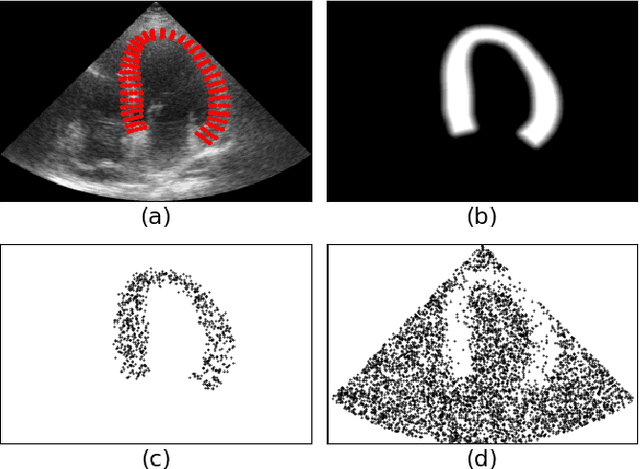
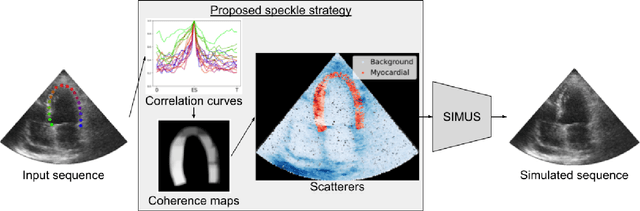
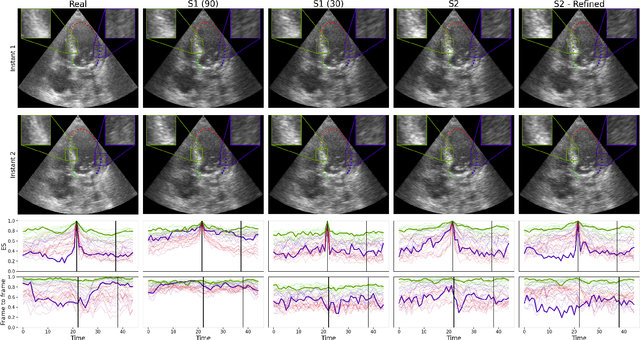
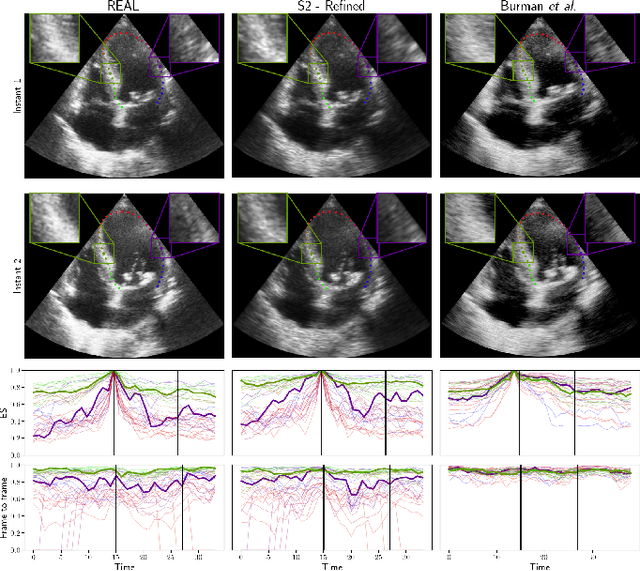
Simulated ultrasound image sequences are key for training and validating machine learning algorithms for left ventricular strain estimation. Several simulation pipelines have been proposed to generate sequences with corresponding ground truth motion, but they suffer from limited realism as they do not consider speckle decorrelation. In this work, we address this limitation by proposing an improved simulation framework that explicitly accounts for speckle decorrelation. Our method builds on an existing ultrasound simulation pipeline by incorporating a dynamic model of speckle variation. Starting from real ultrasound sequences and myocardial segmentations, we generate meshes that guide image formation. Instead of applying a fixed ratio of myocardial and background scatterers, we introduce a coherence map that adapts locally over time. This map is derived from correlation values measured directly from the real ultrasound data, ensuring that simulated sequences capture the characteristic temporal changes observed in practice. We evaluated the realism of our approach using ultrasound data from 98 patients in the CAMUS database. Performance was assessed by comparing correlation curves from real and simulated images. The proposed method achieved lower mean absolute error compared to the baseline pipeline, indicating that it more faithfully reproduces the decorrelation behavior seen in clinical data.