 Add to Chrome
 Add to Firefox
 Add to Edge
A Hybrid AI and Rule-Based Decision Support System for Disease Diagnosis and Management Using Labs
Mar 16, 2026
This research paper outlines the development and implementation of a novel Clinical Decision Support System (CDSS) that integrates AI predictive modeling with medical knowledge bases. It utilizes the quantifiable information elements in lab results for inferring likely diagnoses a patient might have. Subsequently, suggesting investigations to confirm the likely diagnoses -- an assistive tool for physicians. The system fuses knowledge contained in a rule-base expert system with inferences of data driven predictors based on the features in labs. The data for 593,055 patients was collected from 547 primary care centers across the US to model our decision support system and derive Real-Word Evidence (RWE) to make it relevant for a large demographic of patients. Our Rule-Base comprises clinically validated rules, modeling 59 health conditions that can directly confirm one or more of diseases and assign ICD-10 codes to them. The Likely Diagnosis system uses multi-class classification, covering 37 ICD-10 codes, which are grouped together into 11 categories based on the labs that physicians prescribe to confirm the diagnosis. This research offers a novel system that assists a physician by utilizing medical profile of a patient and routine lab investigations to predict a group of likely diseases and then confirm them, coupled with providing explanations for inferences, thereby assisting physicians to reduce misdiagnosis of patients in clinical decision-making.

Cooperation Is All You Need
May 16, 2023Going beyond 'dendritic democracy', we introduce a 'democracy of local processors', termed Cooperator. Here we compare their capabilities when used in permutation-invariant neural networks for reinforcement learning (RL), with machine learning algorithms based on Transformers, such as ChatGPT. Transformers are based on the long-standing conception of integrate-and-fire 'point' neurons, whereas Cooperator is inspired by recent neurobiological breakthroughs suggesting that the cellular foundations of mental life depend on context-sensitive pyramidal neurons in the neocortex which have two functionally distinct points. We show that when used for RL, an algorithm based on Cooperator learns far quicker than that based on Transformer, even while having the same number of parameters.
Unlocking the potential of two-point cells for energy-efficient training of deep nets
Oct 24, 2022Context-sensitive two-point layer 5 pyramidal cells (L5PC) were discovered as long ago as 1999. However, the potential of this discovery to provide useful neural computation has yet to be demonstrated. Here we show for the first time how a transformative L5PC-driven deep neural network (DNN), termed the multisensory cooperative computing (MCC) architecture, can effectively process large amounts of heterogeneous real-world audio-visual (AV) data, using far less energy compared to best available `point' neuron-driven DNNs. A novel highly-distributed parallel implementation on a Xilinx UltraScale+ MPSoC device estimates energy savings up to $245759 \times 50000$ $\mu$J (i.e., $62\%$ less than the baseline model in a semi-supervised learning setup) where a single synapse consumes $8e^{-5}\mu$J. In a supervised learning setup, the energy-saving can potentially reach up to 1250x less (per feedforward transmission) than the baseline model. This remarkable performance in pilot experiments demonstrates the embodied neuromorphic intelligence of our proposed L5PC based MCC architecture that contextually selects the most salient and relevant information for onward transmission, from overwhelmingly large multimodal information utilised at the early stages of on-chip training. Our proposed approach opens new cross-disciplinary avenues for future on-chip DNN training implementations and posits a radical shift in current neuromorphic computing paradigms.
Context-sensitive neocortical neurons transform the effectiveness and efficiency of neural information processing
Jul 15, 2022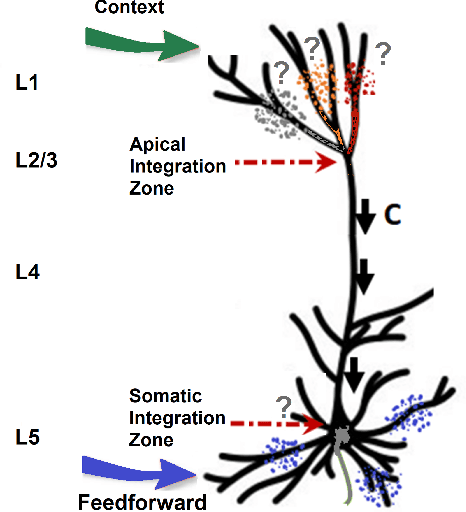
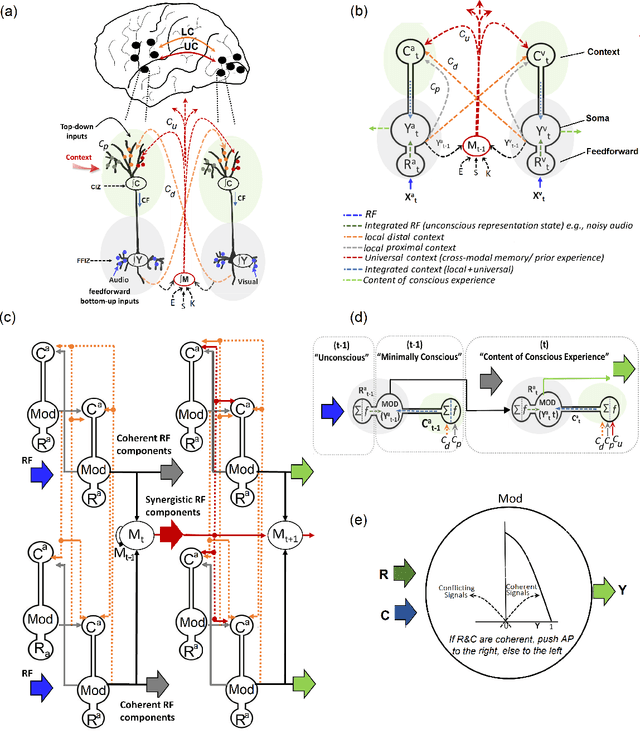
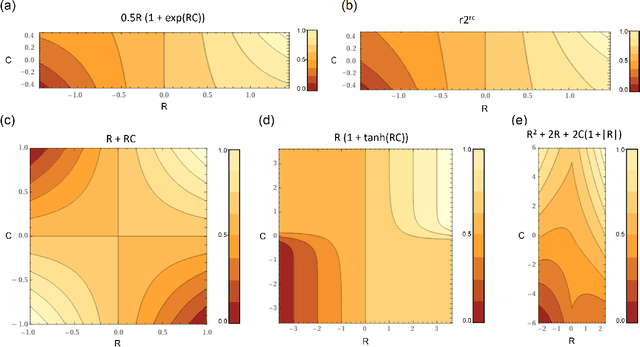
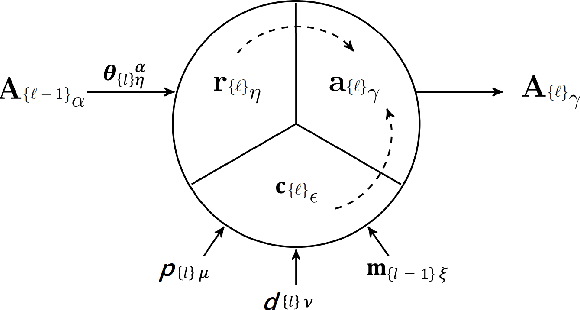
There is ample neurobiological evidence that context-sensitive neocortical neurons use their apical inputs as context to amplify the transmission of coherent feedforward (FF) inputs. However, it has not been demonstrated until now how this known mechanism can provide useful neural computation. Here we show for the first time that the processing and learning capabilities of this form of neural information processing are well-matched to the abilities of mammalian neocortex. Specifically, we show that a network composed of such local processors restricts the transmission of conflicting information to higher levels and greatly reduces the amount of activity required to process large amounts of heterogeneous real-world data e.g., when processing audiovisual speech, these local processors use seen lip movements to selectively amplify FF transmission of the auditory information that those movements generate and vice versa. As this mechanism is shown to be far more effective and efficient than the best available forms of deep neural nets, it offers a step-change in understanding the brain's mysterious energy-saving mechanism and inspires advances in designing enhanced forms of biologically plausible machine learning algorithms.