 Add to Chrome
 Add to Firefox
 Add to Edge
ST-DETrack: Identity-Preserving Branch Tracking in Entangled Plant Canopies via Dual Spatiotemporal Evidence
Dec 17, 2025
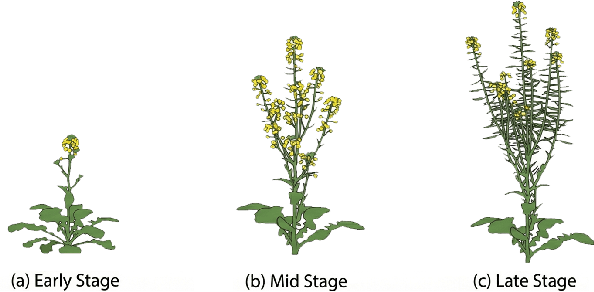
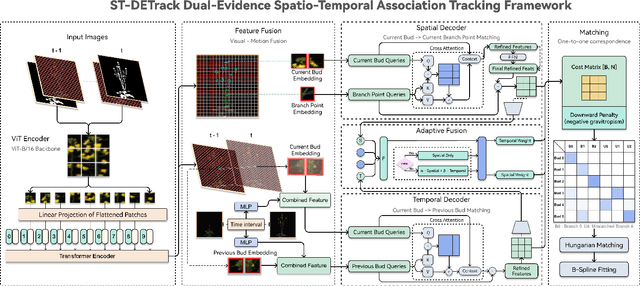
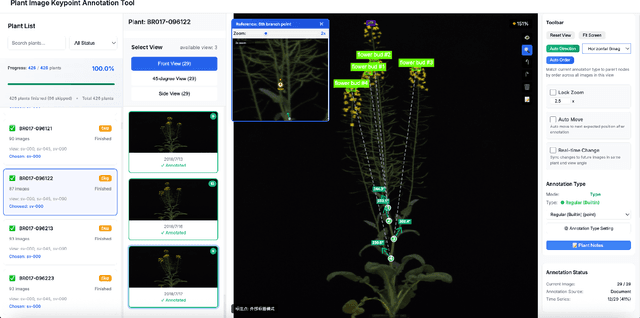
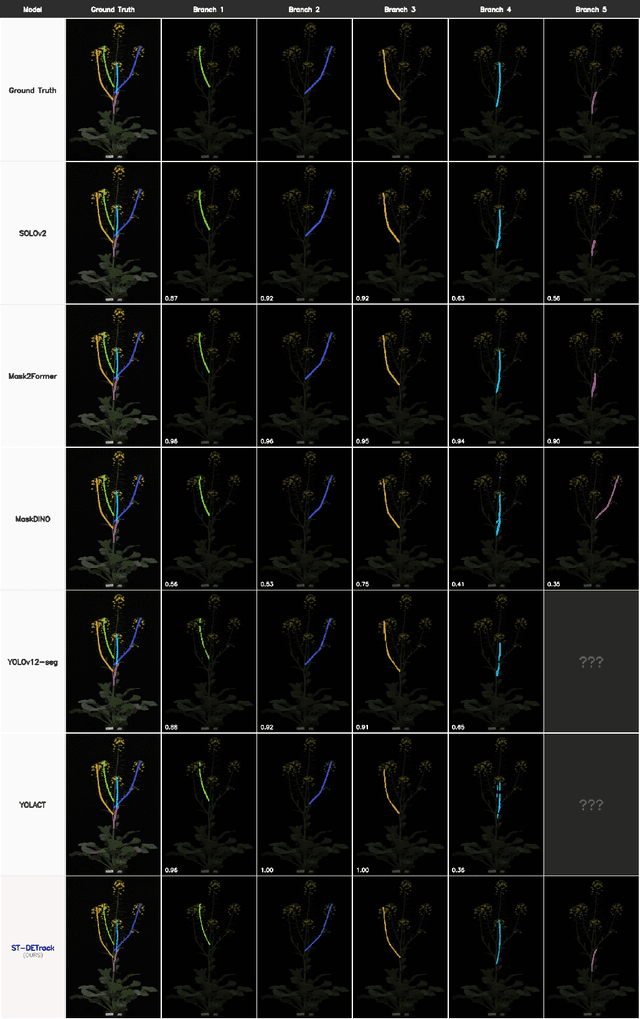
Automated extraction of individual plant branches from time-series imagery is essential for high-throughput phenotyping, yet it remains computationally challenging due to non-rigid growth dynamics and severe identity fragmentation within entangled canopies. To overcome these stage-dependent ambiguities, we propose ST-DETrack, a spatiotemporal-fusion dual-decoder network designed to preserve branch identity from budding to flowering. Our architecture integrates a spatial decoder, which leverages geometric priors such as position and angle for early-stage tracking, with a temporal decoder that exploits motion consistency to resolve late-stage occlusions. Crucially, an adaptive gating mechanism dynamically shifts reliance between these spatial and temporal cues, while a biological constraint based on negative gravitropism mitigates vertical growth ambiguities. Validated on a Brassica napus dataset, ST-DETrack achieves a Branch Matching Accuracy (BMA) of 93.6%, significantly outperforming spatial and temporal baselines by 28.9 and 3.3 percentage points, respectively. These results demonstrate the method's robustness in maintaining long-term identity consistency amidst complex, dynamic plant architectures.

Phase-space analysis of a two-section InP laser as an all-optical spiking neuron: dependency on control and design parameters
Apr 19, 2024Using a rate-equation model we numerically evaluate the carrier concentration and photon number in an integrated two-section semiconductor laser, and analyse its dynamics in three-dimensional phase space. The simulation comprises compact model descriptions extracted from a commercially-available generic InP technology platform, allowing us to model an applied reverse-bias voltage to the saturable absorber. We use the model to study the influence of the injected gain current, reverse-bias voltage, and cavity mirror reflectivity on the excitable operation state, which is the operation mode desired for the laser to act as an all-optical integrated neuron. We show in phase-space that our model is capable of demonstrating four different operation modes, i.e. cw, self-pulsating and an on-set and excitable mode under optical pulse injection. In addition, we show that lowering the reflectivity of one of the cavity mirrors greatly enhances the control parameter space for excitable operation, enabling more relaxed operation parameter control and lower power consumption of an integrated two-section laser neuron.
Chatbots As Fluent Polyglots: Revisiting Breakthrough Code Snippets
Jan 05, 2023The research applies AI-driven code assistants to analyze a selection of influential computer code that has shaped modern technology, including email, internet browsing, robotics, and malicious software. The original contribution of this study was to examine half of the most significant code advances in the last 50 years and, in some cases, to provide notable improvements in clarity or performance. The AI-driven code assistant could provide insights into obfuscated code or software lacking explanatory commentary in all cases examined. We generated additional sample problems based on bug corrections and code optimizations requiring much deeper reasoning than a traditional Google search might provide. Future work focuses on adding automated documentation and code commentary and translating select large code bases into more modern versions with multiple new application programming interfaces (APIs) and chained multi-tasks. The AI-driven code assistant offers a valuable tool for software engineering, particularly in its ability to provide human-level expertise and assist in refactoring legacy code or simplifying the explanation or functionality of high-value repositories.