 Add to Chrome
 Add to Firefox
 Add to Edge
SM-Net: Learning a Continuous Spectral Manifold from Multiple Stellar Libraries
Mar 25, 2026
We present SM-Net, a machine-learning model that learns a continuous spectral manifold from multiple high-resolution stellar libraries. SM-Net generates stellar spectra directly from the fundamental stellar parameters effective temperature (Teff), surface gravity (log g), and metallicity (log Z). It is trained on a combined grid derived from the PHOENIX-Husser, C3K-Conroy, OB-PoWR, and TMAP-Werner libraries. By combining their parameter spaces, we construct a composite dataset that spans a broader and more continuous region of stellar parameter space than any individual library. The unified grid covers Teff = 2,000-190,000 K, log g = -1 to 9, and log Z = -4 to 1, with spectra spanning 3,000-100,000 Angstrom. Within this domain, SM-Net provides smooth interpolation across heterogeneous library boundaries. Outside the sampled region, it can produce numerically smooth exploratory predictions, although these extrapolations are not directly validated against reference models. Zero or masked flux values are treated as unknowns rather than physical zeros, allowing the network to infer missing regions using correlations learned from neighbouring grid points. Across 3,538 training and 11,530 test spectra, SM-Net achieves mean squared errors of 1.47 x 10^-5 on the training set and 2.34 x 10^-5 on the test set in the transformed log1p-scaled flux representation. Inference throughput exceeds 14,000 spectra per second on a single GPU. We also release the model together with an interactive web dashboard for real-time spectral generation and visualisation. SM-Net provides a fast, robust, and flexible data-driven complement to traditional stellar population synthesis libraries.

Spatial Temporal Approach for High-Resolution Gridded Wind Forecasting across Southwest Western Australia
Jul 26, 2024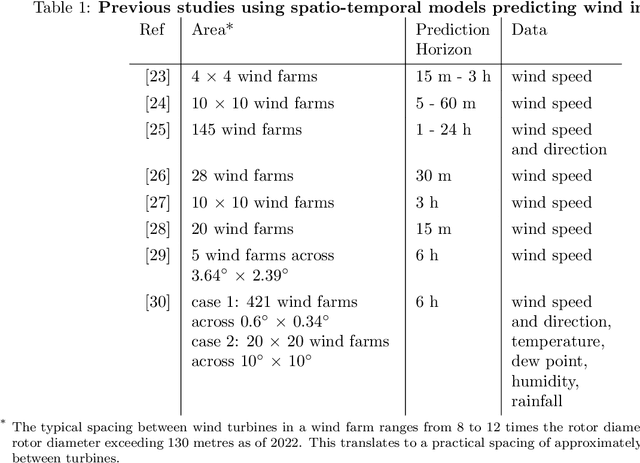
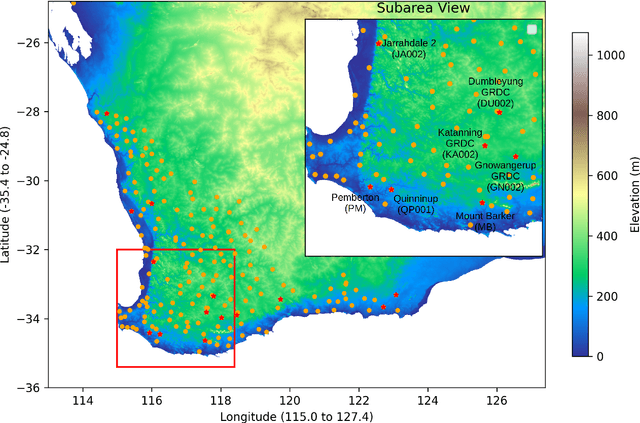
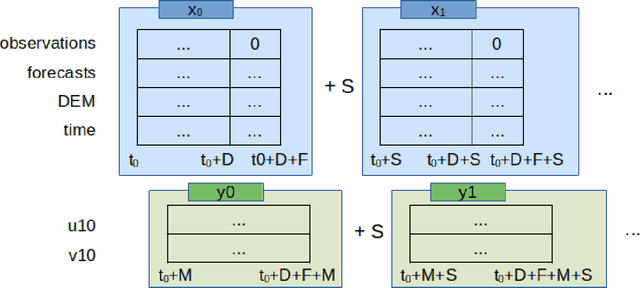

Accurate wind speed and direction forecasting is paramount across many sectors, spanning agriculture, renewable energy generation, and bushfire management. However, conventional forecasting models encounter significant challenges in precisely predicting wind conditions at high spatial resolutions for individual locations or small geographical areas (< 20 km2) and capturing medium to long-range temporal trends and comprehensive spatio-temporal patterns. This study focuses on a spatial temporal approach for high-resolution gridded wind forecasting at the height of 3 and 10 metres across large areas of the Southwest of Western Australia to overcome these challenges. The model utilises the data that covers a broad geographic area and harnesses a diverse array of meteorological factors, including terrain characteristics, air pressure, 10-metre wind forecasts from the European Centre for Medium-Range Weather Forecasts, and limited observation data from sparsely distributed weather stations (such as 3-metre wind profiles, humidity, and temperature), the model demonstrates promising advancements in wind forecasting accuracy and reliability across the entire region of interest. This paper shows the potential of our machine learning model for wind forecasts across various prediction horizons and spatial coverage. It can help facilitate more informed decision-making and enhance resilience across critical sectors.