 Add to Chrome
 Add to Firefox
 Add to Edge
Weighted Sum-of-Trees Model for Clustered Data
Feb 03, 2026
Clustered data, which arise when observations are nested within groups, are incredibly common in clinical, education, and social science research. Traditionally, a linear mixed model, which includes random effects to account for within-group correlation, would be used to model the observed data and make new predictions on unseen data. Some work has been done to extend the mixed model approach beyond linear regression into more complex and non-parametric models, such as decision trees and random forests. However, existing methods are limited to using the global fixed effects for prediction on data from out-of-sample groups, effectively assuming that all clusters share a common outcome model. We propose a lightweight sum-of-trees model in which we learn a decision tree for each sample group. We combine the predictions from these trees using weights so that out-of-sample group predictions are more closely aligned with the most similar groups in the training data. This strategy also allows for inference on the similarity across groups in the outcome prediction model, as the unique tree structures and variable importances for each group can be directly compared. We show our model outperforms traditional decision trees and random forests in a variety of simulation settings. Finally, we showcase our method on real-world data from the sarcoma cohort of The Cancer Genome Atlas, where patient samples are grouped by sarcoma subtype.

GRR-CoCa: Leveraging LLM Mechanisms in Multimodal Model Architectures
Jul 24, 2025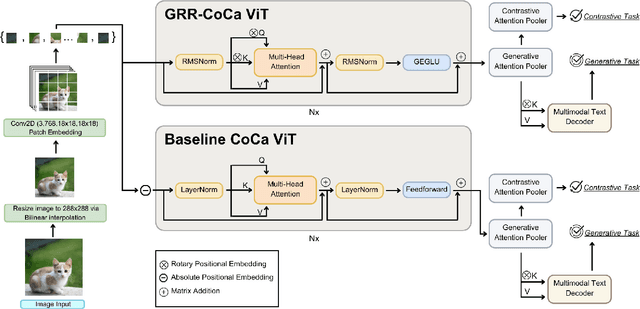
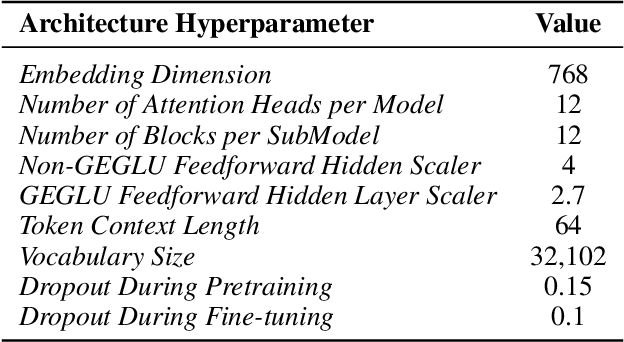
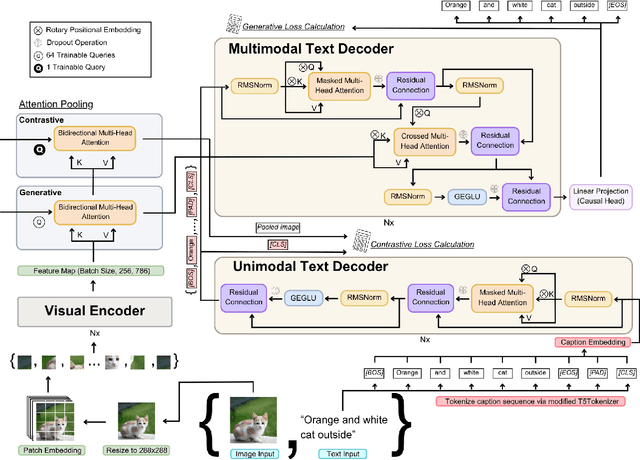
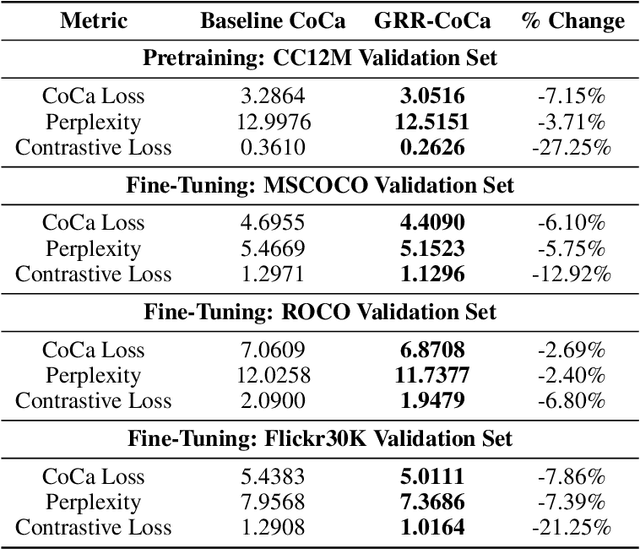
State-of-the-art (SOTA) image and text generation models are multimodal models that have many similarities to large language models (LLMs). Despite achieving strong performances, leading foundational multimodal model architectures frequently lag behind the architectural sophistication of contemporary LLMs. We propose GRR-CoCa, an improved SOTA Contrastive Captioner (CoCa) model that incorporates Gaussian error gated linear units, root mean squared normalization, and rotary positional embedding into the textual decoders and the vision transformer (ViT) encoder. Each architectural modification has been shown to improve model performance in LLMs, but has yet to be adopted in CoCa. We benchmarked GRR-CoCa against Baseline CoCa, a model with the same modified textual decoders but with CoCa's original ViT encoder. We used standard pretraining and fine-tuning workflows to benchmark the models on contrastive and generative tasks. Our GRR-CoCa significantly outperformed Baseline CoCa on the pretraining dataset and three diverse fine-tuning datasets. Pretraining improvements were 27.25% in contrastive loss, 3.71% in perplexity, and 7.15% in CoCa loss. The average fine-tuning improvements were 13.66% in contrastive loss, 5.18% in perplexity, and 5.55% in CoCa loss. We show that GRR-CoCa's modified architecture improves performance and generalization across vision-language domains.