 Add to Chrome
 Add to Firefox
 Add to Edge
CT-Merging: Consensus Directions and Task-Level Scaling for LoRA Adapter Merging
Jul 18, 2026
LoRA adapters provide an efficient way to specialize a pretrained model for many downstream tasks, but deploying one adapter per task requires adapter storage and task selection at inference time. Model merging addresses this issue by combining independently trained adapters into one multi-task adapter. Recent SVD-based LoRA merging methods mainly focus on constructing shared or task specific directions, while the coefficients assigned to the final directions are often directly from the original task SVD. On a fixed merged basis, inherited coefficients preserve component order with high rank correlation, yet their magnitudes differ substantially from the coefficients induced by the task updates. To address this mismatch, we propose CT-Merging, a LoRA-aware merging algorithm that estimates consensus directions from average task subspace projectors and assigns task-level RMS coefficient scales in the final update. CT-Merging uses repeated support across task SVD subspaces to construct the common basis, while reducing reliance on rank wise SVD magnitudes after direction construction. On the DC-Merge CLIP adapter benchmark, CT-Merging achieves superior average normalized accuracy compared to state-of-the-art merging methods and further improves over DC-Merge by 2.56 points on ViT-B/32 and 1.51 points on ViT-L/14 KnoTS-trained checkpoints.

SHEFL: Resource-Aware Aggregation and Sparsification in Heterogeneous Ensemble Federated Learning
Aug 12, 2025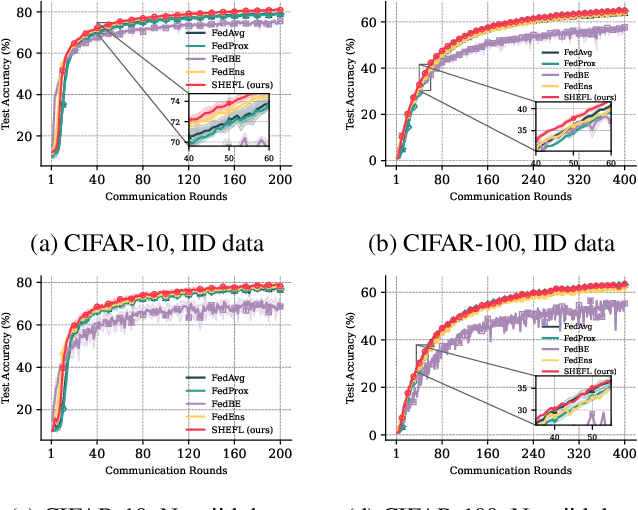
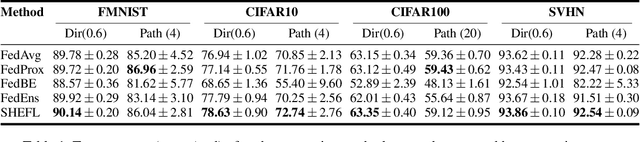
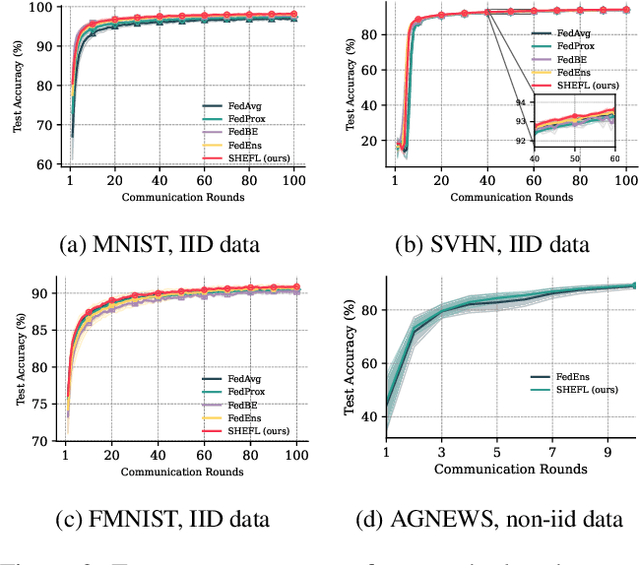
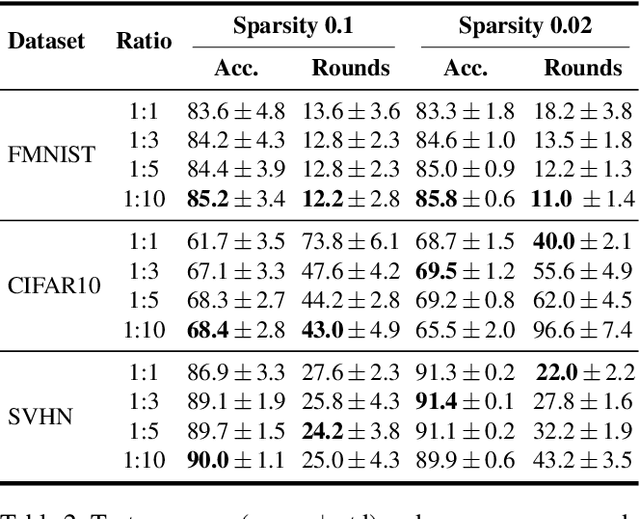
Federated learning enables distributed training with private data of clients, but its convergence is hindered by data and system heterogeneity in realistic communication scenarios. Most existing system heterogeneous FL schemes utilize global pruning or ensemble distillation, yet they often overlook typical constraints required for communication efficiency. Meanwhile, deep ensembles can aggregate predictions from individually trained models to improve performance, but current ensemble-based FL methods fall short in fully capturing the diversity of model predictions. In this work, we propose SHEFL, a global ensemble-based federated learning framework suited for clients with diverse computational capacities. We allocate different numbers of global models to clients based on their available resources. We further introduce a novel aggregation scheme that accounts for bias between clients with different computational capabilities. To reduce the computational burden of training deep ensembles and mitigate data bias, we dynamically adjust the resource ratio across clients - aggressively reducing the influence of underpowered clients in constrained scenarios, while increasing their weight in the opposite case. Extensive experiments demonstrate that our method effectively addresses computational heterogeneity, significantly improving both fairness and overall performance compared to existing approaches.