 Add to Chrome
 Add to Firefox
 Add to Edge
Spatially-Aware Mixture of Experts with Log-Logistic Survival Modeling for Whole-Slide Images
Nov 17, 2025
Accurate survival prediction from histopathology whole-slide images (WSIs) remains challenging due to their gigapixel resolution, strong spatial heterogeneity, and complex survival distributions. We introduce a comprehensive computational pathology framework that addresses these limitations through four complementary innovations: (1) Quantile-Gated Patch Selection for dynamically identifying prognostically relevant regions, (2) Graph-Guided Clustering to group patches by spatial and morphological similarity, (3) Hierarchical Context Attention to model both local tissue interactions and global slide-level context, and (4) an Expert-Driven Mixture of Log-Logistics module that flexibly models complex survival distributions. Across large TCGA cohorts, our method achieves state-of-the-art performance, yielding time-dependent concordance indices of 0.644 on LUAD, 0.751 on KIRC, and 0.752 on BRCA, consistently outperforming both histology-only and multimodal baselines. The framework further provides improved calibration and interpretability, advancing the use of WSIs for personalized cancer prognosis.

Survival Modeling from Whole Slide Images via Patch-Level Graph Clustering and Mixture Density Experts
Jul 22, 2025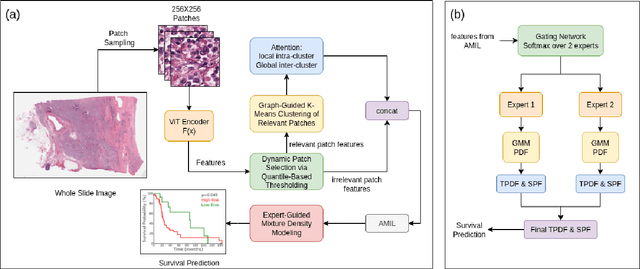
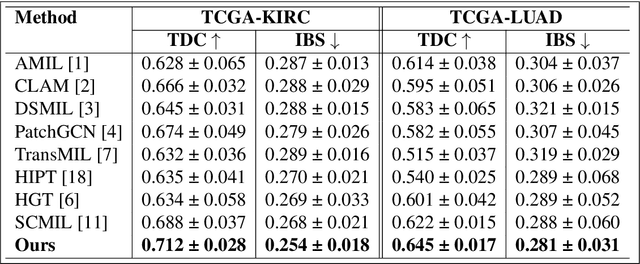
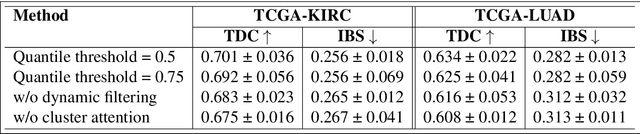
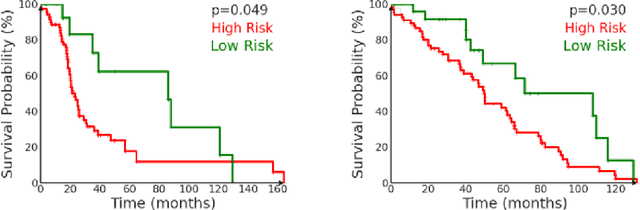
We introduce a modular framework for predicting cancer-specific survival from whole slide pathology images (WSIs) that significantly improves upon the state-of-the-art accuracy. Our method integrating four key components. Firstly, to tackle large size of WSIs, we use dynamic patch selection via quantile-based thresholding for isolating prognostically informative tissue regions. Secondly, we use graph-guided k-means clustering to capture phenotype-level heterogeneity through spatial and morphological coherence. Thirdly, we use attention mechanisms that model both intra- and inter-cluster relationships to contextualize local features within global spatial relations between various types of tissue compartments. Finally, we use an expert-guided mixture density modeling for estimating complex survival distributions using Gaussian mixture models. The proposed model achieves a concordance index of $0.712 \pm 0.028$ and Brier score of $0.254 \pm 0.018$ on TCGA-KIRC (renal cancer), and a concordance index of $0.645 \pm 0.017$ and Brier score of $0.281 \pm 0.031$ on TCGA-LUAD (lung adenocarcinoma). These results are significantly better than the state-of-art and demonstrate predictive potential of the proposed method across diverse cancer types.