 Add to Chrome
 Add to Firefox
 Add to Edge
Learning to Aggregate Zero-Shot LLM Agents for Corporate Disclosure Classification
Mar 21, 2026
This paper studies whether a lightweight trained aggregator can combine diverse zero-shot large language model judgments into a stronger downstream signal for corporate disclosure classification. Zero-shot LLMs can read disclosures without task-specific fine-tuning, but their predictions often vary across prompts, reasoning styles, and model families. I address this problem with a multi-agent framework in which three zero-shot agents independently read each disclosure and output a sentiment label, a confidence score, and a short rationale. A logistic meta-classifier then aggregates these signals to predict next-day stock return direction. I use a sample of 18,420 U.S. corporate disclosures issued by Nasdaq and S&P 500 firms between 2018 and 2024, matched to next-day stock returns. Results show that the trained aggregator outperforms all single agents, majority vote, confidence-weighted voting, and a FinBERT baseline. Balanced accuracy rises from 0.561 for the best single agent to 0.612 for the trained aggregator, with the largest gains in disclosures combining strong current performance with weak guidance or elevated risk. The results suggest that zero-shot LLM agents capture complementary financial signals and that supervised aggregation can turn cross-agent disagreement into a more useful classification target.

Sentiment trading with large language models
Dec 26, 2024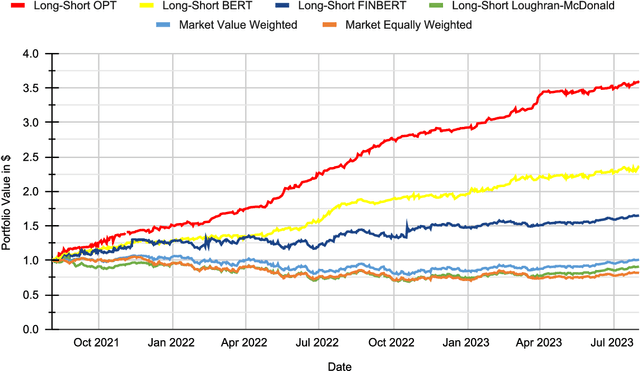

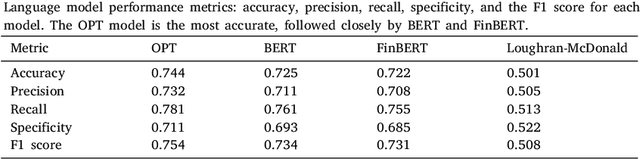
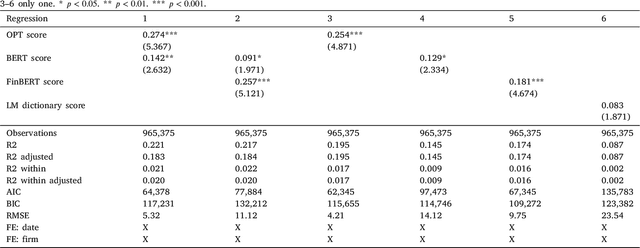
We investigate the efficacy of large language models (LLMs) in sentiment analysis of U.S. financial news and their potential in predicting stock market returns. We analyze a dataset comprising 965,375 news articles that span from January 1, 2010, to June 30, 2023; we focus on the performance of various LLMs, including BERT, OPT, FINBERT, and the traditional Loughran-McDonald dictionary model, which has been a dominant methodology in the finance literature. The study documents a significant association between LLM scores and subsequent daily stock returns. Specifically, OPT, which is a GPT-3 based LLM, shows the highest accuracy in sentiment prediction with an accuracy of 74.4%, slightly ahead of BERT (72.5%) and FINBERT (72.2%). In contrast, the Loughran-McDonald dictionary model demonstrates considerably lower effectiveness with only 50.1% accuracy. Regression analyses highlight a robust positive impact of OPT model scores on next-day stock returns, with coefficients of 0.274 and 0.254 in different model specifications. BERT and FINBERT also exhibit predictive relevance, though to a lesser extent. Notably, we do not observe a significant relationship between the Loughran-McDonald dictionary model scores and stock returns, challenging the efficacy of this traditional method in the current financial context. In portfolio performance, the long-short OPT strategy excels with a Sharpe ratio of 3.05, compared to 2.11 for BERT and 2.07 for FINBERT long-short strategies. Strategies based on the Loughran-McDonald dictionary yield the lowest Sharpe ratio of 1.23. Our findings emphasize the superior performance of advanced LLMs, especially OPT, in financial market prediction and portfolio management, marking a significant shift in the landscape of financial analysis tools with implications to financial regulation and policy analysis.