 Add to Chrome
 Add to Firefox
 Add to Edge
It's Complicated: On the Design and Evaluation of AI-Powered AAC Interfaces
Jun 23, 2026
Artificial intelligence (AI) can enhance what people who use augmentative and alternative communication (AAC) are able to do with their systems. However, evaluating AI-powered AAC interfaces can be difficult. People are intersectional beings and current evaluation metrics can struggle to capture the multifaceted and nuanced desires people may have for their AAC. We explore the complicated nature of six AAC problem spaces, explore how AI might be used in these spaces, and suggest more robust methods of evaluation that take the intersectional nuances of people into account. We also discuss broader issues that arise across these problem spaces and how they could be addressed using our proposed evaluation methods.

Adapting Large Language Models for Character-based Augmentative and Alternative Communication
Jan 17, 2025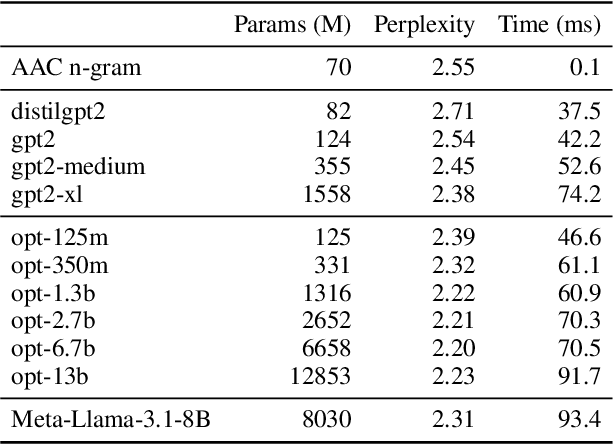
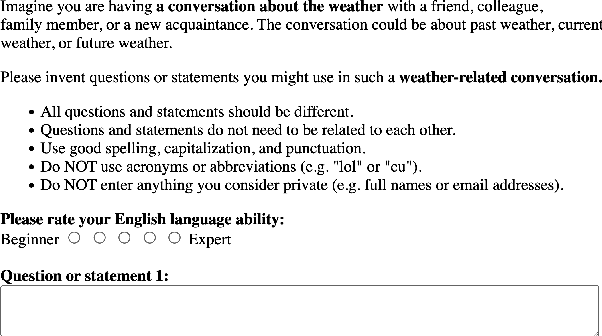
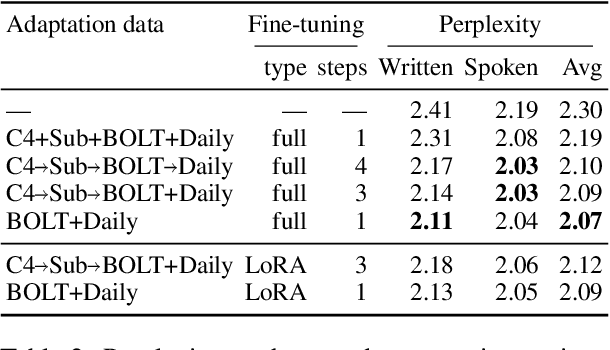
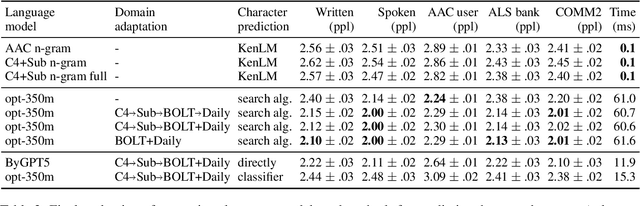
Users of Augmentative and Alternative Communication (AAC) may write letter-by-letter via an interface that uses a character language model. However, most state-of-the-art large pretrained language models predict subword tokens of variable length. We investigate how to practically use such models to make accurate and efficient character predictions. We fine-tune models using a large dataset of sentences we curated in which each sentence is rated according to how useful it might be for spoken or written AAC communication. We find that using an algorithm to produce character predictions from a subword large language model provides more accurate predictions than adding a classification layer or using a byte-level model. We also find that our domain adaptation curriculum is effective at improving model performance on simple, conversational text.
Using Confidence Scores to Improve Eyes-free Detection of Speech Recognition Errors
Oct 27, 2024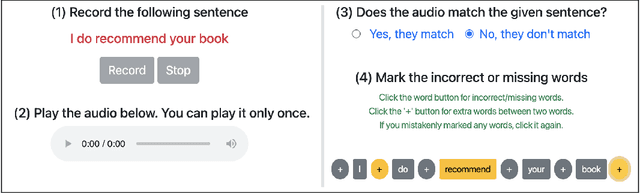
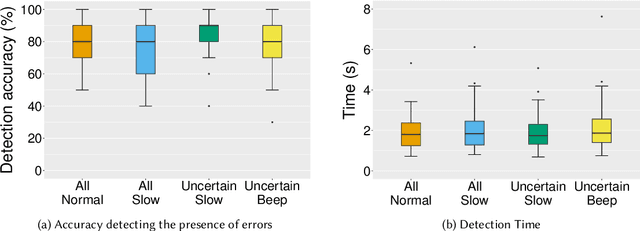
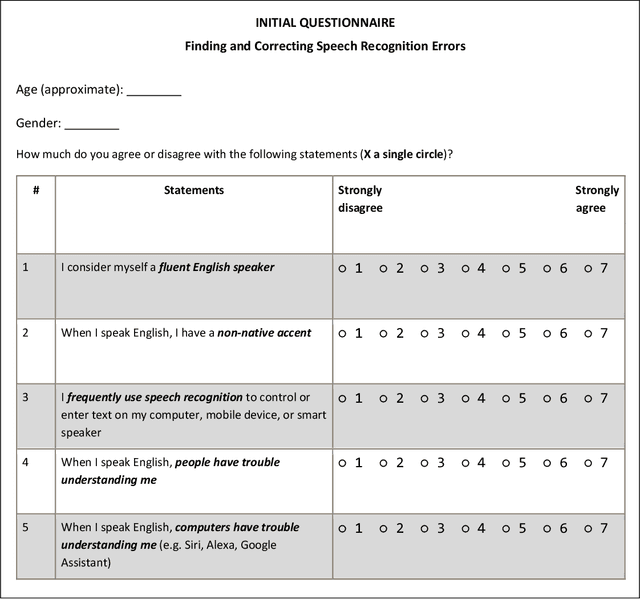
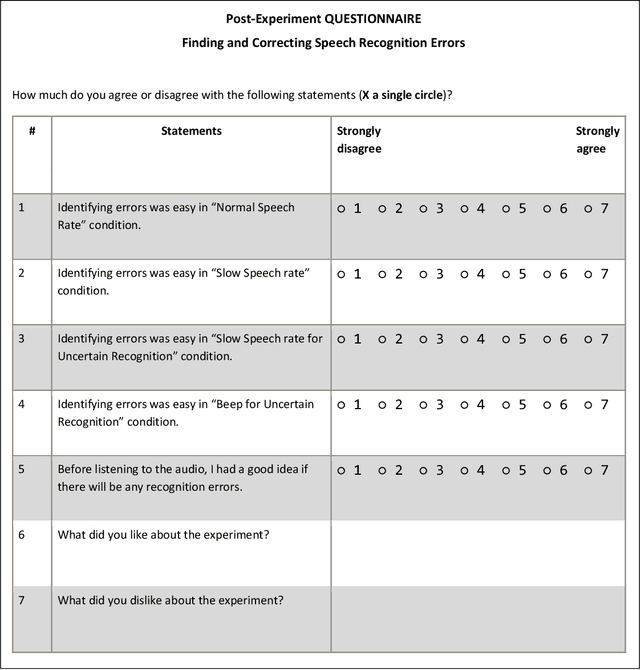
Conversational systems rely heavily on speech recognition to interpret and respond to user commands and queries. Nevertheless, recognition errors may occur, which can significantly affect the performance of such systems. While visual feedback can help detect errors, it may not always be practical, especially for people who are blind or low-vision. In this study, we investigate ways to improve error detection by manipulating the audio output of the transcribed text based on the recognizer's confidence level in its result. Our findings show that selectively slowing down the audio when the recognizer exhibited uncertainty led to a relative increase of 12% in participants' error detection ability compared to uniformly slowing down the audio.