 Add to Chrome
 Add to Firefox
 Add to Edge
S5-SHB Agent: Society 5.0 enabled Multi-model Agentic Blockchain Framework for Smart Home
Mar 05, 2026
The smart home is a key application domain within the Society 5.0 vision for a human-centered society. As smart home ecosystems expand with heterogeneous IoT protocols, diverse devices, and evolving threats, autonomous systems must manage comfort, security, energy, and safety for residents. Such autonomous decision-making requires a trust anchor, making blockchain a preferred foundation for transparent and accountable smart home governance. However, realizing this vision requires blockchain-governed smart homes to simultaneously address adaptive consensus, intelligent multi-agent coordination, and resident-controlled governance aligned with the principles of Society 5.0. Existing frameworks rely solely on rigid smart contracts with fixed consensus protocols, employ at most a single AI model without multi-agent coordination, and offer no governance mechanism for residents to control automation behaviour. To address these limitations, this paper presents the Society 5.0-driven human-centered governance-enabled smart home blockchain agent (S5-SHB-Agent). The framework orchestrates ten specialized agents using interchangeable large language models to make decisions across the safety, security, comfort, energy, privacy, and health domains. An adaptive PoW blockchain adjusts mining difficulty based on transaction volume and emergency conditions, with digital signatures and Merkle tree anchoring to ensure tamper evident auditability. A four-tier governance model enables residents to control automation through tiered preferences from routine adjustments to immutable safety thresholds. Evaluation confirms that resident governance correctly separates adjustable comfort priorities from immutable safety thresholds across all tested configurations, while adaptive consensus commits emergency blocks.

S5-HES Agent: Society 5.0-driven Agentic Framework to Democratize Smart Home Environment Simulation
Mar 02, 2026The smart home is a key domain within the Society 5.0 vision for a human-centered society. Smart home technologies rapidly evolve, and research should diversify while remaining aligned with Society 5.0 objectives. Democratizing smart home research would engage a broader community of innovators beyond traditional limited experts. This shift necessitates inclusive simulation frameworks that support research across diverse fields in industry and academia. However, existing smart home simulators require significant technical expertise, offer limited adaptability, and lack automated evolution, thereby failing to meet the holistic needs of Society 5.0. These constraints impede researchers from efficiently conducting simulations and experiments for security, energy, health, climate, and socio-economic research. To address these challenges, this paper presents the Society 5.0-driven Smart Home Environment Simulator Agent (S5-HES Agent), an agentic simulation framework that transforms traditional smart home simulation through autonomous AI orchestration. The framework coordinates specialized agents through interchangeable large language models (LLMs), enabling natural-language-driven end-to-end smart home simulation configuration without programming expertise. A retrieval-augmented generation (RAG) pipeline with semantic, keyword, and hybrid search retrieves smart home knowledge. Comprehensive evaluation on S5-HES Agent demonstrates that the RAG pipeline achieves near-optimal retrieval fidelity, simulated device behaviour and threat scenarios align with real-world IoT datasets, and simulation engine scales predictably across home configurations, establishing a stable foundation for Society 5.0 smart home research. Source code is available under the MIT License at https://github.com/AsiriweLab/S5-HES-Agent.
Enhanced Robot Motion Block of A-star Algorithm for Robotic Path Planning
Dec 25, 2023
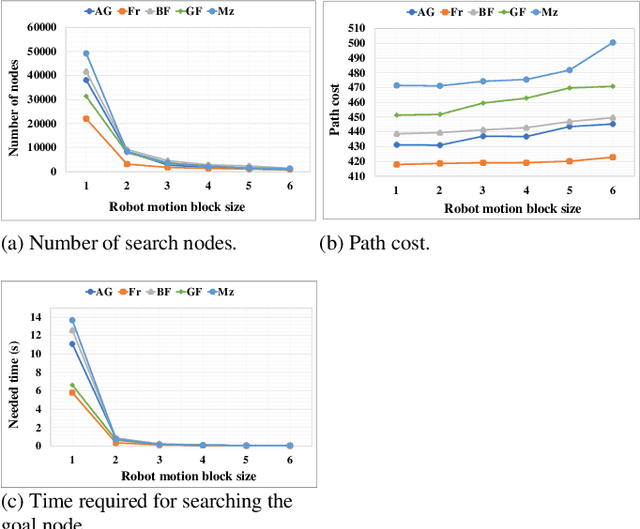


An efficient robot path-planning model is vulnerable to the number of search nodes, path cost, and time complexity. The conventional A-star (A*) algorithm outperforms other grid-based algorithms for its heuristic search. However it shows suboptimal performance for the time, space, and number of search nodes, depending on the robot motion block (RMB). To address this challenge, this study proposes an optimal RMB for the A* path-planning algorithm to enhance the performance, where the robot movement costs are calculated by the proposed adaptive cost function. Also, a selection process is proposed to select the optimal RMB size. In this proposed model, grid-based maps are used, where the robot's next move is determined based on the adaptive cost function by searching among surrounding octet neighborhood grid cells. The cumulative value from the output data arrays is used to determine the optimal motion block size, which is formulated based on parameters. The proposed RMB significantly affects the searching time complexity and number of search nodes of the A* algorithm while maintaining almost the same path cost to find the goal position by avoiding obstacles. For the experiment, a benchmarked online dataset is used and prepared three different dimensional maps. The proposed approach is validated using approximately 7000 different grid maps with various dimensions and obstacle environments. The proposed model with an optimal RMB demonstrated a remarkable improvement of 93.98% in the number of search cells and 98.94% in time complexity compared to the conventional A* algorithm. Path cost for the proposed model remained largely comparable to other state-of-the-art algorithms. Also, the proposed model outperforms other state-of-the-art algorithms.