 Add to Chrome
 Add to Firefox
 Add to Edge
Analysis of Memory-Runtime Trade-offs in Caching Strategies for Genetic Programming Symbolic Regression
Jul 31, 2026
Genetic Programming Symbolic Regression (GPSR) generates mathematical expressions to model input-output relationships using an evolutionary process. A significant challenge in GPSR lies in the repeated evaluation of entire expressions or their sub-expression, which inflates computational runtime. To address this inefficiency, caching mechanisms have been employed to reduce redundant computations. However, prior studies predominantly employ a single caching strategy, offering limited insights into their comparative performance or memory-runtime trade-offs. In this paper, we present a comprehensive analysis of caching mechanisms for GPSR on synthetic and real-world datasets. We also include an empirical study of key-value usage frequencies under an infinitely large cache, offering insights into optimal cache sizing. Furthermore, we provide actionable guidelines for configuring caching strategies based on computational and memory constraints. Our findings indicate that complex caching mechanisms necessitate a minimum cache size to achieve computational time reductions. Conversely, lightweight caching strategies, such as Least Recently Used (LRU) and, notably, First-In-First-Out (FIFO), can significantly decrease computation time for fitness evaluations, which are a substantial component of the overall runtime.
* 9 pages, 7 figures. Published in GECCO '25

Teaching the Teacher: Improving Neural Network Distillability for Symbolic Regression via Jacobian Regularization
Jul 30, 2025
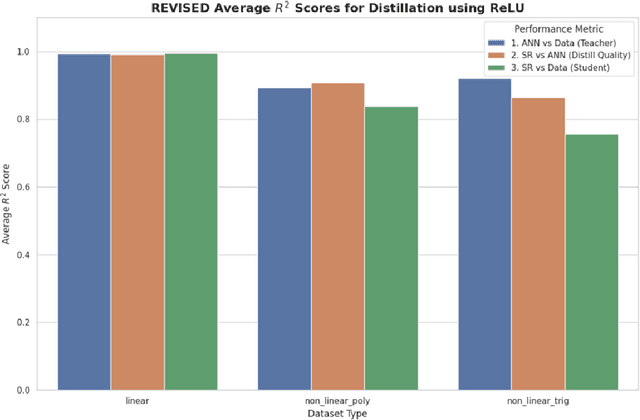
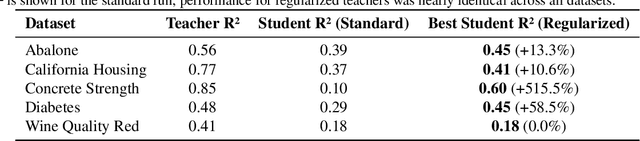
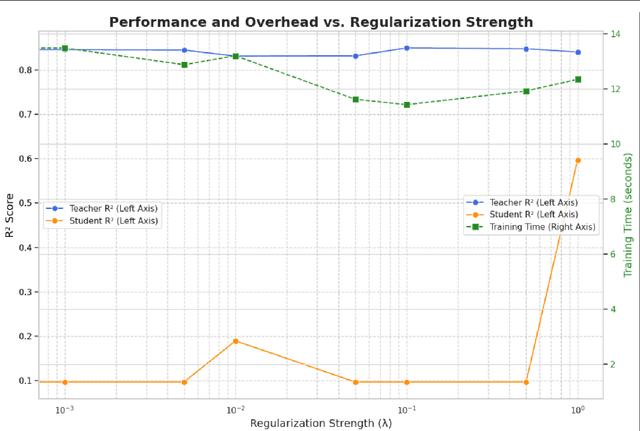
Distilling large neural networks into simple, human-readable symbolic formulas is a promising path toward trustworthy and interpretable AI. However, this process is often brittle, as the complex functions learned by standard networks are poor targets for symbolic discovery, resulting in low-fidelity student models. In this work, we propose a novel training paradigm to address this challenge. Instead of passively distilling a pre-trained network, we introduce a \textbf{Jacobian-based regularizer} that actively encourages the ``teacher'' network to learn functions that are not only accurate but also inherently smoother and more amenable to distillation. We demonstrate through extensive experiments on a suite of real-world regression benchmarks that our method is highly effective. By optimizing the regularization strength for each problem, we improve the $R^2$ score of the final distilled symbolic model by an average of \textbf{120\% (relative)} compared to the standard distillation pipeline, all while maintaining the teacher's predictive accuracy. Our work presents a practical and principled method for significantly improving the fidelity of interpretable models extracted from complex neural networks.