 Add to Chrome
 Add to Firefox
 Add to Edge
Instant and Reversible Adhesive-free Bonding Between Silicones and Glossy Papers for Soft Robotics
Mar 03, 2026
Integrating silicone with non-extensible materials is a common strategy used in the fabrication of fluidically-driven soft actuators, yet conventional approaches often rely on irreversible adhesives or embedding processes that are labor-intensive and difficult to modify. This work presents silicone-glossy paper bonding (SGB), a rapid, adhesive-free, and solvent-reversible bonding approach that forms robust silicone-paper interfaces simply through contact. The SGB interface withstands high mechanical loads (shear strength > 61 kPa) and can be fully detached and reassembled via ethanol immersion without loss of performance, enabling component reuse and rapid redesign. Characterization studies indicate that surface functional groups primarily govern adhesion on the glossy paper and the modulus of the silicone, while durability and environmental response clarify the conditions for reversible debonding. The results further suggest a synergistic interaction of hydrogen bonding and oligomer diffusion, yielding strong yet reconfigurable adhesion. Soft actuators fabricated using SGB design exhibit equal or greater performance compared to conventional embedded-layer design and enable programmable actuation modes, including contraction, bending, and twisting. By simplifying fabrication while supporting reuse and rapid iteration, SGB offers a scalable and sustainable platform for rapid prototyping in soft robotics.

Plant robots
Jul 26, 2024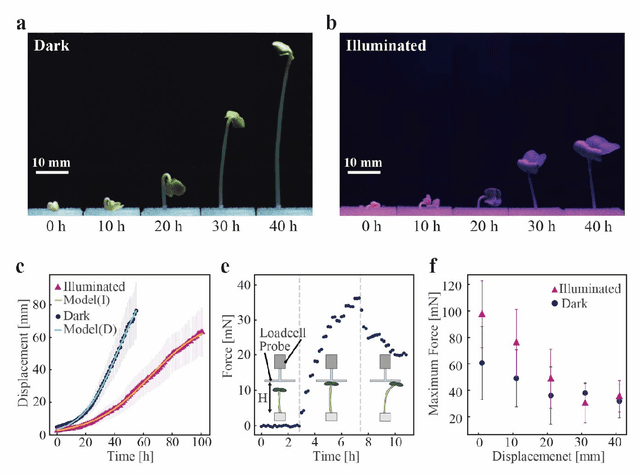
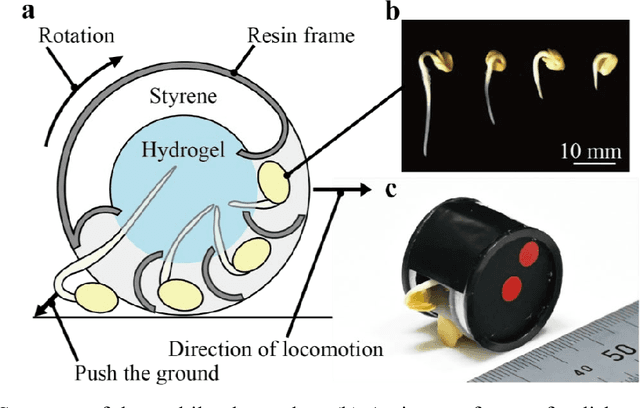
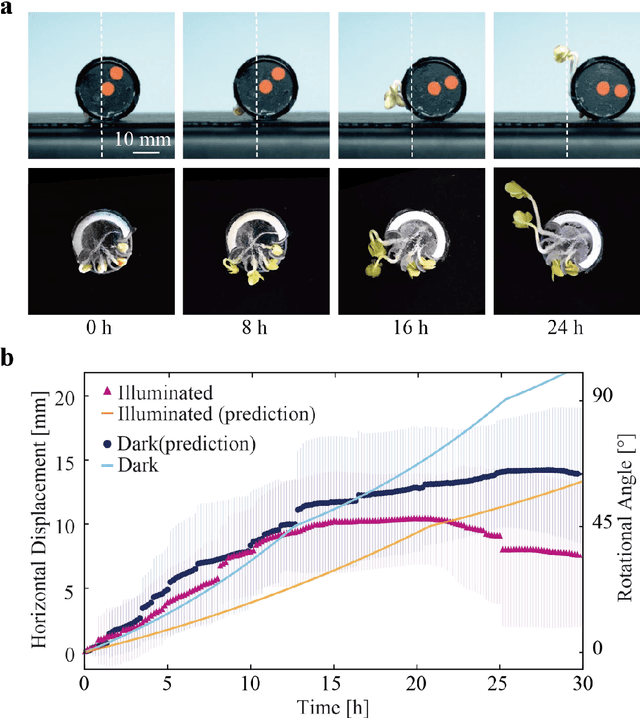
Plants display physical displacements during their growth due to photosynthesis, which converts light into chemical energy. This can be interpreted as plants acting as actuators with a built-in power source. This paper presents a method to create plant robots that move and perform tasks by harnessing the actuation output of plants: displacement and force generated from the growing process. As the target plant, radish sprouts are employed, and their displacement and force are characterized, followed by the calculation of power and energy densities. Based on the characterization, two different plant robots are designed and fabricated: a rotational robot and a gripper. The former demonstrates ground locomotion, achieving a travel distance of 14.6 mm with an average speed of 0.8 mm/h. The latter demonstrates the picking and placing of an object with a 0.1-g mass by the light-controlled open-close motion of plant fingers. A good agreement between the experimental and model values is observed in the specific data of the mobile robot, suggesting that obtaining the actuation characteristics of plants can enable the design and prediction of behavior in plant robots. These results pave the way for the realization of novel types of environmentally friendly and sustainable robots.