 Add to Chrome
 Add to Firefox
 Add to Edge
A Neural Field-Based Approach for View Computation & Data Exploration in 3D Urban Environments
Nov 18, 2025
Despite the growing availability of 3D urban datasets, extracting insights remains challenging due to computational bottlenecks and the complexity of interacting with data. In fact, the intricate geometry of 3D urban environments results in high degrees of occlusion and requires extensive manual viewpoint adjustments that make large-scale exploration inefficient. To address this, we propose a view-based approach for 3D data exploration, where a vector field encodes views from the environment. To support this approach, we introduce a neural field-based method that constructs an efficient implicit representation of 3D environments. This representation enables both faster direct queries, which consist of the computation of view assessment indices, and inverse queries, which help avoid occlusion and facilitate the search for views that match desired data patterns. Our approach supports key urban analysis tasks such as visibility assessments, solar exposure evaluation, and assessing the visual impact of new developments. We validate our method through quantitative experiments, case studies informed by real-world urban challenges, and feedback from domain experts. Results show its effectiveness in finding desirable viewpoints, analyzing building facade visibility, and evaluating views from outdoor spaces. Code and data are publicly available at https://urbantk.org/neural-3d.

Deep Umbra: A Generative Approach for Sunlight Access Computation in Urban Spaces
Feb 27, 2024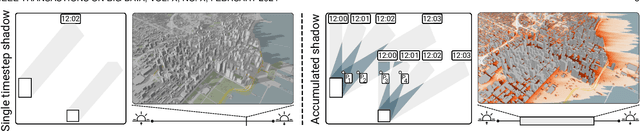
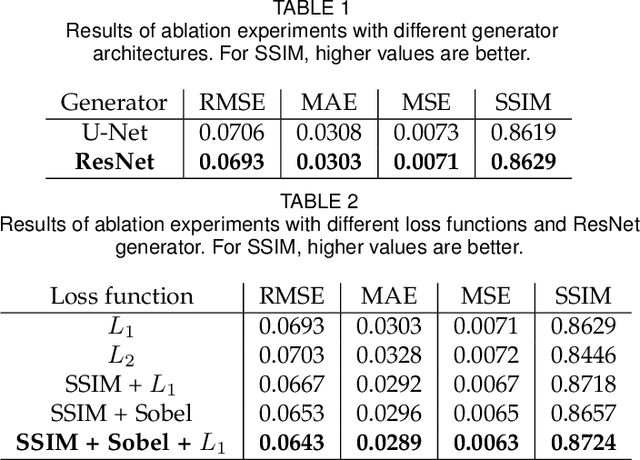
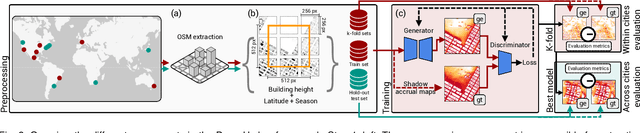
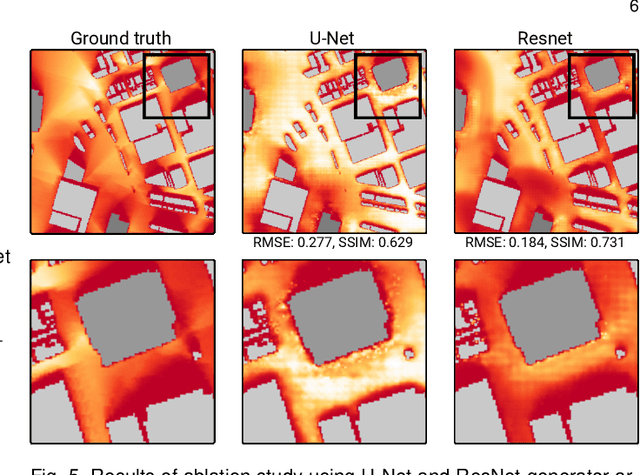
Sunlight and shadow play critical roles in how urban spaces are utilized, thrive, and grow. While access to sunlight is essential to the success of urban environments, shadows can provide shaded places to stay during the hot seasons, mitigate heat island effect, and increase pedestrian comfort levels. Properly quantifying sunlight access and shadows in large urban environments is key in tackling some of the important challenges facing cities today. In this paper, we propose Deep Umbra, a novel computational framework that enables the quantification of sunlight access and shadows at a global scale. Our framework is based on a conditional generative adversarial network that considers the physical form of cities to compute high-resolution spatial information of accumulated sunlight access for the different seasons of the year. We use data from seven different cities to train our model, and show, through an extensive set of experiments, its low overall RMSE (below 0.1) as well as its extensibility to cities that were not part of the training set. Additionally, we contribute a set of case studies and a comprehensive dataset with sunlight access information for more than 100 cities across six continents of the world. Deep Umbra is available at https://urbantk.org/shadows.