 Add to Chrome
 Add to Firefox
 Add to Edge
Learning Preference-Based Objectives from Clinical Narratives for Sequential Treatment Decision-Making
Apr 12, 2026
Designing reward functions remains a central challenge in reinforcement learning (RL) for healthcare, where outcomes are sparse, delayed, and difficult to specify. While structured data capture physiological states, they often fail to reflect the overall quality of a patient's clinical trajectory, including recovery dynamics, treatment burden, and stability. Clinical narratives, in contrast, summarize longitudinal reasoning and implicitly encode evaluations of treatment effectiveness. We propose Clinical Narrative-informed Preference Rewards (CN-PR), a framework for learning reward functions directly from discharge summaries by treating them as scalable supervision for trajectory-level preferences. Using a large language model, we derive trajectory quality scores (TQS) and construct pairwise preferences over patient trajectories, enabling reward learning via a structured preference-based objective. To account for variability in narrative informativeness, we incorporate a confidence signal that weights supervision based on its relevance to the decision-making task. The learned reward aligns strongly with trajectory quality (Spearman rho = 0.63) and enables policies that are consistently associated with improved recovery-related outcomes, including increased organ support-free days and faster shock resolution, while maintaining comparable performance on mortality. These effects persist under external validation. Our results demonstrate that narrative-derived supervision provides a scalable and expressive alternative to handcrafted or outcome-based reward design for dynamic treatment regimes.

Advancing Multi-Organ Disease Care: A Hierarchical Multi-Agent Reinforcement Learning Framework
Sep 06, 2024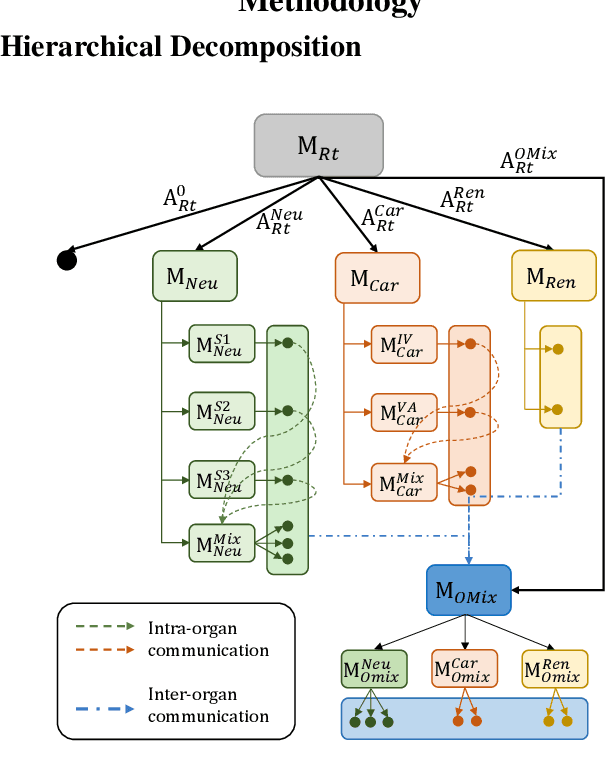
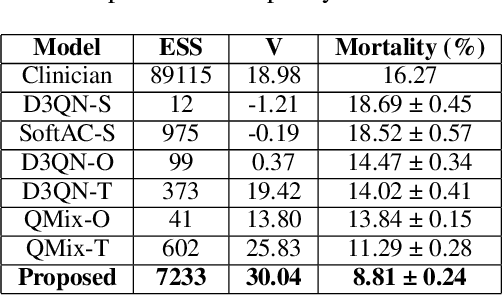
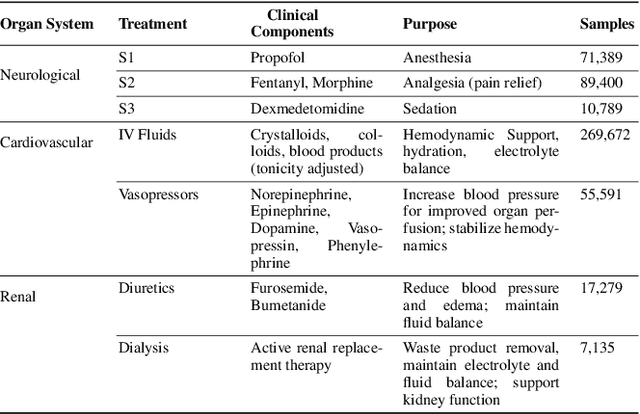
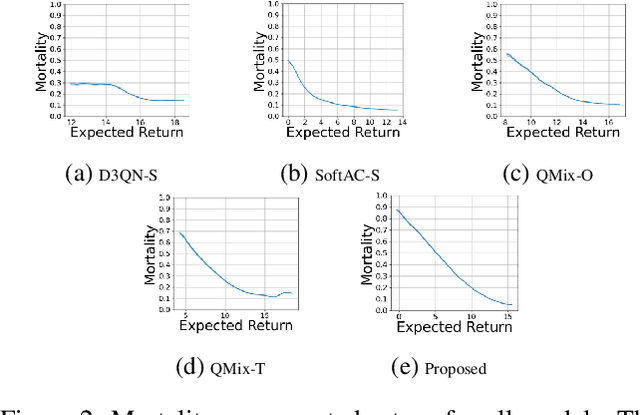
Multi-organ diseases present significant challenges due to their simultaneous impact on multiple organ systems, necessitating complex and adaptive treatment strategies. Despite recent advancements in AI-powered healthcare decision support systems, existing solutions are limited to individual organ systems. They often ignore the intricate dependencies between organ system and thereby fails to provide holistic treatment recommendations that are useful in practice. We propose a novel hierarchical multi-agent reinforcement learning (HMARL) framework to address these challenges. This framework uses dedicated agents for each organ system, and model dynamic through explicit inter-agent communication channels, enabling coordinated treatment strategies across organs. Furthermore, we introduce a dual-layer state representation technique to contextualize patient conditions at various hierarchical levels, enhancing the treatment accuracy and relevance. Through extensive qualitative and quantitative evaluations in managing sepsis (a complex multi-organ disease), our approach demonstrates its ability to learn effective treatment policies that significantly improve patient survival rates. This framework marks a substantial advancement in clinical decision support systems, pioneering a comprehensive approach for multi-organ treatment recommendations.